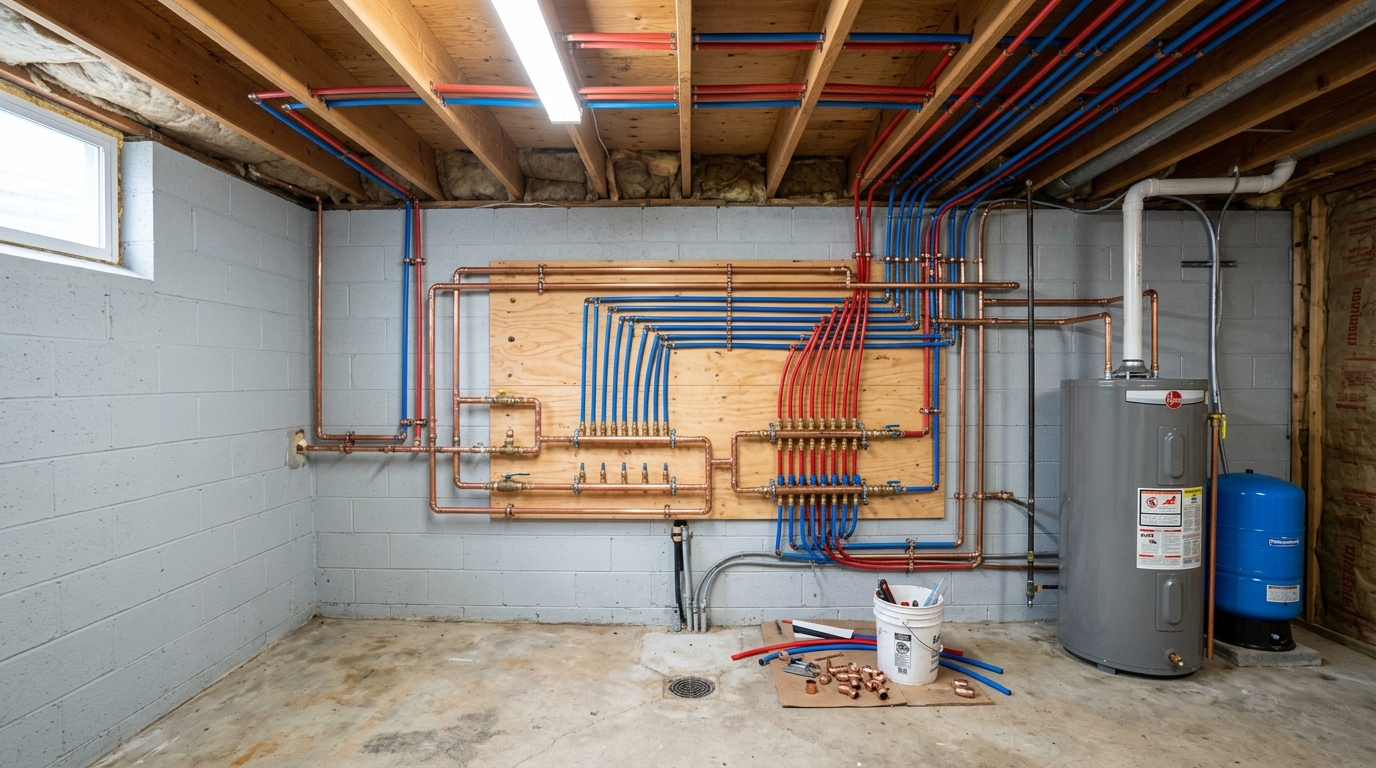
What plumbers charge in North Huntingdon
North Huntingdon’s plumbing prices reflect both the local housing stock and how quickly you need help. With 89.9% single-family homes and over 70% of homes built before 1980 (U.S. Census Bureau, ACS 2024), the age and construction era of the neighborhood drive what goes wrong. Here, homes in post‑1945 suburban tracts—especially those in Hempfield and North Huntingdon—are well into the lifespan of their original copper or galvanized supply lines. Those older materials are now reaching the point where leaks, low pressure, and water quality issues add up to real costs.
For every plumbing job, timing is everything. Emergency repairs—like a burst pipe at 1 a.m.—nearly always cost more than the same job scheduled on a weekday. This is not just about the plumber’s inconvenience; rapid response means pushing other jobs, finding parts after hours, and managing damage control. Standard rate work (the kind done during normal business hours with no water gushing onto your basement floor) is reliably cheaper, and you should prefer it whenever possible.
| Service |
Scope |
Emergency rate |
Standard rate |
| Emergency repair — burst pipe |
locate, open, repair section, restore service |
$650–$1,250 |
$375–$1,250 |
| Water heater replacement (gas, 40–50 gal) |
remove old, install, test, haul away |
$2,000–$2,900 |
$1,250–$2,900 |
| Drain cleaning — main line |
augering or hydro-jet, camera if needed |
$350–$800 |
$200–$500 |
| Sewer line spot repair |
excavate or reline a failed section |
$2,100–$12,500 |
$2,100–$12,500 |
| Whole-house repipe |
replace supply lines throughout, patch and finish |
|
$3,700–$8,900 |
| Water service line replacement |
street to house, excavation and restoration |
|
$5,800–$12,500 |
Estimates for a typical North Huntingdon home. Access difficulty and pipe material move these figures more than anything else.
Dating your plumbing by what it's made of
If you live in North Huntingdon or the wider Hempfield area, your home's plumbing is almost a timeline—following the waves of housing growth and material standards. Most post‑1945 tracts started with galvanized steel or copper supply lines. Galvanized steel, common before 1960, can be spotted by its threaded joints and grayish color; if a magnet sticks and you see dull threads, it’s galvanized. Copper took over in the 1950s and still shows up in new work—reddish, non-magnetic and with soldered joints. Polybutylene, a blue-gray plastic tubing used from the late 1970s to mid-1990s, is flexible but notorious for failing at joints. PEX (cross-linked polyethylene), which is usually red, blue, or white with brass or plastic fittings, is standard now.
For drains, cast iron was installed in homes up to around 1975. Its rough, black appearance and heavy weight make it easy to spot; tapping it sounds solid rather than hollow. Clay tile sewer laterals are recognizable by their orange-brown color and bell-shaped joints. Post-1970s, PVC and ABS plastic became the drain materials of choice—white or black, glued joints, and lightweight.
Knowing your material gives you a sense of remaining service life and what problems you might face next. If you have galvanized and your water pressure drops or you’re already dealing with leaks, it's on borrowed time. Cast iron and clay drains often last half a century, but corrosion, cracks, and roots become common near the end.
| Material |
Typical era |
Failure mode |
Service life |
| Galvanized steel supply |
pre-1960 |
internal corrosion, pressure loss |
40–60 yrs |
| Copper supply |
1950s–present |
pinhole leaks, joint failure |
50–70 yrs |
| Polybutylene supply |
late 1970s–1995 |
fitting failure, sudden bursts |
unreliable |
| PEX supply |
2000s–present |
fitting or UV degradation |
40–50 yrs |
| Cast iron drain |
pre-1975 |
corrosion, cracking, scale |
50–75 yrs |
| Clay tile sewer lateral |
pre-1980 |
root intrusion at joints, offset |
50–60 yrs |
| PVC / ABS drain |
1970s–present |
joint separation, crushing |
50+ yrs |
Frozen pipes in North Huntingdon: prevention and thaw
With a frost depth of 36 inches and winter lows reaching 8 °F, pipes in North Huntingdon face serious freeze risk most years. The heavy freeze-thaw cycle—paired with older construction—means many homes have pipes running through exterior walls, garages, crawlspaces, or unconditioned attics. The critical failure happens not where the freeze occurs but between the ice blockage and a closed faucet; as pressure builds, the pipe splits downstream from the frost plug. By the time you spot it, you’re usually facing water pouring into your ceiling or basement.
Preventing a freeze is always cheaper than repairing a burst. Start by insulating any exposed pipes with foam sleeves—especially under sinks, in basements, or any run near an exterior wall. Electric heat tape is an option for pipes you know are vulnerable (make sure it’s UL-listed and installed per manufacturer instructions). On extreme cold nights, let a faucet trickle to keep water moving, and open cabinet doors to allow warmth to reach hidden pipes. Always shut off and drain outdoor spigots before the first hard freeze to avoid split hose bibs.
If pipes do freeze, start thawing with a hair dryer, heating pad, or portable electric heater—never an open flame. Warm the pipe slowly, working toward the frozen section. If you’re not getting flow after patient work, it’s time to call for help. Post-thaw, check for leaks. If a pipe did burst, you’re looking at a repair cost of $375–$1,250 plus possible water cleanup.
What a plumbing quote should contain
When you request a plumbing quote in North Huntingdon, expect to see one of two billing models: flat rate or time-and-materials. Flat rate means the contractor builds in every foreseeable cost, so you know the final bill regardless of surprises, but some risk is priced in. Time-and-materials begins with a lower estimate but grows if the job gets complicated—fine for an easy fixture swap, not so great for unknown leaks behind walls. What matters most is that the model is stated clearly up front.
Watch for a diagnostic or service fee, which may be credited to the repair if you go ahead. The quote should state not just the price, but the exact scope—what walls or floors may be opened, what level of finish restoration you’ll get, parts and brands to be used, and whether the quote includes required permits (particularly for new work or modifications). Labor warranty should be distinct from the manufacturer's part warranty, and any after-hours rate should appear in the paperwork before the work starts.
| Line item |
What to look for |
Red flag if… |
| Billing model |
flat rate or hourly, stated up front |
unstated |
| Diagnostic fee |
amount, and whether it credits |
vague |
| Scope |
what is opened, repaired and restored |
price with no scope |
| Restoration |
drywall and finish explicitly in or out |
silent |
| Permit |
included and priced |
'not needed' |
| Parts |
brand and model for fixtures |
'standard fixture' |
| Warranty |
labour period stated separately |
parts only |
Verifying a North Huntingdon plumber's credentials
In Pennsylvania, plumbing is not licensed by the state. Instead, it’s regulated at the municipal level. This means a plumber licensed or registered in Greensburg or Pittsburgh may have no credential in North Huntingdon unless that municipality also requires it. The right question isn’t, "Are you licensed?" but, "Are you registered or approved to work here?" In Westmoreland County, the City of Greensburg maintains its own contractor registration for plumbing firms; other municipalities handle their own requirements.
For North Huntingdon homes, when plumbing work alters or adds to the system—anything more than a simple fixture swap—check with your township office if a permit is needed. Some townships, like Hempfield, require permits for any new or altered plumbing connected to public water or sewer. Inspectors from your local code office, not the state, perform the approval checks.
All employers in Pennsylvania must carry workers' compensation, whether privately or self-insured, and you can verify this through WCAIS (wcais.pa.gov). For larger jobs (anything over $500), confirm the contractor holds a valid Home Improvement Contractor registration—this can be checked on the state Attorney General’s database (hic.attorneygeneral.gov). This ensures you have a written contract and the right to cancel within three business days, as required by law.
Camera inspection, relining and replacement
In most of North Huntingdon, the sewer lateral—the pipe running from your house to the public main in the street—is owned and maintained by the homeowner, not by the city or township. This is the single most common source of confusion and dispute, especially when a failure happens in the section under your driveway or even in the public right-of-way.
Warning signs of a lateral problem begin with a single slow drain, progress to gurgling or water backing up in the lowest fixture (often a basement floor drain or utility sink), and culminate in a full backup. Before approving any excavation or major repair, insist on a camera inspection. Cameras show where roots have infiltrated clay tile joints, where bellies or sags have trapped water, or where offsets and cracks are letting soil in and wastewater out.
In older parts of Westmoreland County, clay tile laterals are especially at risk for root intrusion at joints. Many homes in surrounding townships, outside the main sewer grid, are still on septic systems—here, tank pumping and drainfield health are separate issues (slow drains may signal a full tank, not a broken pipe).
For failed laterals, trenchless relining may avoid excavation, but is only possible when the old line is structurally sound enough to act as a host pipe. If collapse or major displacement has occurred, open-cut replacement is often unavoidable. No matter the solution, never authorize a full replacement without being shown the relevant camera footage—and if you’re quoted for a repair over $2,100–$12,500, ensure it matches the defect shown on the screen.
When to repipe a North Huntingdon home
If you've had two or more leaks in the same line or on the same material in three years, it’s a trend, not bad luck. North Huntingdon homes—most built between the late 1940s and 1980s—are reaching the age where original copper and galvanized supply lines are at, or past, their useful life. Telltale signals include persistent low water pressure throughout the house (not just one sink), brown or rusty water on first use, visible corrosion or mineral buildup at joints, and repeated pinhole leaks.
Choosing between repair and replacement depends on the scale and materials. PEX is less expensive and faster to install than copper, but both will mean accessing pipes in walls and floors. The hidden cost homeowners often miss is wall and ceiling repair—especially in homes with original plasterwork. Patching, painting, and cleanup can represent nearly as much labor as replacing the pipes themselves.
In Hempfield and North Huntingdon’s tract homes, if pipes are accessible (unfinished basements or crawlspaces), partial replacement may make sense for now. But for main lines in finished spaces, a full repipe is usually more cost-effective in the long run than chasing leak after leak.
| Situation |
Recommendation |
Cost |
Reasoning |
| One leak, accessible, modern pipe |
Spot repair |
$375–$1,250 |
Modern materials, isolated issue |
| Two or more leaks in 3 years |
Partial repipe |
$3,700–$6,000 |
Material at end of life, cut losses |
| Galvanized supply, pressure loss |
Full repipe |
$3,700–$8,900 |
Bore constricted, recurring leaks likely |
| Polybutylene anywhere in the house |
Full repipe |
$3,700–$8,900 |
Uninsurable, high risk of sudden failure |
| Cast iron drain with root intrusion |
Camera, then reline or replace |
$2,100–$12,500 |
Pipe compromised, recurring backups |
| Suspected lead service line |
Test, then replace the lateral |
$5,800–$12,500 |
Health risk, usually original to pre-1980 homes |
Frequently asked questions — plumbing in North Huntingdon
What do I do if sewage is backing up?
A sewage backup in a North Huntingdon home is a true emergency. Stop all water use immediately—no flushing, no running sinks, no laundry. If the backup is at the lowest drain or toilet in your house, it likely means your main sewer line or the immediate branch is blocked, and wastewater is taking the path of least resistance. Don’t reach for a chemical drain opener, as it rarely helps with mainline blockages and can worsen the mess. The best step is to call a plumber for immediate service; expect to pay $350–$800 if mainline drain cleaning with a camera inspection is needed. If you’re on a septic system (which is common in parts of the townships), make sure it’s not a tank overload before considering excavation. Be ready to show the plumber where the main cleanout is, if you have one—that can speed the work and lower cost.
Why do all my drains drain slowly at once?
Slow drainage from every fixture—sinks, showers, toilets—at the same time in a North Huntingdon home signals a main sewer line issue, not just a local clog. This can be due to grease or sludge buildup, roots intruding at pipe joints (especially in older clay tile sewers), or a partial blockage far down the line. In many Westmoreland County houses built before 1980, root problems are common. The first step is a professional camera inspection and cleaning—a service typically in the $200–$500 range for a scheduled job. If you’re on a septic system, a full or failing tank will cause similar symptoms; in that case, tank pumping is needed instead of sewer cleaning. Whatever you do, don’t ignore this problem, as it can quickly progress to a full backup.
How much does a plumber cost in North Huntingdon?
In North Huntingdon, plumbing repair costs range based on both the job and whether you need emergency service. Standard-hour repairs for leaks, clogs, or fixture swaps generally run $375–$1,250. A water heater replacement is usually $1,250–$2,900, depending on brand and access. Emergency calls—like a burst pipe that can’t wait—push prices higher, especially late at night, often in the $650–$1,250 range for just the repair. Always ask if the rate is flat or hourly, and for urgent situations, expect a higher minimum charge simply for rapid response. The good news is that most plumbers in the area give free estimates for non-emergencies, so you have the option to compare before you hire.
Do I need to drain outdoor spigots in North Huntingdon?
Yes, absolutely—North Huntingdon’s winter temperatures routinely drop below freezing, with 36-inch frost depth and plenty of freeze-thaw. Outdoor spigots (hose bibs) are among the most common sources of burst pipes after the first hard freeze. In the fall, shut off the interior supply valve to each spigot, open the outdoor faucet to drain it, and leave it open through winter. If your home has frost-proof hose bibs, these still need hoses removed and the faucet opened briefly to ensure no water is trapped. If you do forget and a split occurs, repair runs $375–$1,250—about 10 times the cost of a new hose bib itself, not counting the headache.
Who owns the sewer lateral, me or the city?
In North Huntingdon and most of Westmoreland County, the homeowner owns and is responsible for the sewer lateral from the house all the way to the public main. This includes the section running under your driveway or front yard and often even out to the middle of the street. If there’s a blockage or collapse, repairs or replacement are on you. Costs for spot repairs start around $2,100–$12,500, so camera documentation before committing to any excavation is critical—don’t proceed without seeing footage of the actual defect. Be aware that in some township areas, you may be on a septic system instead, which brings different maintenance and repair responsibilities.
What does drain cleaning cost in North Huntingdon?
Main line drain cleaning in North Huntingdon, including a typical camera inspection, costs $200–$500 for scheduled appointments. Emergency or after-hours service for a stubborn or full backup escalates to $350–$800. Prices depend on access—an accessible basement cleanout keeps labor low, while attic or crawlspace main stacks are harder and more expensive. If the cleaning uncovers root intrusion in a clay or cast iron line, expect a discussion about preventative options like root cutting, chemical treatments, or, in severe cases, full or partial line replacement, which is a much higher cost tier.
Are tree roots a common sewer problem in North Huntingdon?
Yes, tree roots are a frequent trouble spot in North Huntingdon, especially in neighborhoods with older clay tile sewer laterals common before 1980. Clay pipes were laid with unsealed bell joints, which roots exploit to find water and nutrients—eventually leading to slowdowns, recurring backups, and, in the worst case, total collapse. The first sign is usually a slow drain or gurgling sound from the lowest fixture, often progressing to a backup. Standard drain cleaning with a machine cutter is in the $200–$800 range, but chronic root intrusion usually means the pipe is at or near the end of its life. A full repair or pipe relining runs from $2,100–$12,500, with costs scaling up for deeper or longer sections.
Repair or replace a leaking water heater?
In most North Huntingdon homes, water heaters start to show their age between 8 and 12 years. For small leaks at pipe joints or the relief valve, repair is usually cost-effective if the unit is under 10 years old—expect a bill around $375–$1,250. But if the tank itself is leaking (see water pooling under the heater, not at pipe joints), replacement is the only fix, as the tank will rupture even further over time. Replacing a typical gas water heater, installed and hauled away, will run $1,250–$2,900. If your unit is pushing its second decade, replacement is almost always the better choice for both safety and efficiency.
Do I need a permit for plumbing work in North Huntingdon?
For most plumbing jobs in North Huntingdon Township, a permit is required any time you alter existing plumbing—this includes moving or adding lines or fixtures connected to public water or the sewer system. Fixture swaps (like-for-like water heater, faucet, or toilet replacement, with no piping changes) typically do not require a permit, but check with your township as requirements do vary. In nearby Greensburg, fixture swaps without piping changes are usually considered ordinary maintenance. For permitted work, your plumber should obtain and include the cost of the permit in your quote. Full repipes, water service replacements, new bathrooms—these always need inspection. Permit fees are minor compared to the labor, but unpermitted work can void insurance or stall a home sale, so don’t skip this step just to save on the price of $3,700–$8,900 for a whole-house job.