What plumbers charge in Whitehall
Whitehall has a mix of homes—over half are single-family and 67.9% were built before 1980 (U.S. Census Bureau, ACS 2024). This is not just trivia: the era your house was built is the best predictor of whether you have galvanized, copper, or modern PEX pipes, and it often sets what you will pay for repairs or upgrades. In the post‑1950 suburban tract housing in nearby South Whitehall and Upper Macungie, copper-to-PEX repiping and fixture modernization are common now, since aging copper lines from that boom are reaching replacement age.
When it comes to price, timing changes everything. The same repair—swapping a water heater, fixing a leak—will cost more if you need a plumber out there right now, after hours, or because a pipe burst. You pay a premium for speed and urgency, which is fair, but you should still get a written quote and clear explanation of the scope for every job.
Below are typical price ranges you’ll see for common plumbing work in Whitehall. These reflect the fact that access, pipe material, and construction era move costs up or down as much as the job itself.
| Service |
Scope |
Emergency rate |
Standard rate |
| Emergency repair — burst pipe |
locate, open, repair section, restore service |
$600–$1,200 |
$350–$1,200 |
| Water heater replacement (gas, 40–50 gal) |
remove old, install, test, haul away |
$1,900–$2,800 |
$1,200–$2,800 |
| Drain cleaning — main line |
augering or hydro-jet, camera if needed |
$350–$800 |
$200–$500 |
| Sewer line spot repair |
excavate or reline a failed section |
$2,000–$12,000 |
$2,000–$12,000 |
| Whole-house repipe |
replace supply lines throughout, patch and finish |
|
$3,500–$8,400 |
| Water service line replacement |
street to house, excavation and restoration |
|
$5,400–$12,000 |
Estimates for a typical Whitehall home. Access difficulty and pipe material move these figures more than anything else.
Flat rate versus time and materials
In Whitehall, you’ll see plumbers bill in two ways: flat rate and time-and-materials. Flat rate means you get a single quoted price for the job, no matter how long it takes. This gives you price certainty—good for emergencies or if you hate surprises—but you’re also paying for the risk the plumber is taking on. With time-and-materials, you pay for actual hours worked plus parts. On straightforward or small jobs, this can mean a lower bill, but the final tally is open-ended if hidden problems turn up.
Neither model is bad or dishonest as long as you know upfront which one you’re on. What you want to watch for is an estimate that’s just a single price—no clear explanation whether it’s flat rate, what exactly is included, or if you’ll pay more for after-hours work or wall/floor restoration.
A good quote lays out: any diagnostic fee (and if it’s credited toward the job), what will be opened and repaired, if permits are needed, whether restoration is included, what warranties apply, and any after-hours premiums. You should see brands and models for any replacement fixtures, not just “standard.” If it’s not in writing, assume it’s not included.
| Line item |
What to look for |
Red flag if… |
| Billing model |
flat rate or hourly, stated up front |
unstated |
| Diagnostic fee |
amount, and whether it credits |
vague |
| Scope |
what is opened, repaired and restored |
price with no scope |
| Restoration |
drywall and finish explicitly in or out |
silent |
| Permit |
included and priced |
'not needed' |
| Parts |
brand and model for fixtures |
'standard fixture' |
| Warranty |
labour period stated separately |
parts only |
Water heater replacement decisions
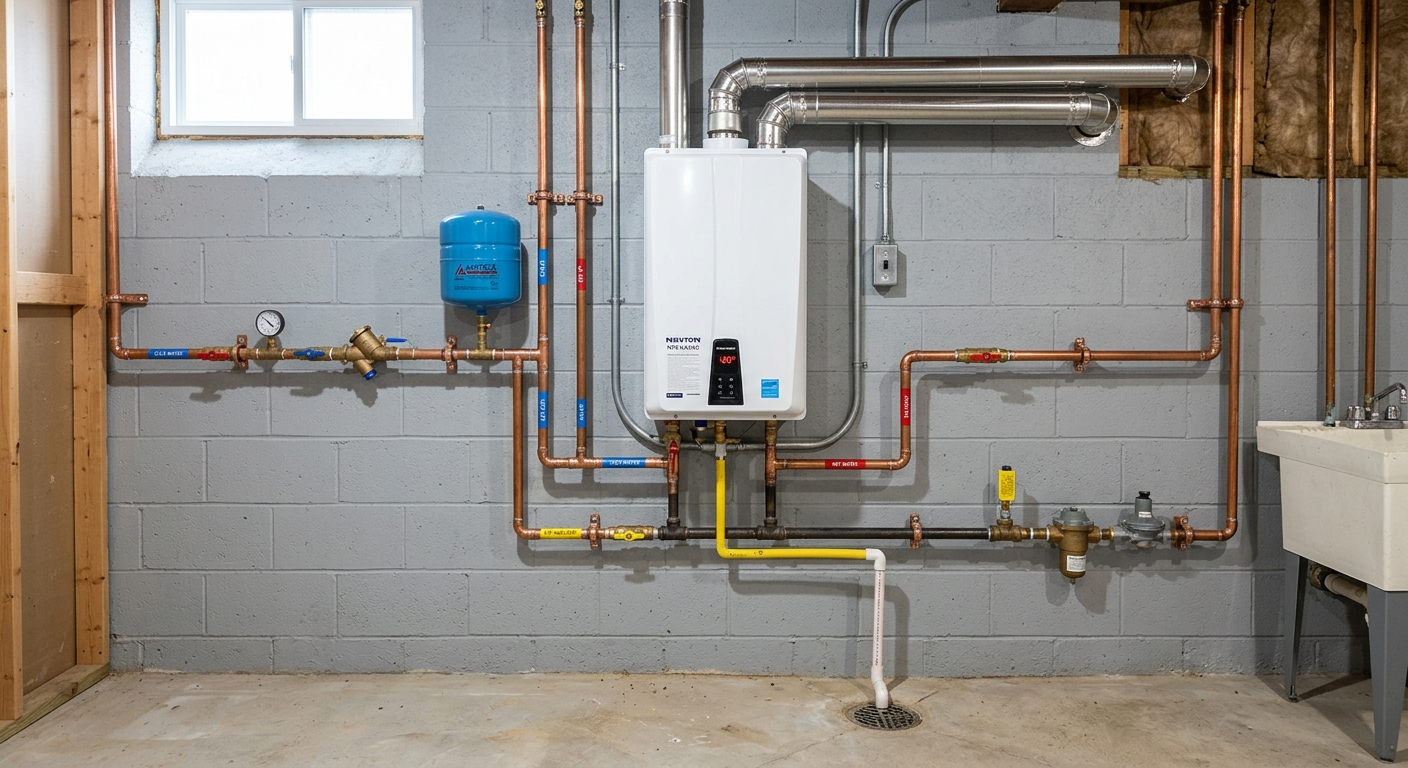
Whitehall homes generally have gas service available, but your water heater options still deserve a careful look. Three main types are common. Storage tanks—whether gas or electric—are cheapest to install, but have the shortest lives and waste some energy keeping water hot all the time. Tankless gas heaters cost more up front but provide endless hot water. Be warned: in homes originally set up for a tank, tankless gas models often require a bigger gas line and a new flue, which can surprise you with extra cost if not quoted up front.
Heat pump water heaters are the most efficient but only make sense where there’s enough space and warmth; they cool their installation area and create steady background noise. Installing one in a finished basement or tight closet is a poor fit.
How do you pick? Look at the first-hour rating, not just gallons. Expansion tanks, pans, and floor drains are required by local building code. The overwhelming majority of failures are tank ruptures, not the controls.
| Type |
Installed cost |
Service life |
Operating cost |
Best when |
| Gas tank, 40–50 gal |
$1,200–$2,800 |
8–12 yrs |
moderate |
existing gas line, moderate use, lowest upfront |
| Electric tank, 40–50 gal |
$1,200–$1,900 |
10–15 yrs |
high |
no gas, smallest upfront cost, infrequent use |
| Gas tankless |
$1,900–$2,800 |
18–25 yrs |
low-moderate |
endless showers, happy to pay more upfront |
| Heat pump water heater |
$1,900–$2,800 |
13–15 yrs |
lowest |
ample space, low electric rate, no gas |
Galvanized, copper, PEX, cast iron
The suburban expansion after 1950 in South Whitehall and Upper Macungie left many Whitehall homes with copper water lines and cast iron or PVC drains. Here's how to sort out what you have and what to expect. Galvanized steel pipe (dull gray, magnetic, and with threaded joints) went into homes before 1960 and fails by corroding from the inside—your water pressure drops long before you see a leak. Copper pipe (bright, non-magnetic, soldered joints) is durable but can develop tiny pinhole leaks, especially if the water is aggressive.
If your supply pipes are light gray-blue plastic with crimped brass rings, you’re likely seeing PEX—today’s standard. Polybutylene, a silvery blue-gray flexible pipe with plastic fittings, was used for a few decades but is unreliable and often uninsurable. For drains, cast iron (thick, black, heavy) and clay tile (orange-brown, found underground) are common in older homes, failing by corrosion, cracks, or root intrusion, while PVC (white plastic) and ABS (black plastic) are today’s norm.
Knowing what you have helps predict future costs and possible insurance trouble. A scratch test on exposed pipe (shiny gray = galvanized, yellow-copper = copper, white/blue = plastic) and checking for magnetism can help.
| Material |
Typical era |
Failure mode |
Service life |
| Galvanized steel supply |
pre-1960 |
internal corrosion, pressure loss |
40–60 yrs |
| Copper supply |
1950s–present |
pinhole leaks, joint failure |
50–70 yrs |
| Polybutylene supply |
late 1970s–1995 |
fitting failure, sudden bursts |
unreliable |
| PEX supply |
2000s–present |
fitting or UV degradation |
40–50 yrs |
| Cast iron drain |
pre-1975 |
corrosion, cracking, scale |
50–75 yrs |
| Clay tile sewer lateral |
pre-1980 |
root intrusion at joints, offset |
50–60 yrs |
| PVC / ABS drain |
1970s–present |
joint separation, crushing |
50+ yrs |
What construction era means for your pipes
With 67.9% of Whitehall homes built before 1980, there’s a good chance your plumbing is at or near the end of its original life. Older houses often started with galvanized supply lines (now mostly replaced) and cast iron or clay tile for drains and sewers. If your house sits in the 1950s–1970s window, copper supply and possibly early PVC/ABS drains are common, but the original copper may now show signs of pinholing or green stains where leaks have started.
Sewer laterals from this era are likely to be clay tile—durable for the first half-century but vulnerable to root intrusion and ground movement. If you’re on a corner lot or one that hasn’t seen a major yard excavation in decades, expect the original service lines are still present, possibly lead or aging copper.
In post‑1980 or newer Whitehall builds, expect PEX supply (or late-era copper), PVC or ABS waste lines, and water heaters likely on their second or maybe third replacement, given a 10–12 year cycle. New does not mean issue-free—builder-grade fixtures from the 1990s or 2000s are now at end-of-life, and some late builders used polybutylene for supply lines, which raises a different set of concerns. You may be due for upgrades not because the pipes failed yet, but because parts or insurance coverage just ran out.
Who is allowed to do plumbing work in Pennsylvania
Pennsylvania does not license plumbers at the statewide level. Instead, it’s up to each municipality to require and enforce trade licensing. In Lehigh County, the City of Allentown Building Office oversees plumbing trade licenses countywide, but a plumber licensed in one town might not have the credential in the next township. For work in Whitehall, you want a plumber who is not just registered with Pennsylvania’s Home Improvement Contractor (HIC) registration (which is required for jobs over $500), but also holds a plumbing license from the city or township where your property sits—if your local UCC office requires it.
Most plumbing alterations, including water heater replacement, need a permit in Lehigh County municipalities. Your plumber should pull the permit and arrange for inspection through the municipal or third-party UCC office. Very minor, like-for-like fixture repairs inside the home can often be done without a permit. You can and should verify registration at hic.attorneygeneral.gov and check workers' compensation status via the WCAIS system (wcais.pa.gov) for any employer working in your home.
The smart move is to ask not “are you licensed?” but “are you licensed to do this work in Whitehall Township (or my municipality)?” For pre-1978 homes, make sure EPA Lead RRP certification is supplied and verified at certifiedrenovatorsearch.epa.gov if paint is disturbed.
What's in the water here
Most of Whitehall gets its water from the Lehigh County Authority under the City of Allentown concession, which means you can review the annual water quality report specific to your system by request. The region’s water is not unusually hard, but there is enough mineral content to leave moderate scale inside water heaters and fixtures over time. This is especially true for older tank water heaters, where you’ll see a gradual drop in efficiency and hot water volume well before a full failure.
If you have copper supply lines, aggressive water can sometimes cause pinhole leaks—these are rare but not unheard of in some city blocks. If you’re considering a water softener, know that for most of Whitehall, the benefit is moderate: it can cut down on scale in appliances, but savings rarely outweigh the installation and salt expense unless you have other reasons to install one. For whole-house filtration, be wary of oversold “treatment stacks.” For most homes, a point-of-use filter at the kitchen tap or refrigerator is all that’s really needed if the public report shows no troubling contaminants.
If your property uses a private well, regular water testing is your responsibility—no agency publishes results for private systems, so periodic testing for bacteria, lead, and nitrates is just insurance for your own health.
Frequently asked questions — plumbing in Whitehall
Who pays to replace a lead service line in Whitehall?
The cost to replace a lead service line in Whitehall usually falls on the homeowner, not the water utility. The Lehigh County Authority, administering water under the City of Allentown, does maintain a lead service line inventory and replacement program, but public reporting is limited. Typically, if the lead is on your side of the curb (from the curb stop to your house), you are financially responsible. Replacement ranges from $5,400–$12,000 depending on access and restoration needed. Sometimes grants help—contact the utility to check for current programs. For most, it’s an out-of-pocket upgrade. If you’re buying an older home, always ask for service line material records before closing.
Do older Whitehall homes have galvanized pipes?
Yes, many older Whitehall homes—especially those built before 1960—originally had galvanized steel pipes. Over time, these corrode internally, narrowing and reducing pressure. Many pre-1980 homes, which make up nearly 68% of local stock, have since had some or all of these lines replaced, often with copper or PEX. If your home still has galvanized, you’ll eventually face replacement, especially if water flow is dropping. A whole-house repipe by a licensed contractor runs $3,500–$8,400 in Whitehall, depending on accessibility and your finish requests.
How deep do water lines need to be buried in Whitehall?
In northeastern Pennsylvania, including Whitehall, water lines must be buried below the local frost depth, which is 36 inches. This depth keeps pipes from freezing even during the coldest snaps (the winter design temperature here is just 4 °F). If you are repairing or replacing your service line—often required in aging neighborhoods—professional excavation will make sure the new pipe is at or below this minimum. Service line replacements run $5,400–$12,000 with restoration.
Is a water softener worth it in Whitehall?
The honest answer for most Whitehall homes is: probably not, unless you’re unsatisfied with scale in your appliances or fixtures. Our municipal water has moderate hardness. The savings in detergent and appliance wear don’t usually outstrip the cost of installing and maintaining a softener for most local folks. Systems can run several hundred to a few thousand installed, but if your concern is pinhole leaks in copper, softeners won’t help—only lowering the water’s aggressiveness would. Where you might go all-in is if you’re on a well with high hardness, but for city water, invest instead in repair or efficiency. For that money, you might be close to a new water heater (typically $1,200–$2,800).
Who inspects plumbing work in Whitehall?
In Whitehall, plumbing inspections are required for most major plumbing jobs—like water heater replacements or new pipe runs—since these trigger a permit, but small fixture repairs do not. The City of Allentown Building Office, or a third-party UCC enforcement office (depending on your municipality), will dispatch an inspector to check for code compliance before walls are closed up. Your plumber pulls the permit and schedules the inspection. The permit and inspection ensure work is done to current codes, not just “how we’ve always done it.” For projects above $500, you should always get a written contract per the Home Improvement Consumer Protection Act.
Why do plumbers charge a diagnostic fee?
Most Whitehall plumbers charge a diagnostic fee to cover the time and expertise needed to locate the source of leaks, clogs, or failures—which can be time-consuming, especially in older homes with uncertain pipe runs. The fee compensates for travel, inspection, and troubleshooting, even if you don’t move forward with the full repair. Many reputable companies will credit the diagnostic fee toward the final repair bill if you hire them for the fix. In Whitehall, a typical service call for urgent repair runs $350–$1,200, with the lower end covering short diagnostic visits.
How long should a water heater last in Whitehall?
In local Whitehall homes, traditional gas storage water heaters last 8–12 years on average, while electric models stretch to 10–15 years. The main culprit in tank failures isn’t the controls or thermostat, but internal corrosion, accelerated by mild to moderate water hardness typical here. You’ll often see minor leaks or a drop in hot water volume before a full failure. Budgeting for a standard replacement at $1,200–$2,800 is smart if your tank approaches a decade in age. Tankless and heat pump models can last longer, but correct installation is absolutely crucial here.
What do I do if sewage is backing up?
If you notice sewage backing up in your Whitehall home—slow drains, bubbling toilets, or water rising from a basement floor drain—stop using all plumbing immediately and call a professional. Backups can be caused by tree roots in clay tile laterals (common in pre-1980 homes), collapsed pipes, or mainline blockages. Don’t use chemical drain cleaners, as these can make things worse and damage old pipes. An emergency drain cleaning visit, using augering or hydro-jet as appropriate, costs $350–$800 in Whitehall. A plumber who specializes in sewer work will also have a camera system to confirm the true cause before you commit to bigger repairs.
What does drain cleaning cost in Whitehall?
Drain cleaning prices depend on the location and level of blockage. In Whitehall, a main line cleaning visit typically runs $200–$500 for routine calls, and $350–$800 if you need emergency service or have a more severe blockage. This often covers snaking or hydro-jetting, but if a full camera inspection is needed, some plumbers charge extra, while others include it. If you’re quoted higher, ask exactly what’s included—restoration of floors or walls usually isn’t, unless clearly stated. Always get a written scope, so you know if you’re paying for a simple clear-out or diagnosing a deeper issue like a broken or root-infiltrated clay tile lateral.