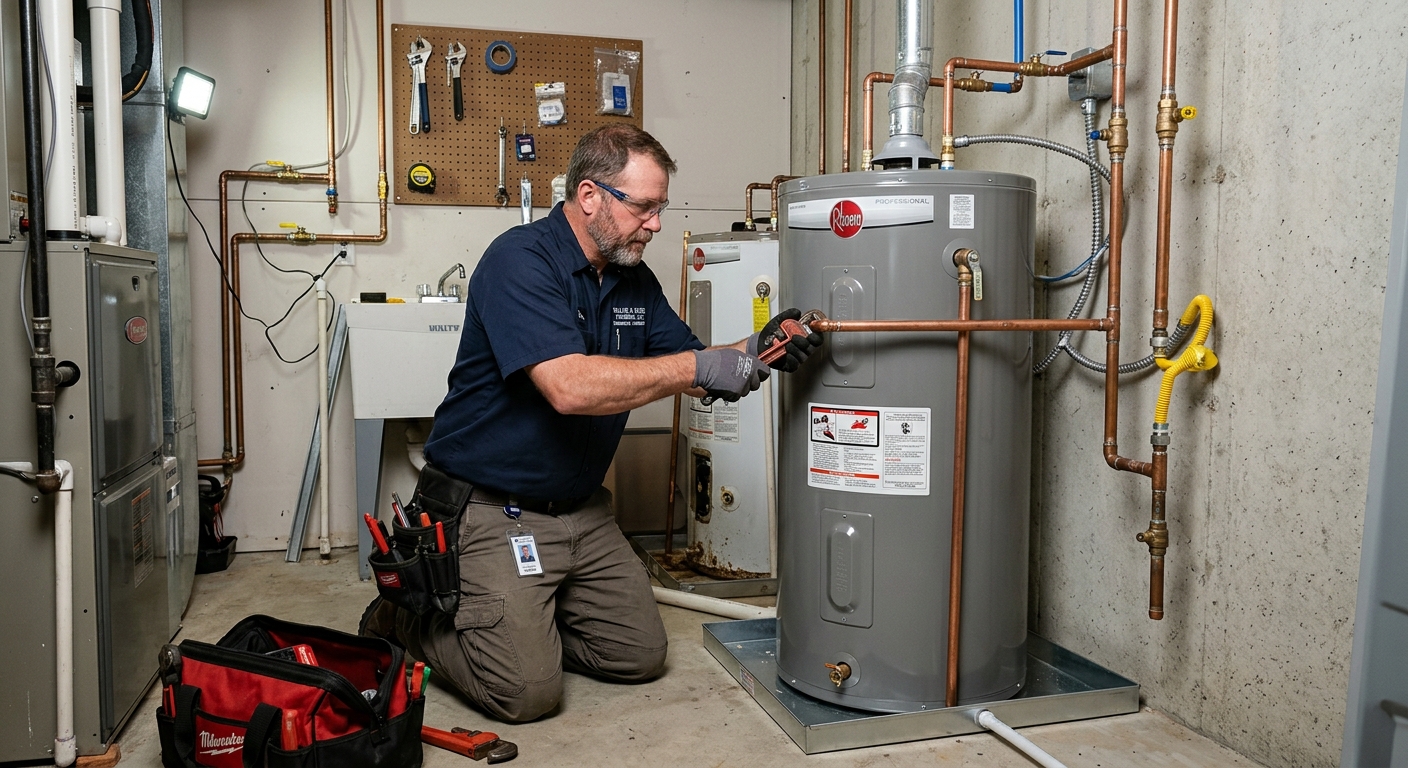
What plumbers charge in Wilkes-Barre
Wilkes-Barre’s plumbing costs are shaped by its older housing stock and mixed-use downtown. With 87.9% of homes built before 1980 and many pre-1940 multifamily units (U.S. Census Bureau, ACS 2024), pipe repairs here often mean dealing with old galvanized supply lines and difficult access behind plaster. In Luzerne County, construction era strongly predicts what kind of piping is hidden in your home—galvanized, copper, or newer PEX—and that determines what fails and how much it costs to fix.
The biggest factor in your bill is whether you’re facing an emergency. The same job—a pipe leak, a failed water heater—costs more at midnight or when water is pouring onto the floor. Emergency rates reflect both urgency and the contractor’s cost to reshuffle their schedule, source parts after hours, and possibly handle more damage. In a city like Wilkes-Barre, with a compressed downtown and stretches of rural township where plumbers have to travel, access also moves the price.
Here’s what typical plumbing jobs cost in Wilkes-Barre:
| Service |
Scope |
Emergency rate |
Standard rate |
| Emergency repair — burst pipe |
locate, open, repair section, restore service |
$500–$1,050 |
$300–$1,050 |
| Water heater replacement (gas, 40–50 gal) |
remove old, install, test, haul away |
$1,650–$2,400 |
$1,050–$2,400 |
| Drain cleaning — main line |
augering or hydro-jet, camera if needed |
$350–$800 |
$200–$500 |
| Sewer line spot repair |
excavate or reline a failed section |
$1,750–$10,500 |
$1,750–$10,500 |
| Whole-house repipe |
replace supply lines throughout, patch and finish |
— |
$3,100–$7,400 |
| Water service line replacement |
street to house, excavation and restoration |
— |
$4,800–$10,500 |
Estimates for a typical Wilkes-Barre home. Access difficulty and pipe material move these figures more than anything else.
Comparing plumbing estimates in Wilkes-Barre
When you get a plumbing estimate in Wilkes-Barre, you’ll usually see either a flat rate (one price for the whole job) or time-and-materials (an hourly rate plus parts). Flat rate bids give certainty up front—they build in the contractor’s risk for hidden problems and slowdowns, which means you’re unlikely to pay more, but you may pay extra for that certainty. Time-and-materials can save money if everything goes smoothly and the issue turns out simple, but if access is hard (as it often is with the city’s older stock) or the problem mushrooms, your final bill is open-ended. Neither model is a trick—the real trouble is when the quote doesn’t say which you’re agreeing to.
A good estimate in Wilkes-Barre should detail more than just the price. Look for a diagnostic fee and whether it applies to the final bill, a clear scope describing what’s opened up and restored, and whether wall and finish repairs are included or excluded. Permit costs must be handled up front—Wilkes-Barre requires permits for new or altered supply or drain lines that need inspection. Lastly, labor warranty should be stated separately from any manufacturer’s part warranty, and emergency/after-hours rates should be spelled out before the work begins.
| Line item |
What to look for |
Red flag if… |
| Billing model |
flat rate or hourly, stated up front |
unstated |
| Diagnostic fee |
amount, and whether it credits |
vague |
| Scope |
what is opened, repaired and restored |
price with no scope |
| Restoration |
drywall and finish explicitly in or out |
silent |
| Permit |
included and priced |
'not needed' |
| Parts |
brand and model for fixtures |
'standard fixture' |
| Warranty |
labour period stated separately |
parts only |
Licensing and permits for plumbing work in Wilkes-Barre
Unlike some trades in Pennsylvania, plumbing licensing is not handled at the state level. In Luzerne County, each municipality sets its own requirements. That means a plumber working legally in one township might not be properly licensed in Wilkes-Barre. The city’s Code Enforcement Office oversees contractor licensing and code administration within city limits. Always ask: “Are you licensed with the Wilkes-Barre City Code Enforcement Office?”—not just “Are you licensed?”
Permits are required in Wilkes-Barre for any plumbing work that changes supply or drain lines and triggers municipal inspection. Routine fixture swaps might not always need a permit, but any job where lines are opened or altered (like water heater replacement, supply line repairs, or whole-house repipes) will. The city inspects permitted plumbing work to ensure it meets the Pennsylvania Uniform Construction Code (UCC), based on the IRC.
Before hiring a contractor, verify Home Improvement Contractor (HIC) registration for jobs over $500 at hic.attorneygeneral.gov. Proof of workers’ compensation insurance is required for all employers in Pennsylvania and can be checked through WCAIS (wcais.pa.gov). If your home is pre-1978, federal EPA Lead RRP rules apply—verify trained renovators at the EPA’s website.
Sewer line problems in Wilkes-Barre
If you own a home in Wilkes-Barre, you likely own the sewer lateral from your house all the way to the city main—even if that main is under the street. When problems happen, you’re usually responsible for repairs up to (and sometimes into) the roadway. Watch for these symptoms: a single slow drain can mean a local blockage, but if multiple fixtures slow, gurgle, or water backs up at the lowest drain, the main sewer line is likely involved. In Wilkes-Barre’s older neighborhoods with clay tile or cast iron laterals, root intrusion, cracks, and collapsed pipe are very common.
A trustworthy plumber will run a camera inspection before quoting any big repair. This video identifies the real issue—roots, a sag (“belly”), or an offset joint—and where the failure sits. Sometimes, the fix is a trenchless relining; other times, excavation is unavoidable, especially with full collapses.
Never accept a sewer excavation quote without seeing the camera footage. The repair cost in Wilkes-Barre ranges widely, with spot repair pricing between $1,750–$10,500 depending on access and extent. In Wilkes-Barre proper, sanitary and storm sewers are separated. But many rural Luzerne County homes still use septic systems, where issues like tank overfilling or a failed drainfield mimic sewer backups but are solved differently—usually with tank pumping or, if the drainfield is saturated, by replacement. A camera inspection answers which problem you have.
Hardness, treatment and fixture life in Wilkes-Barre
Most homes in Wilkes-Barre draw from Pennsylvania American Water or other local public water systems. Each supplier publishes an annual water quality report you can request. Hardness (mineral buildup from calcium and magnesium) is moderate here and will reduce water heater lifespan, especially in older galvanized or copper systems. You’ll see scale around fixtures and inside tea kettles after a few years; water heaters can develop lime deposits that drive up operating costs and shorten the tank’s life.
Corrosive or “aggressive” water (sometimes a risk in older cities on certain sources) can also lead to pinhole leaks in copper lines over time. Water softeners can cut down on scale, which extends water heater and fixture life a few years, but in this area they’re not a sure-fire money-saver. For most Wilkes-Barre homeowners, softeners mean less scrubbing but not a big payback. Whole-house water filters are only worth it if your water report shows actual issues—otherwise, point-of-use filters for taste and chlorine at one faucet are more cost-effective. If you’re on a private well (mostly in Luzerne County’s rural fringe), you’ll need to test your own supply for contaminants, as no public report covers you.
Choosing a water heater in Wilkes-Barre
In Wilkes-Barre, most homes use natural gas or electric for water heating. The upfront price, expected life, and running cost vary by type. A standard gas tank model is the cheapest to install, but with 8–12 years lifespan you may be replacing it sooner than you think. Tankless (on-demand) gas water heaters provide endless hot water, but installation often reveals surprises: many older Wilkes-Barre homes need bigger gas lines run from the meter and upgraded venting (that’s a major add-on cost). Heat pump water heaters are the most efficient—lowest to operate—but need plenty of air around them, work best in basements above 50°F, chill the room, and are noisier. That’s important in finished basements or when sound carries upstairs.
Don’t choose by tank gallon size alone—look for the “first-hour rating,” which tells you how much hot water is truly available if several people shower back to back. Any new install in Wilkes-Barre should come with a new expansion tank and pan with a drain. When water heaters fail, it's almost always the tank leaking, not the controls. Replacing just parts rarely pays with older units.
| Type |
Installed cost |
Service life |
Operating cost |
Best when |
| Gas tank, 40–50 gal |
$1,050–$2,400 |
8–12 yrs |
moderate |
Existing gas, typical family use |
| Electric tank, 40–50 gal |
$1,050–$1,650 |
10–15 yrs |
high |
No gas service, smaller households |
| Gas tankless |
$1,650–$2,400 |
18–25 yrs |
low-moderate |
High demand, long-term home |
| Heat pump water heater |
$1,650–$2,400 |
13–15 yrs |
lowest |
Large, warm basement; high efficiency goal |
Vetting a plumber in Luzerne County
If you’re hiring in Wilkes-Barre or another Luzerne County municipality, confirm licensing is current with that specific city’s code office—and that the company’s HIC registration is valid at hic.attorneygeneral.gov for jobs over $500. Insurance matters: ask for a certificate naming your property, and make sure they carry workers’ compensation (PA employers must, check at WCAIS). For older homes, the EPA Lead RRP Rule applies on pre-1978 renovations—verify the renovator’s certification through the EPA’s site.
Ask if work is done by employees or subcontractors. Some contractors dispatch subs for big or urgent jobs; you deserve to know who will come. With Wilkes-Barre’s dense downtown and spread-out rural edges, market competition is high, but travel fees for the suburbs aren’t unusual. Never let anyone push you into an emergency callout without clear pricing, and never sign off on a sewer or repipe without seeing a camera or pressure test.
- Licensed with Wilkes-Barre City Code Enforcement (for city jobs)
- HIC registration verified for work over $500
- Liability insurance certificate with your address named
- Workers’ compensation insurance verified via WCAIS
- EPA Lead RRP certification for pre-1978 homes
- Clear billing model (flat rate or time-and-materials)
- Diagnostic/trip fee spelled out up front
- Quote defines scope: what will be opened up, and whether finish work is included
- Permit and inspection costs included up front
- Labor warranty period stated in writing
- No pressure to approve night/weekend rates sight-unseen
- Sewer/repipe quotes always backed by camera or pressure test results
Red flags are most common in this high-competition market: anyone who skips the permit, won’t provide camera footage, or pressures for a big repair without evidence, should make you walk away.
Frequently asked questions — plumbing in Wilkes-Barre
Is a sewer line replacement covered by homeowner's insurance?
Most standard homeowner’s insurance policies in Wilkes-Barre do not cover sewer line replacements for routine failure due to age, roots, or typical wear—these repairs are considered homeowner responsibility for maintenance. Some insurers offer a "service line" rider, which can apply to unexpected, sudden damage (such as collapse due to a shifting foundation), but even then, strict exclusions apply. In Wilkes-Barre, sewer line spot repairs can range from $1,750–$10,500 depending on location and access. If you have frequent backups or a history of old clay or cast iron laterals (common in many city properties), check whether your insurer offers this rider and understand what triggers a covered claim. Don’t rely on insurance for issues like tree roots or pipe corrosion—they’re nearly always excluded.
Is a water softener worth it in Wilkes-Barre?
In Wilkes-Barre, public water is moderately hard—enough to cause some mineral buildup inside water heaters and on fixtures over several years, but not severe. A water softener will save you scrubbing and cut down on scale, and it might extend your water heater’s life by a few years, but it is not an automatic payback. A new water heater replacement here runs $1,050–$2,400, and for most households, the cost of softener equipment and salt doesn’t fully offset appliance savings unless you have high hot water use or very expensive fixtures. If you notice excessive buildup or tub rings, and are annoyed by soap scum, you’ll appreciate it—but for many, a softener is optional, not essential.
Should I leave a faucet dripping in cold weather?
Yes, in Wilkes-Barre’s cold winters—our local frost depth is 36 inches and winter design temperature dips to 4°F—leaving one faucet dripping slightly during the harshest cold snaps can help prevent pipes from freezing, especially in older, poorly insulated homes with legacy galvanized lines. This is most important for pipes running along outside walls or through unheated basements and crawlspaces, which are common in the city’s pre-1940 housing stock. The cost of a burst pipe emergency repair in Wilkes-Barre can run from $300–$1,050. If you have a history of frozen pipes, add insulation, keep cabinet doors open under sinks, and drip the faucet furthest from the main just enough to keep water moving.
What does emergency plumbing cost in Wilkes-Barre?
Emergency plumbing work in Wilkes-Barre, such as a burst pipe or sudden leak, reflects both the urgency and the after-hours or holiday premium. You can expect an emergency repair to run from $500–$1,050 for a rapid response to isolate, repair, and restore service to a typical home. If more extensive work is needed or access is tight—common in multifamily buildings downtown—it may approach the higher end. Always clarify if the quoted price is flat rate or hourly, if it includes diagnostic fees, and what is restored (walls, ceilings) before the crew leaves. Daytime rates for the same job may be less—about $300–$1,050.
How long should a water heater last in Wilkes-Barre?
In Wilkes-Barre, a standard gas tank water heater lasts 8 to 12 years, and electric tank versions go 10 to 15. The city’s water is moderately hard—scale buildup shortens tank life. If your heater is nearing 10 years old, keep watch for rusty water, rumbling, or slow recovery time. Tankless gas units typically last 18 to 25 years due to their design and fewer corrosion points, while heat pump water heaters run 13 to 15 years. Replacing a failed tank before it bursts can save you from water cleanup running into the hundreds (a burst pipe repair is $300–$1,050).
How much does a water heater replacement cost in Wilkes-Barre?
Replacing a gas or electric tank-style water heater (40–50 gallons) in Wilkes-Barre typically costs between $1,050–$2,400, depending on access, venting, and whether it’s an emergency. Tankless gas water heaters run at the higher end—$1,650–$2,400—mainly due to the need for new gas lines or special venting in older multifamily buildings downtown. High-efficiency heat pump water heaters also land in the $1,650–$2,400 ballpark. Removal of the old unit and haul-away is usually included, but check if expansion tanks and drain pans are part of the quote.
How hard is the water in Wilkes-Barre?
Wilkes-Barre’s public water is moderately hard—enough to cause scale buildup on plumbing fixtures and shorten water heater life over many years, but not usually severe enough to demand a softener for most households. You may notice white crust on faucet aerators and inside teakettles or coffee makers after a couple of years. The impact over time is slow efficiency loss in water heaters (possibly speeding up replacement, which here costs $1,050–$2,400), and extra cleaning of shower doors. Soft water isn’t essential for appliance life, but if you want less cleaning, it can help.
Does Pennsylvania license plumbers at the state level?
No—Pennsylvania does not license plumbers statewide. Instead, licensing is handled municipally. In Wilkes-Barre, plumber licensing, inspections, and permits are administered by the City’s Code Enforcement Office, not by any state agency or board. That means a plumber licensed in one Luzerne County township may not be allowed to pull a permit or work legally across the line in Wilkes-Barre. Always confirm local credentialing if you’re hiring for a permitted job; for contracts over $500, HIC registration from the Pennsylvania Office of Attorney General is also required and public at hic.attorneygeneral.gov.
What counts as a plumbing emergency?
In Wilkes-Barre, emergencies are any situations where water is actively leaking and causing damage—burst pipes, water heaters flooding the basement, sewer backups into living spaces, or total loss of water supply. These require immediate attention (usually same-day or after hours), and service costs rise accordingly—an emergency pipe repair here costs $500–$1,050. Slower leaks, clogged drains that aren’t backing up at the lowest fixture, and slow water heating are urgent but not emergencies. If there is visible water, loss of all service, or risk to property structure, call for emergency help; otherwise, regular hours will save you money.