What plumbers charge in Springfield
Springfield, in Bucks County, sits at the heart of a region where construction era and house type tell you more about the likely plumbing costs than just about anything else. With 84.1% of homes owner-occupied and a high percentage built before 1980 (U.S. Census Bureau, ACS 2024), most Springfield plumbing customers face the issues that come with aging pipes. Levittown in Falls Township, just to the south, is dominated by post‑1950 mass‑built homes that now see frequent need for replacement of under-sized copper and galvanized supply lines. When it comes to cost, the biggest single factor is this: the same repair can cost twice as much when it’s an emergency call, especially nights or weekends. Not only do you pay the “drop everything” surcharge, but access, restoration, and parts can all be more complicated when water is running loose or the system can’t wait. Routine replacements or upgrades—done on a schedule—tend to land at the lower end of the band, while active leaks or failures climb the scale.
| Service |
Scope |
Emergency rate |
Standard rate |
| Emergency repair — burst pipe |
locate, open, repair section, restore service |
$650–$1,350 |
$400–$1,350 |
| Water heater replacement (gas, 40–50 gal) |
remove old, install, test, haul away |
$2,100–$3,100 |
$1,350–$3,100 |
| Drain cleaning — main line |
augering or hydro-jet, camera if needed |
$350–$800 |
$200–$500 |
| Sewer line spot repair |
excavate or reline a failed section |
$2,200–$13,500 |
$2,200–$13,500 |
| Whole-house repipe |
replace supply lines throughout, patch and finish |
— |
$3,900–$9,500 |
| Water service line replacement |
street to house, excavation and restoration |
— |
$6,200–$13,500 |
Estimates for a typical Springfield home. Access difficulty and pipe material move these figures more than anything else.
Choosing a plumbing contractor
Verification matters more in Springfield than the sales pitch. Plumbing licensing is handled by the local municipality, not the state, so “licensed” must mean “licensed right here.” Always check that the contractor has a valid Home Improvement Contractor (HIC) registration from the Pennsylvania Office of Attorney General for any job over $500—verify at hic.attorneygeneral.gov. Insurance should name your property and cover the job at hand. Workers' compensation is mandatory for all employers in Pennsylvania; you can verify this at WCAIS (wcais.pa.gov). Make sure the contractor uses their own trained crew, not just the “principal” and a series of subs you’ll never meet. For emergencies, request the pricing structure in writing before anyone picks up a wrench—honest shops will show you their actual rates and charge a premium only for true emergencies, not routine jobs. In Bucks County, with competition fierce along the Bensalem–Bristol–Levittown corridor, take a moment to compare.
- Confirm HIC registration at hic.attorneygeneral.gov for contracts over $500
- Check municipal plumbing license status—valid right here in Springfield
- Get an insurance certificate that names your address
- Verify workers’ compensation with WCAIS (wcais.pa.gov)
- Ask if work is done by employees or by subcontractors
- Get the written contract mandated by law (over $500 jobs)
- Know your three business-day right of cancellation on contracts
- Request a fixed emergency dispatch fee before work begins
- Insist on clean, camera-documented sewer diagnoses
- Check EPA Lead RRP certification for pre-1978 homes
- Push for pressure tests and visual proof before approving major replacements
- Contact the local code office if you doubt required permits
Red flags: anyone pushing a full repipe or sewer replacement without showing camera footage and running a pressure test, or anyone who can’t prove insurance or registration at your address. In Bucks County’s crowded market, take your time—don’t cave to scare tactics.
Licensing and permits for plumbing work in Springfield
Pennsylvania has no statewide plumbing license system—licenses for plumbing are issued municipally, and each township or borough sets the rules for who can work where. In Springfield’s part of Bucks County, always verify your plumber is licensed to work specifically within the municipality, not just “in Pennsylvania.” The question to ask is not “are you licensed” but “are you licensed for plumbing in this township?” A credential for Doylestown or Bensalem does not automatically transfer to Springfield. The Home Improvement Contractor (HIC) registration from the Pennsylvania Office of Attorney General is required for any job over $500—check this at hic.attorneygeneral.gov. If the company employs anyone, not just the owner, their workers must be covered by workers' compensation, verifiable at WCAIS (wcais.pa.gov).
Permitting practice is local: In Bensalem Township, plumbing work that alters piping layout or fixture count typically requires a township plumbing permit, and inspection will come from the township code office. In Falls Township, minor, like-for-like faucet or showerhead swaps inside an existing bathroom commonly proceed without a separate plumbing permit. Always confirm with your code office for Springfield before work begins, as each Bucks County township makes its own call on what triggers a permit. Ask your plumber to provide a copy of valid insurance for your address, links to their local registration, and proof of workers’ comp coverage using the actual state system.
The point where patching stops making sense
In any Springfield home built before 1980, and especially in Levittown’s postwar sections, two or more leaks in three years on the same supply pipes means you’re beyond isolated bad luck—it's a systemic problem. Falling water pressure across the whole house, not just at one fixture, is classic for corroded galvanized lines. Discolored water on first draw or visible corrosion at exposed joints signals that sections of the pipe have reached end of life. If you’re patching more than once per year, or if you see repeat pinholes in copper, it’s probably time to weigh a larger replacement rather than more repairs.
Copper pipe is durable, but aggressive water can cause pinholes. PEX is now the standard for replacement: flexes, resists scaling, is fast to install, and doesn’t drive up insurance like polybutylene does. Partial repipes make sense if the problem is isolated to one old line, but full replacement is the only solution for widespread galvanized, polybutylene, or universal pressure loss. Homeowners often overlook the cost of restoring drywall and plaster when the plumbing is done—in a 1950s Levittown or Springfield home with pristine plaster, that can rival the pipework itself.
| Situation |
Recommendation |
Cost |
Reasoning |
| One leak, accessible, modern pipe |
Spot repair |
$400–$1,350 |
Cheapest and fastest if the rest of the run is sound |
| Two or more leaks in 3 years |
Partial repipe |
$3,900–$6,400 |
Localizes cost, but doesn’t fix hidden old lines |
| Galvanized supply, pressure loss |
Full repipe |
$3,900–$9,500 |
Systemic corrosion means any patch is temporary |
| Polybutylene anywhere in the house |
Full repipe |
$3,900–$9,500 |
Material is prone to catastrophic failure |
| Cast iron drain with root intrusion |
Camera, then reline or replace |
$2,200–$13,500 |
Roots and cracks indicate old age, can’t be patched |
| Suspected lead service line |
Test, then replace the lateral |
$6,200–$13,500 |
Proven hazard, best remediated at once if present |
Tank, tankless or heat pump water heater?
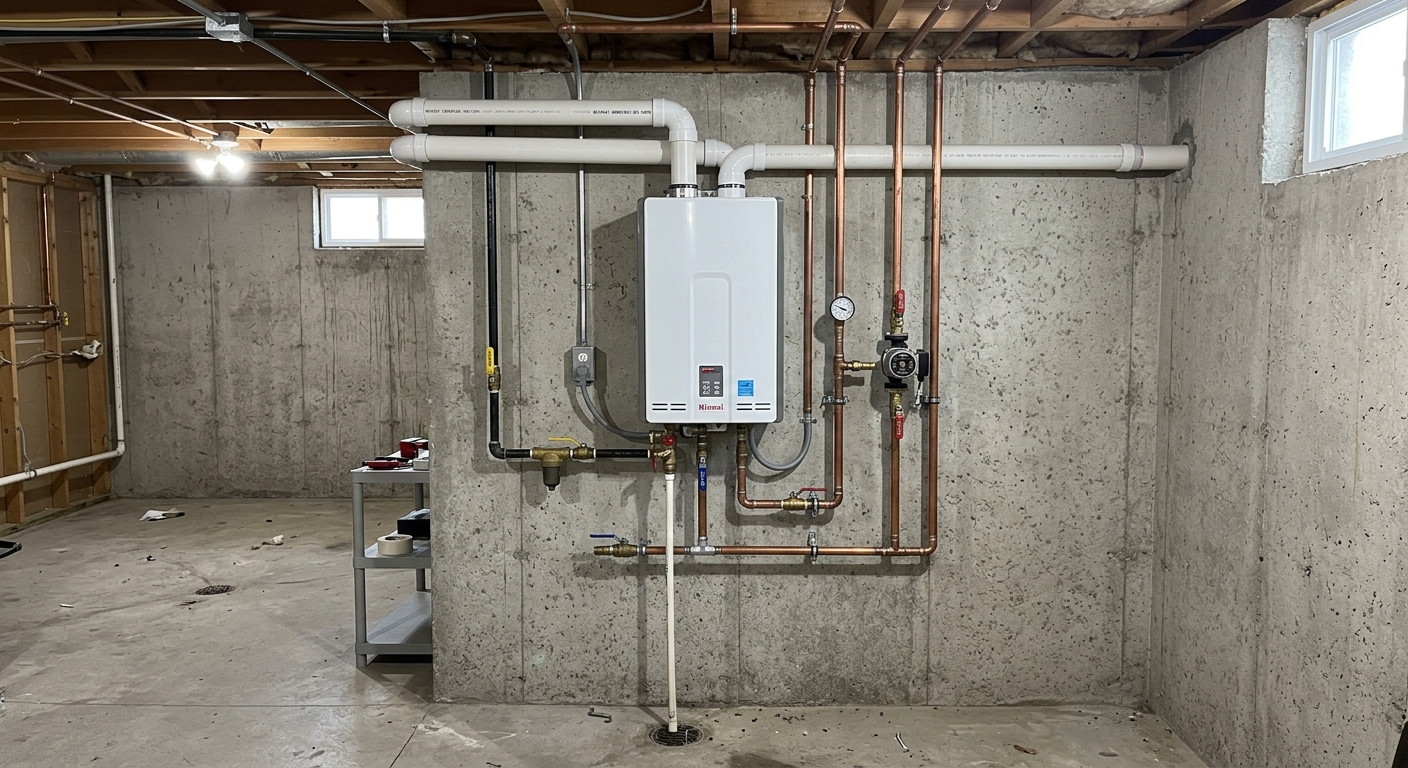
Every water heater style has its sweet spot in Springfield homes. Traditional gas or electric tanks are the cheapest up front and fit in tight basement corners, but their lifespan is shortest and you pay for standby heat loss. Tankless models (gas) mean endless hot water, but the install usually costs more and, in older Bucks County houses, frequently requires bigger gas supply lines and new venting, which can jump the bill—many buyers are caught off guard by this. Heat pump water heaters are the cheapest to run and last well, but need a large, warm, unfinished basement or utility room; they cool the air around them noticeably and are louder than tank or tankless types, which matters if you want quiet in a finished basement.
Choosing a new unit isn’t about tank gallons but about the first-hour rating—the amount of hot water available at peak demand. Any replacement should include a modern expansion tank (required by code in many Bucks County townships), a drip pan with a working drain, and a proper shutoff. Failures are almost always tank leaks, not electronics, so look for units that allow full, bottom-side draining. If you have public gas—most Springfield homes do—you can choose between gas tank or tankless by balancing install cost and convenience. Where gas is less available, more homes migrate to heat pump water heaters or high-efficiency electric tanks.
| Type |
Installed cost |
Service life |
Operating cost |
Best when |
| Gas tank, 40–50 gal |
$1,350–$3,100 |
8–12 yrs |
moderate |
existing gas line in place; quick replacement |
| Electric tank, 40–50 gal |
$1,350–$2,100 |
10–15 yrs |
high |
fully electric home; lowest upfront cost |
| Gas tankless |
$2,100–$3,100 |
18–25 yrs |
low-moderate |
high hot water demand, space savings |
| Heat pump water heater |
$2,100–$3,100 |
13–15 yrs |
lowest |
unfinished/large basement, electric service |
Frozen pipes in Springfield: prevention and thaw
With a frost depth of 30 inches and winter design temps down to 14 °F, Springfield sees moderate freeze-thaw cycles every year—cold enough to burst pipes, but mild enough that the damage often comes from pipes in spots plumbers would rather you didn’t have: exterior walls, unheated crawlspaces, garages, and attics built before energy code was a thing. The classic Bucks County burst happens between the ice plug and a closed faucet, as ice blocks the pipe and pressure builds on the downstream side—so the actual rupture may be distant from the freeze itself.
Pipes on or near exterior walls, above uninsulated garages, or feeding hose bibs are most at risk. First-line prevention is insulation—wrap all exposed supply lines, especially those near exterior walls. Heat tape, plugged into a GFCI outlet, adds protection in crawlspaces or vulnerable spots. During a hard freeze, keep a pencil-width trickle running at the furthest fixture and open cabinet doors under kitchen or bathroom sinks to circulate interior air. Remember to shut off and drain outdoor hose valves before the first real cold snap. Never try to thaw with an open flame—use a hair dryer, heating pad, or warm towels only.
Most burst pipe callouts in Springfield land at $650–$1,350 for emergency repair. Every dollar spent preventing a freeze saves multiples in restoration, not to mention the risk of flooding finished basements or damaging plaster ceilings.
Galvanized, copper, PEX, cast iron
In Springfield and the postwar Levittown corridor, unraveling what’s behind your walls starts with understanding the plumbing materials of each era. Galvanized steel—common pre‑1960—fails as the bore rusts from the inside, killing pressure first, then leaking at crusted joints. Copper supply appeared in the 1950s; it’s durable, but pinholes are a real threat in houses with aggressive water chemistry or certain solders. Polybutylene briefly came and went; its fittings fail without warning, and most insurers refuse to cover it. PEX is industry standard now—flexible, reliable, and quick to run for whole-house repipes. Drainage is another story: cast iron, found in houses through the mid‑1970s, lasts 50 to 75 years but ultimately cracks or corrodes through. Clay tile laterals run all the way to the street and let roots in at every joint. From the ‘70s on, PVC and ABS are the norm for drain piping.
You can identify what you have with a quick check: shiny silver pipes that thread together are galvanized; reddish pipes joined with solder are copper (a magnet won’t stick). Blue, red, or white flexible lines are probably PEX. Black or gray plastic is likely ABS or PVC. For all but the most modern builds, linking your house era to material tells you how much runway you have before replacement—or what to look for during leaks and pressure drops.
| Material |
Typical era |
Failure mode |
Service life |
| Galvanized steel supply |
pre-1960 |
internal corrosion, pressure loss |
40–60 yrs |
| Copper supply |
1950s–present |
pinhole leaks, joint failure |
50–70 yrs |
| Polybutylene supply |
late 1970s–1995 |
fitting failure, sudden bursts |
unreliable |
| PEX supply |
2000s–present |
fitting or UV degradation |
40–50 yrs |
| Cast iron drain |
pre-1975 |
corrosion, cracking, scale |
50–75 yrs |
| Clay tile sewer lateral |
pre-1980 |
root intrusion at joints, offset |
50–60 yrs |
| PVC / ABS drain |
1970s–present |
joint separation, crushing |
50+ yrs |
Frequently asked questions — plumbing in Springfield
What counts as a plumbing emergency?
In Springfield, a plumbing emergency is anything that threatens your property with immediate water damage, loss of service, or risk to safety—burst pipes, sewer backups, or complete water heater failure all make the list. What sets emergencies apart is urgency: a leak actively flooding your basement, sewage coming up into tubs or drains, or no water at all mid-winter calls for immediate intervention. Expect to pay higher rates for service outside regular hours or when the job can’t wait. For example, stopping a burst pipe and restoring water service usually falls in the $650–$1,350 range for emergency response. Minor drips or a slow drain, on the other hand, can almost always wait for a regular appointment at far lower cost. If in doubt, shut off your main water valve and call to discuss scope before authorizing any work.
How do I prevent frozen pipes in Springfield?
Springfield's winter temperatures routinely drop below freezing, with a design low of 14 °F and a frost depth of 30 inches. The best prevention is insulation on any pipe near an exterior wall, inside unheated spaces, or in crawlspaces and garages. Before each winter, shut off and drain outside hose bibs. On especially cold nights, keep a trickle of water running at the farthest tap from your meter and open cabinet doors under sinks to circulate room air. Never use an open flame to thaw; use a hair dryer, heating pad, or warm towels. Frozen pipes that do burst are not cheap to handle—burst pipe repairs in Springfield will typically cost between $650–$1,350 when it’s an emergency. A few dollars of insulation is a bargain by comparison.
Is my water line lead?
In Springfield and Bucks County, many homes built before 1980 have a higher chance of containing lead service lines, especially where records are thin. The Bucks County Water & Sewer Authority still lists about 2,000 known or suspected lead lines awaiting replacement. The surest way to check is to look at the pipe entering your home—lead pipes are dull gray, easily scratched with a coin, and not magnetic. If your home is older or you can't tell, ask your plumber to test or verify. If a lead line is found, the best move is a full replacement, which typically costs between $6,200–$13,500 in Springfield, depending on distance from the curb and restoration required.
What does drain cleaning cost in Springfield?
Drain cleaning is one of the most common calls in Springfield, especially in neighborhoods where roots invade older clay tile or cast iron sewers. A main line snaking or hydro-jetting with a camera check runs between $200–$800, depending on the level of blockage and whether it's done as an emergency. Weekend or after-hours calls—where wastewater is backing up and causing damage—trend higher within that band. Always insist on camera footage before signing up for expensive repairs: in most Springfield homes, ordinary augering will restore flow unless the pipe is badly broken or collapsed.
How much does sewer line repair cost in Springfield?
Sewer line repairs in Springfield range enormously in price, from spot fixes after a camera inspection to full excavations and replacements, especially in older Bucks County neighborhoods with clay or cast iron pipes. Spot repairs or trenchless linings can start as low as $2,200, but heavily damaged or deeply buried sections with tree root intrusion can exceed $13,500. The most common reason for large bills is delayed response—waiting until a backup floods the basement nearly always drives up restoration cost. Before committing, demand clear footage and a detailed scope; a proper repair will last decades.
Who owns the sewer lateral, me or the city?
In Springfield (and throughout Bucks County), the homeowner owns and is responsible for the entire sewer lateral—the stretch from your house to where it connects with the public main in the street. That means any blockages, collapse, or leaks are yours to fix, not the city’s. This puts the onus for maintenance and repair, and sometimes full replacement, squarely on the property owner. Costs for repairing or replacing a failed lateral can range from $2,200–$13,500 depending on the material, location, and how deep or long the run is. If you’re buying a home built before 1980, a video inspection of the lateral is a wise investment before closing.
Which utility supplies water to Springfield?
Most Springfield homes receive their water through the Bucks County Water & Sewer Authority, which provides public water service across large portions of the county—including the Springfield area as well as Bensalem and Bristol. If you’re unsure, your water bill will specify the supplier. The Authority is currently replacing known or suspected lead service lines at prioritized addresses, so check your home’s construction date or contact the utility if you have concerns about pipe material. Typical replacement of a water service line in Springfield costs between $6,200–$13,500, including excavation and restoration.
Does Pennsylvania license plumbers at the state level?
No—Pennsylvania does not license plumbers statewide. Plumbing licensing in Springfield and Bucks County is handled by each local municipality, so a valid license in Doylestown or Bensalem does not automatically entitle a plumber to work in Springfield. The only universal credential required for home improvement jobs over $500 is the Home Improvement Contractor (HIC) registration, issued by the Office of Attorney General. Always verify any claimed local license with the specific Springfield code office and the contractor’s HIC at hic.attorneygeneral.gov. Workers’ compensation coverage is also mandatory and can be checked via the WCAIS system. Choosing a properly registered and locally licensed pro is your best shield against inflated repairs and hidden liability costs, including emergency jobs which can run $650–$1,350.
Is a water softener worth it in Springfield?
In Springfield, most homes have municipal water service provided by Bucks County Water & Sewer Authority, which treats for hardness, so extremely hard water is uncommon compared to rural areas with individual wells. If you’re seeing scale on fixtures or sediment in your water heater, a test kit or plumber’s spot check is the first step—not an automatic softener buy. For most Springfield homeowners, a softener is not a must-have, but it can extend the life of water heaters or dishwashers in edge cases. Install costs typically run in the same ballpark as a tank water heater replacement—$1,350–$3,100. Don’t buy until a test confirms you genuinely need one.