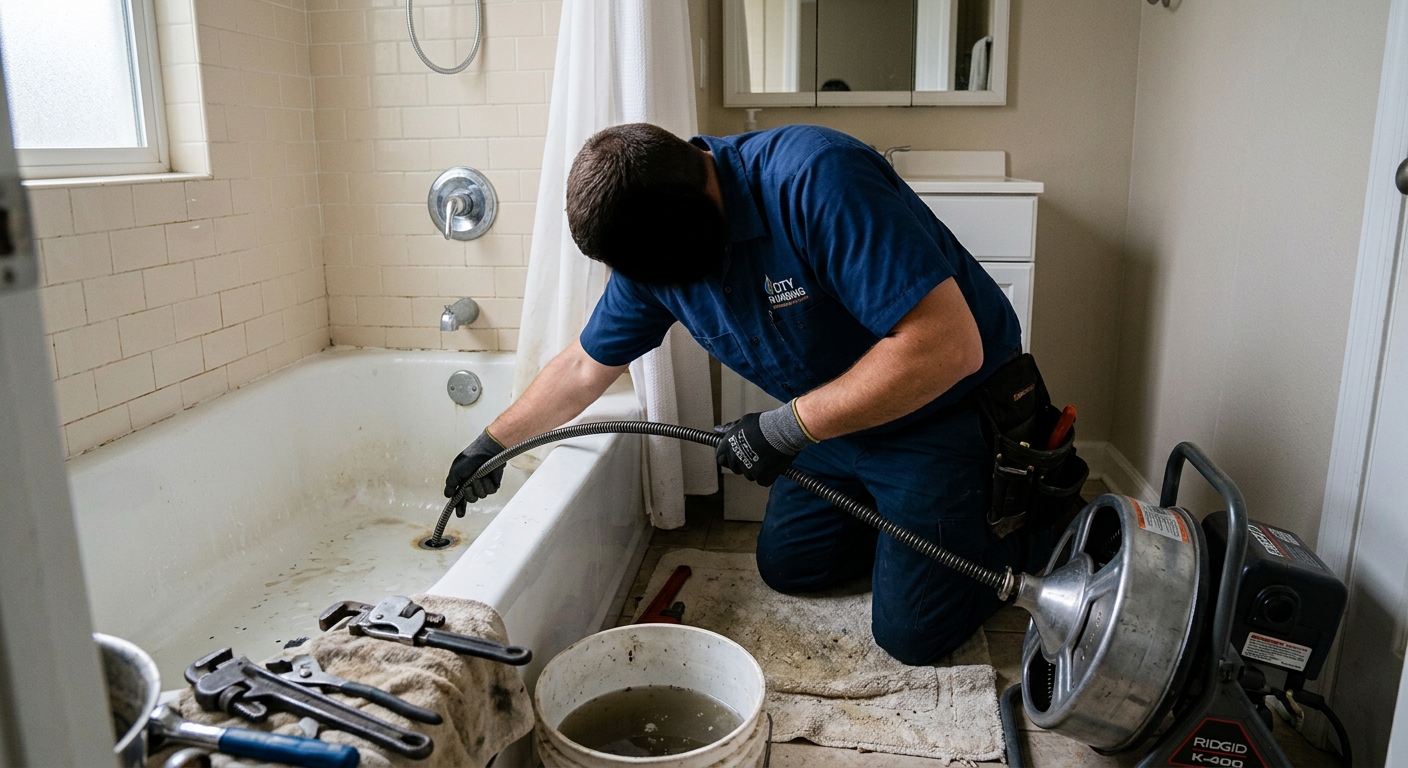
Tyrone plumbing prices by job type — 2026
In Tyrone, plumbing costs can swing sharply depending on whether you’re booking ahead or dealing with a midnight leak. With about 1,352 owner households (U.S. Census Bureau, ACS 2024), many built before 1980, your home’s plumbing is often tied directly to its era. Older homes—especially those from Blair County’s major 1900–1950 building wave—may still have galvanized supply lines and cast iron or clay tile drains, all pushing old age and raising repair costs. The fact that 86.3% of homes here are pre-1980 means more service calls for corrosion, root intrusion, and aging water heaters on their third or even fourth lives.
Emergency calls always come at a premium. A burst pipe that needs fixing now will cost more—sometimes double—compared to the same repair booked for next week. This premium applies not only to nights and weekends but anytime water is actively leaking or there’s a risk of property damage. Regular installation or non-urgent repairs, on the other hand, fall at the lower end of the price band, especially if access is simple and pipe runs are short. Permit or inspection requirements within Blair County’s municipalities can also add time and cost.
| Service |
Scope |
Emergency rate |
Standard rate |
| Emergency repair — burst pipe |
locate, open, repair section, restore service |
$550–$1,050 |
$325–$1,050 |
| Water heater replacement (gas, 40–50 gal) |
remove old, install, test, haul away |
$1,700–$2,500 |
$1,050–$2,500 |
| Drain cleaning — main line |
augering or hydro-jet, camera if needed |
$350–$800 |
$200–$500 |
| Sewer line spot repair |
excavate or reline a failed section |
$1,800–$10,500 |
$1,800–$10,500 |
| Whole-house repipe |
replace supply lines throughout, patch and finish |
— |
$3,100–$7,600 |
| Water service line replacement |
street to house, excavation and restoration |
— |
$4,900–$10,500 |
Estimates for a typical Tyrone home. Access difficulty and pipe material move these figures more than anything else.
The leak you can hear but can't see
If you suspect a leak but can’t find obvious water damage, do a quick meter test before you call anyone. Shut off all faucets and fixtures, then check your water meter—if the dial keeps spinning, you’re losing water somewhere on the supply side. This is a free DIY check that narrows things down without costing a dime.
For hidden leaks—whether under a slab, inside a wall, or on an irrigation line—professional plumbers use a few main technologies. Acoustic listening searches for the sound of water movement in pipes and runs around $325–$1,050 when bundled with repair. Modern thermal imaging spots temperature changes behind walls and floors; tracer gas uses special sensors to "sniff" escaping gas through structural barriers—both can find pinhole leaks with minimal demolition, usually adding under $550 to the diagnostic charge. Locating a slab leak, which is less common here due to older foundations but still possible, will add time and bump up cost but is still cheaper than breaking the wrong concrete.
The right approach is always to locate first, then open up. Any plumber who wants to cut open floors or walls without confirming the leak’s location is working backwards—especially in Tyrone, where older homes are a tangle of added and re-routed pipes. Confirm the source, see the location, then decide if opening up is worth it.
Tyrone's housing stock and its plumbing
Tyrone’s homes are overwhelmingly from before 1980, a fact that matters for what’s lurking behind the walls and under the lawn. In these homes, galvanized steel was the standard supply pipe for the first half of the 20th century—left unchecked, those pipes have now outlived their 40–60 year life and constrict flow or start leaking. Copper replaced galvanized roughly in the 1950s, so you’ll find a patchwork of both in many properties, especially after piecemeal repairs. Sewer laterals from this era are often clay tile, notorious for root intrusion.
Your drain lines may be cast iron, giving you a 50–75 year window before corrosion or cracks set in. Kitchen and bathroom drains swapped over to PVC/ABS in the later years, but those homes are fewer in Tyrone. If your home’s water heater hasn’t been swapped two or three times by now, it's overdue. For homes built after 1980, polybutylene supply lines sometimes crop up, along with builder-grade fixtures and 40-year-old water heaters now at their end of life—but these constructions are the minority here.
Bottom line: vintage does not mean trouble-free. Most Tyrone homes have a mix of old and older pipe, meaning pre-emptive repipe planning is smart, not alarmist.
Sewer laterals: the pipe you own and can't see
Every homeowner in Tyrone owns the sewer lateral from the house to the main line, and maintenance (or replacement) is entirely your responsibility—not the utility’s. Most become aware of this only after a backup. Watch for symptoms: a single slow drain may just be a local clog, but when several fixtures back up or gurgle, especially at the lowest drain or toilet, you’ve likely got a lateral problem. Odor outside, or wet spots above your buried line, are further warning signs.
The first step should always be a camera inspection. In older Blair County homes with clay tile laterals, root intrusion at the joints is common. “Bellies”—sagged sections that hold water—and offset joints are frequent finds in early 20th-century lines. Don’t let anyone quote excavation or relining without showing you the footage; a legitimate plumber will provide this as standard practice. Excavation (“open-cut”) is sometimes unavoidable, but trenchless relining is possible and less disruptive if conditions allow.
For homes outside urban Tyrone, with septic instead of sewer connections, problems are a different animal: regular tank pumping (every 3–5 years) is a must, and drainfield issues call for septic pros, not pipe diggers. Don’t pay for lateral work if you’re on septic—wrong problem, wrong solution.
Pipe materials in Tyrone homes and how they fail
Blair County’s 1900–1950 boom left Tyrone with decades of layered plumbing materials, each with failure quirks. If your home is pre-1960, odds are you have galvanized steel supply lines. You can ID these by scratching the pipe—dull gray means galvanized, and a magnet will stick. Galvanized fails by clogging up inside before leaking outright, a silent pressure killer. Copper supply pipes—common from the 1950s onward—have soldered (not threaded) joints and shine when scratched; they’re tough but not immune, with pinhole leaks in old or aggressive water chemistry areas. Polybutylene (late 1970s–mid-1990s) is gray-blue plastic, usually with crimped or barbed fittings, and is now considered unreliable and mostly phased out. PEX, the new standard, is flexible plastic in red, blue, or white and resists corrosion but can fail if exposed to UV light or improper fitting installs.
Drain lines? Cast iron was the workhorse pre-1975—heavy, dull, leaves black smear. These corrode and can crack out of sight. Clay tile sewer laterals look orange and come in short sections with visible joints; root entry at these joints is a hallmark. PVC or ABS plastic shows up in newer homes—white or black, lightweight, and usually glued at the joints, these are more robust but can separate in shifting ground.
Era plus identification means you can estimate your runway—if your home’s original pipes are galvanized or cast iron, you’re on borrowed time. If you have copper or PEX, plan for long service but check joints yearly, especially if you’re seeing pressure drops or damp spots.
| Material |
Typical era |
Failure mode |
Service life |
| Galvanized steel supply |
pre-1960 |
internal corrosion, pressure loss |
40–60 yrs |
| Copper supply |
1950s–present |
pinhole leaks, joint failure |
50–70 yrs |
| Polybutylene supply |
late 1970s–1995 |
fitting failure, sudden bursts |
unreliable |
| PEX supply |
2000s–present |
fitting or UV degradation |
40–50 yrs |
| Cast iron drain |
pre-1975 |
corrosion, cracking, scale |
50–75 yrs |
| Clay tile sewer lateral |
pre-1980 |
root intrusion at joints, offset |
50–60 yrs |
| PVC / ABS drain |
1970s–present |
joint separation, crushing |
50+ yrs |
Who is allowed to do plumbing work in Pennsylvania
Pennsylvania does not license plumbers at the state level. Instead, plumbing registration and licensing are handled by individual municipalities. This means a plumber’s badge from one city or township may not carry over to the next. If you’re hiring in Tyrone or surrounding Blair County towns, always ask if your plumber is registered or permitted for your specific municipality. The big exception locally is Altoona, where the city requires its own contractor license for commercial plumbing work—elsewhere in Blair County, requirements vary and may be minimal for residential fixture swaps.
Every job with a contract over $500 must use a written agreement under the Home Improvement Consumer Protection Act, giving you three business days to cancel, and you can verify the contractor’s HIC registration at hic.attorneygeneral.gov. Employers must have workers' compensation (you can check at wcais.pa.gov), and both general liability and worker’s comp should name your property on the certificate. Permits for residential fixture swaps are typically not required here, but major plumbing changes—such as repiping, sewer work, or water service line replacement—may trigger permit and inspection requirements, particularly in Altoona. Final sign-off comes from municipal code officials or, in opt-out areas, by the state Department of Labor & Industry. Always ask who provides code compliance and inspection for your job.
How to find a good plumber in Tyrone
Start by checking a contractor’s registration through the Pennsylvania Office of Attorney General’s HIC portal (hic.attorneygeneral.gov). For jobs requiring a permit in Tyrone or Blair County’s urban core, confirm the plumber’s local credentials, as there’s no state plumbing license. Insurance is critical—request a certificate naming your property, not just a generic printout. Workers' compensation is mandatory; validate coverage at wcais.pa.gov.
Know who’s doing the work. Some shops send their own crews, some subcontract—ask outright. Get the emergency rate, after-hours premium, and base service fee up front, as these can widen the cost gap fast.
- Confirm registration for contracts over $500 at hic.attorneygeneral.gov
- Check workers' compensation status at wcais.pa.gov
- Ask if the company’s credentials match your specific municipality
- Verify insurance certificate with your address listed
- Request to see the local permit or inspection requirement in writing
- Ask who will be on site—employees or subcontractors
- Get written emergency and after-hours rates
- Insist on camera inspection before sewer or repipe quotes
- Never accept a major excavation quote based on a guess
- Get a detailed scope of work, not just one-line descriptions
- Require a written contract with your right to cancel (over $500 jobs)
- Ask for references from jobs in Blair County, not just anywhere
Red flags: quotes for repiping or sewer repairs without camera footage or pressure testing, vague “emergency” charges, refusal to provide insurance, and reluctance to provide permits or references. In Blair County’s moderate market, the best contractors are known by word of mouth, not big ads. Don’t be rushed by scare tactics or “today only” prices.
Frequently asked questions — plumbing in Tyrone
How long should a water heater last in Tyrone?
In Tyrone, where 86.3% of homes were built before 1980, it’s rare to find an original water heater still running. Most gas water heaters will last 8–12 years before efficiency and corrosion problems make replacement sensible. If your tank is older, especially if Tyrone’s harder water has started to build scale, it can start leaking or drop temperature at shower time—a sure sign it’s due. Annual flushing helps, but once you see rust around the base or brown water on startup, swap it out. Typical replacement costs here run $1,050–$2,500; a proactive replacement can save you from bigger water damage bills down the line.
Does Pennsylvania license plumbers at the state level?
Pennsylvania does not offer a statewide plumbing license. Licensing for plumbers is handled by each municipality, so a plumber who is certified in one area—like Altoona or a nearby township—might not have authority to work in another. This is especially important in Tyrone and Blair County, where local permit and credential rules change town by town. Before hiring, always ask if the contractor’s paperwork matches where your property is located and verify their Home Improvement Contractor registration at hic.attorneygeneral.gov. Emergency repairs (like a burst pipe at $325–$1,050) don’t change this rule—licensing is always local.
What does drain cleaning cost in Tyrone?
Tyrone drain cleaning prices depend on whether it’s an urgent clog or routine main line maintenance. For a standard main drain cleaning, you’ll see rates between $200–$500. That includes the typical augering, snaking, or light hydro-jetting found in the majority of Tyrone’s older homes. If it’s an emergency call—like water backing up during a Sunday dinner—expect the bill to climb to $350–$800. Main line cleaning for older Blair County homes, many with cast iron or clay pipes, may require a camera to check for roots or offsets, so always ask if that’s included.
Which utility supplies water to Tyrone?
Water service for Tyrone is handled by the Altoona Water Authority. This utility provides public water not only to Altoona but to several townships and smaller municipalities throughout Blair County, Tyrone among them. If you have issues with water pressure, billing, or potential lead service lines, you’ll be dealing with the Altoona Water Authority’s service team. They also maintain a lead inventory, but the current status of full countywide lead line replacement is unknown. Emergency repairs to your supply line from the street typically cost between $4,900–$10,500 if you’re dealing with a full replacement.
Should I wait until business hours to call?
In Tyrone, timing matters for your wallet. Emergency rates kick in for after-hours, weekends, or urgent repairs risking property damage, like a burst supply pipe or active leak. If you can safely shut off the water and wait for business hours, you’ll likely save hundreds—standard rates for an emergency repair run $325–$1,050. But if shutting off the main would leave you without heat or basic facilities, or if you see water actively spreading, the extra after-hours cost is justified. For slow drains, water heater trouble, or minor leaks, waiting until regular working hours will save you money and may mean a better job, as suppliers are open and parts easier to source.
How much does a water heater replacement cost in Tyrone?
For a 40–50 gallon gas water heater replacement in Tyrone, expect to pay between $1,050–$2,500. This covers removing the old tank, installing and testing the new one, hauling away the old unit, and correcting any minor code issues. If your home is older and the supply lines or venting need adjustments—as is often true in the pre-1980 housing stock—the cost may land in the upper part of that range. Emergency replacements (for tanks that have failed and are leaking badly) can run from $1,700–$2,500. Always ask for a written quote that spells out everything included.
Should I reline or replace my sewer line?
The decision between relining and replacing a sewer line in Tyrone should be based on what’s actually wrong—something a camera inspection should confirm. For local clay tile laterals, root intrusion and joint offsets are frequent, which can be resolved with trenchless relining if the rest of the pipe is stable. Relining is less disruptive and faster but may not work if the pipe has collapsed or there are major “bellies.” Full replacement, often using open-cut excavation, is the answer for aged-out or badly broken lines. Either way, expect costs from $1,800–$10,500. Never accept a quote for either option without having seen the inspection footage with your own eyes.
How deep do water lines need to be buried in Tyrone?
Blair County’s winters are cold—with a 36-inch frost depth required by code. In Tyrone, that’s your minimum burial depth for any water service line to keep pipes from freezing even during harsh cold snaps (winter design temp is 2°F). Lines buried shallower are prone to freezing pipes and burst risks, especially in older lawns or during record cold. If you’re having your service line replaced—typical cost $4,900–$10,500—always have the installer document the new depth and route. Skimping on this is gambling with your winter water supply.
Does insurance cover a burst pipe in Tyrone?
Many standard homeowners’ insurance policies in Tyrone do cover sudden and accidental water damage from burst pipes, including cleanup, drying, and repair of damaged finishes. However, coverage may not extend to replacing old, corroded pipes themselves—insurance pays for the aftermath, not for routine upgrades. You’ll still be responsible for repair costs, which in Tyrone run $325–$1,050 for a typical burst pipe emergency. Always call your carrier as soon as you find a burst, document the damage, and hold onto repair invoices—they’ll want to see proof before settling any claim.