What plumbers charge in Murrysville
Murrysville homeowners see plumbing prices shaped by the area’s specific housing era and layout. With 80.2% single-family homes and over half of the homes built before 1980 (U.S. Census Bureau, ACS 2024), most plumbing systems trace back to post‑1945 construction. This matters: the dominant supply lines are copper or galvanized steel in these homes. When these pipes fail—bursts from wear, corrosion, or freezing—the needed repair depends heavily on the location and access, not just the pipe material.
The same job comes at a higher price if it’s an emergency call. Nights, weekends, and any situation where the water is actively leaking or leaving you without service mean extra travel and overtime. In Murrysville, this puts emergency repairs in a different bracket than those you can schedule on your calendar, especially when contractor availability tightens after a cold snap or heavy rain.
| Service |
Scope |
Emergency rate |
Standard rate |
| Emergency repair — burst pipe |
locate, open, repair section, restore service |
$650–$1,250 |
$375–$1,250 |
| Water heater replacement (gas, 40–50 gal) |
remove old, install, test, haul away |
$2,000–$2,900 |
$1,250–$2,900 |
| Drain cleaning — main line |
augering or hydro-jet, camera if needed |
$350–$800 |
$200–$500 |
| Sewer line spot repair |
excavate or reline a failed section |
$2,100–$12,500 |
$2,100–$12,500 |
| Whole-house repipe |
replace supply lines throughout, patch and finish |
|
$3,700–$9,000 |
| Water service line replacement |
street to house, excavation and restoration |
|
$5,800–$12,500 |
Estimates for a typical Murrysville home. Access difficulty and pipe material move these figures more than anything else.
Choosing a water heater in Murrysville
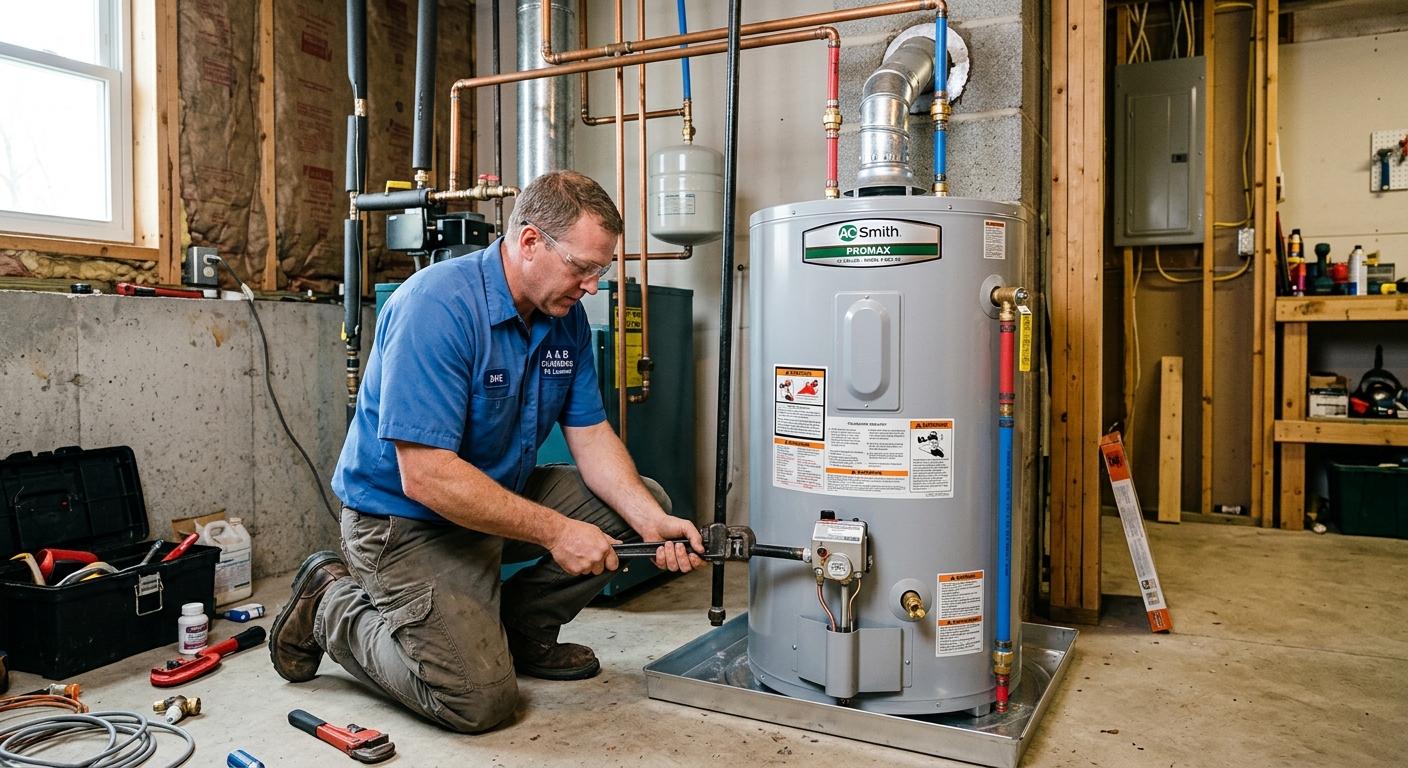
When replacing a water heater in Murrysville, you’re deciding between three core types: traditional tank, tankless (on-demand), and heat pump water heaters. For most homes, a gas tank model is the lowest immediate cost and easiest swap, especially when working with existing venting and gas supply. These tanks are cheap to install but lose the most heat when not in use, and their typical life expectancy is about 8–12 years—sometimes shorter if water quality is harsh or maintenance is ignored.
Tankless gas heaters provide endless hot water and can last up to 25 years, but installation gets expensive when the current gas line is undersized or venting doesn't meet code—very common in post‑war homes. The upfront bill surprises many: a tankless swap often means $2,000 or more, mainly due to those upgrades.
Heat pump water heaters run cheapest in the long term using electricity, but they need a large, non-freezing space (like an unfinished basement). They cool and dehumidify the area, get noisy, and won’t fit in every Murrysville basement—something to consider if your utility room doubles as finished space.
Sizing is best determined by the first-hour rating, not just tank volume. Expansion tanks are now code whenever you install a new heater. Always use a pan and floor drain—most failures are tank ruptures, not just leaking controls.
| Type |
Installed cost |
Service life |
Operating cost |
Best when |
| Gas tank, 40–50 gal |
$1,250–$2,900 |
8–12 yrs |
moderate |
existing gas lines, space for vent |
| Electric tank, 40–50 gal |
$1,250–$2,000 |
10–15 yrs |
high |
no gas available, smaller households |
| Gas tankless |
$2,000–$2,900 |
18–25 yrs |
low-moderate |
high-volume, endless hot water needed |
| Heat pump water heater |
$2,000–$2,900 |
13–15 yrs |
lowest |
ample basement space, electric rate concern |
Who is allowed to do plumbing work in Pennsylvania
Pennsylvania does not issue a statewide plumbing license. Instead, plumbers are licensed at the municipal level where required. In practice, this means a plumber can be licensed and registered in, for example, the City of Greensburg, but hold no legal credential at all in neighboring townships or Murrysville—which runs its own permit office. So, for homeowners, the main question isn’t “Are you licensed?” but “Are you registered and permitted to work here in my municipality?”
For larger plumbing work connected to public water or sewer in the area (as in Hempfield Township), a township-issued construction permit is typically required and the job will be inspected by the town or its designee. Like-for-like fixture swap with no piping changes in Greensburg is considered ordinary maintenance and usually does not require a city plumbing permit.
All contractors performing jobs over $500 must carry Home Improvement Contractor (HIC) registration—verify at hic.attorneygeneral.gov. Employers must maintain valid workers’ compensation, which you can check through WCAIS (wcais.pa.gov). Code enforcement authority is local: Hempfield Township and surrounding boroughs run their own inspector offices. In all cases, get written proof of insurance and check registration before signing a contract.
Flat rate versus time and materials
In Murrysville, plumbers price work either as a flat rate (one stated total for the job) or time-and-materials (by the hour, plus the actual cost of parts). Flat rate buys price certainty, but it also means you pay for the plumber to assume risk—if the job goes quick, you still pay the quoted amount; if it goes long, the contractor eats the extra labor. Time-and-materials will often be cheaper for simple jobs, like snaking a straightforward clog, but the bill is open-ended if something unexpected comes up.
Neither model is a scam; what hurts you is not knowing which you’re paying for. Always ask if there’s a diagnostic fee and whether it credits towards repair. The quote should spell out what’s getting opened and fixed, not just a series of prices. Restoration—putting drywall or flooring back—is often excluded, so check. Local rules mean certain jobs require a permit, which should always be priced in; “not needed” is a red flag if you know a permit is required. Warranty on labor and parts should be written separately, since manufacturer warranties don’t cover labor if there’s ever a callback.
| Line item |
What to look for |
Red flag if… |
| Billing model |
flat rate or hourly, stated up front |
unstated |
| Diagnostic fee |
amount, and whether it credits |
vague |
| Scope |
what is opened, repaired and restored |
price with no scope |
| Restoration |
drywall and finish explicitly in or out |
silent |
| Permit |
included and priced |
'not needed' |
| Parts |
brand and model for fixtures |
'standard fixture' |
| Warranty |
labour period stated separately |
parts only |
Winter pipe failures in southwestern Pennsylvania
In southwestern Pennsylvania, the frost depth runs at 36 inches, with a winter design temperature around 8°F. That means our region’s freeze-thaw swings hit plumbing hard—especially in older homes with uninsulated lines in crawlspaces, exterior walls, under garages, or near hose bibs. Most pipe bursts don’t actually occur at the frozen section. Ice forms, expands, and blocks the pipe, but the rupture typically happens between the ice plug and a closed faucet as water pressure builds. That’s why damage often shows up inside the house, not on the shaded wall where the freeze hit.
Vulnerable spots: pipes in unheated crawl spaces, attics, attached garages, and any hose bib or sillcock sticking through an exterior wall. Prevention is cheap compared to the cost of a burst pipe, which can mean a bill of $650–$1,250 for a late-night repair in Murrysville. Insulate exposed pipes. Use heat tape as a backup in critical areas. Let a cold-water faucet trickle during extreme lows, open cabinet doors below kitchen and bath sinks against outside walls, and always shut off and drain outdoor spigots by Thanksgiving.
If you do find a frozen pipe, thaw with a hair dryer or heat lamp—never an open flame. Open flames can start fires, and it’s not worth the risk just to bring pipes back in line.
Detection methods and what they cost
If you suspect a hidden leak in your Murrysville home, start with the meter test: turn off every faucet and appliance, then check the water meter. If the dial moves, you’ve got a leak somewhere after the meter, possibly under a slab or inside a wall.
Professional detection methods include acoustic listening (using sensitive microphones to hear water escaping), thermal imaging (showing temperature changes from wet spots), tracer gas (safe gases pumped into pipes and detected where they escape), and slab leak location with advanced sensors. For most home supply leaks, acoustic and thermal tests run $375–$1,250 when tied to a repair call-out. Tracer gas or slab location gear costs more, but is essential when a leak is under a finished slab or behind multi-layer construction.
Common use cases: slab leaks (main supply under a basement or garage), wall-cavity leaks (shows as mystery water stains), or hidden irrigation lines outside. Plumbers should always locate the leak before opening walls or floors; if someone wants to start demolition before finding the leak’s location, get a second contractor.
Plumbing systems in Murrysville homes
Murrysville’s housing stock is mostly single-family homes, with more than half built before 1980 and many others in post-WWII suburban tracts. That makes the typical plumbing setup a mix of copper and galvanized steel for the supply lines. Drains from this period were usually cast iron or clay pipes—especially for the buried sewer laterals, which are now prone to tree root intrusion and cracks after fifty-plus years underground.
Many homes in Murrysville have now had at least one round of fixture or water heater replacement. If your place is pre-1980 and hasn’t had a major supply upgrade, corroded galvanized lines may cause low pressure and eventual leaks. Sewer lines here—especially if original—are likely clay, which means spot repairs or even full replacement is common when persistent backups appear. Houses built in the post‑war tracts often have copper supply but can now show pinhole leaks from old flux and mineral build-up.
If your house is from a newer suburb, beware builder-grade fixtures and, for those built in the late 1980s to mid-1990s, polybutylene supply pipes in some installations. Don’t assume everything is fine just because the house isn’t “old”—each plumbing era brings its own set of issues in Murrysville.
Frequently asked questions — plumbing in Murrysville
What does emergency plumbing cost in Murrysville?
Emergency plumbing services in Murrysville start at $375–$1,250 for a burst pipe or active leak, with the average bill running about $650 when you need a plumber right away. Nights, weekends, or holiday calls push it to the top of that range. This covers labor, basic materials, and quick restoration if access is straightforward. Complex situations—like opening finished ceilings or tracing a hidden leak through multiple walls—can send the cost up fast. Murrysville’s housing stock, with a high percentage built before 1980, means many supply lines are original copper or galvanized steel, so emergency repairs often require more than just a clamp or patch. If the problem turns out to be a main shut-off failure or frozen pipe, the underlying repair could fall at the upper end of the range, especially if you need restoration work after the fix.
Should I wait until business hours to call?
If water is spraying, flooding is ongoing, or you cannot safely shut off water to a leaking pipe, make the call immediately, even after hours. In Murrysville, waiting until business hours to report an active leak can easily double or triple the damage—flooring, walls, and ceilings go quickly if water is left running. Emergency rates start at $650–$1,250 for a burst pipe, but the cost to patch drywall, replace flooring, or remediate mold is often far higher than the premium for an after-hours plumber. If you have a “minor” leak (like a slow drip in a sink trap or a water heater sweating), and you can confidently shut off the fixture’s valve without impacting the rest of the home, it’s reasonable to wait until morning. For main line leaks, burst pipes, or sewage backing up, don’t risk the delay in Murrysville’s freeze-thaw environment.
Does Pennsylvania license plumbers at the state level?
No, Pennsylvania does not license plumbers at the state level. Instead, plumbing licensure happens at the municipal level. For example, within Westmoreland County, the City of Greensburg maintains its own contractor registration for plumbing. The state does require all contractors performing home improvement work over $500—including plumbing—to hold a registered Home Improvement Contractor (HIC) number, which anyone can verify at hic.attorneygeneral.gov. Licensed does not automatically mean “licensed for your town,” so if you live in Murrysville, confirm any plumber is authorized to work within your municipality and can obtain any required permits for your job. Local permitting also means inspection by the township, and only registered firms with valid insurance can legally pull permits for your home.
How do I prevent frozen pipes in Murrysville?
Frozen pipes are common in Murrysville’s winter, with frost lines at 36 inches and deep freezes that can hit 8°F or lower. Prevention starts with insulating pipes that run through exterior walls, crawlspaces, and garages—use pipe foam and consider heat tape in extremely cold or exposed areas. Always shut off and drain outdoor faucets before the first hard freeze. When temperatures drop into the single digits, open cabinet doors beneath sinks that back up to outside walls and let a faucet trickle to keep water moving. Never use an open flame to thaw a frozen pipe; a hair dryer or heat lamp is much safer. Compared to the potential emergency repair bill of $650–$1,250 for a burst pipe, a roll of pipe insulation is the cheapest insurance you can buy.
Is a sewer line replacement covered by homeowner's insurance?
In Murrysville and elsewhere in Pennsylvania, standard homeowner's insurance typically does not cover replacement of a deteriorated or failed sewer line due to age, root intrusion, or wear—these are considered maintenance issues. Some policies will cover sudden accidental breaks caused by events like a shifting foundation, but even then, coverage is usually limited to only the part of the line under insured structures and only for direct repair. The out-of-pocket cost for a sewer line spot repair runs $2,100–$12,500, depending on access and how much pipe needs replacing. Many local policies now offer service line endorsements at extra cost; if you have an older lateral or live in a post‑1945 house with original clay tile, it’s worth checking with your insurance agent before you face a big repair bill.
How much does a plumber cost in Murrysville?
Plumbing rates in Murrysville depend on the service, time of day, and the type of property. Routine jobs like drain cleaning start at $200–$500 for a main line under standard conditions and during business hours. Emergency jobs—a burst pipe or active leak—fall in the $650–$1,250 range, mainly due to after-hours and responsiveness. Replacing a water heater typically runs $1,250–$2,900. Location matters: houses built before 1980 may have hidden access issues, longer runs, or brittle galvanized lines, which can change the bill. Always ask for either a flat rate or a detailed breakdown before agreeing to work, and confirm whether restoration (like drywall patching) is part of the price.
Repair or replace a leaking water heater?
In most Murrysville homes, if your water heater is leaking from the tank itself (and not just at the supply valve or drain), replacement is almost always the answer. Tanks rust from the inside out, and once they breach, there’s no lasting repair that’s safe or code-compliant. Expect to pay $1,250–$2,900 for a typical gas or electric replacement, installed and hauled away. If the leak is from a connection, a valve, or the temperature and pressure (T&P) relief, a repair might buy you time—sometimes for under $375. But with over half of Murrysville homes built before 1980, most heaters you see failing are already at or past their typical lifespan and can corrode fittings under the insulation, hiding the true leak source. Most of the time, repair dollars are better spent on a new unit.
How long should a water heater last in Murrysville?
In Murrysville, a standard gas tank water heater typically lasts 8–12 years, and an electric tank can stretch to 10–15 years with good water quality and regular maintenance (like draining a small amount to flush sediment annually). Tankless models, while more expensive to install—$2,000–$2,900—can last up to 25 years if properly descaled. Heat pump water heaters run about 13–15 years. The big factor is local water chemistry and the age of the house: homes built before 1980 often have water heaters installed in tougher-to-reach spots, and original piping can speed up rusting. Older units also lack expansion tanks and pans, increasing the risk of hidden leaks. If your heater is over a decade old, keep an eye out for rust at the base, uneven heating, or water around the pan—these are signs it’s nearing the end.
Is Murrysville on combined sewers or septic?
Murrysville lies in Westmoreland County, where sanitary infrastructure varies by township. Greensburg uses separate sanitary and storm sewers, but many outlying Westmoreland townships—including around Murrysville—still have a large number of single-family homes on individual septic systems. If your property is on public sewer, the line from your house connects to the larger sanitary system; if not, a septic tank will be present on your property for wastewater treatment. The type of system matters greatly for repairs—a sewer line spot repair starts at $2,100–$12,500, whereas septic system repair or replacement is a different process and cost bracket entirely. Always confirm with your township office or your own property records which system your home uses before arranging repairs.