What plumbers charge in Carroll
Carroll sits squarely in the southern Pittsburgh suburbs, where most homes are single-family properties with a high ownership rate (82.7%), and nearly 70% were built before 1980 (U.S. Census Bureau, ACS 2024). The age of your plumbing is not just a curiosity—it’s the single biggest factor in what things cost to fix. Most homes built in the 1980s to 2000s, especially in nearby Peters Township, used copper originally—many are now being repiped in PEX when leaks start cropping up. In houses from before 1980, you’ll find a patchwork: old galvanized, copper, sometimes even legacy lead service lines in certain City of Washington neighborhoods.
When you need a plumber, pricing splits immediately: the same job during business hours and after-hours are two different animals. For example, a burst pipe fixed on an emergency call—nights, weekends, holidays, or with water flooding inside—costs more not just for labor, but also mobilization and after-hours dispatch. If you can wait until regular hours, you might pay half as much.
| Service |
Scope |
Emergency rate |
Standard rate |
| Emergency repair — burst pipe |
locate, open, repair section, restore service |
$600–$1,150 |
$325–$1,150 |
| Water heater replacement (gas, 40–50 gal) |
remove old, install, test, haul away |
$1,850–$2,700 |
$1,150–$2,700 |
| Drain cleaning — main line |
augering or hydro-jet, camera if needed |
$350–$800 |
$200–$500 |
| Sewer line spot repair |
excavate or reline a failed section |
$1,900–$11,500 |
$1,900–$11,500 |
| Whole-house repipe |
replace supply lines throughout, patch and finish |
— |
$3,400–$8,200 |
| Water service line replacement |
street to house, excavation and restoration |
— |
$5,300–$11,500 |
Estimates for a typical Carroll home. Access difficulty and pipe material move these figures more than anything else.
Emergency rates versus scheduled work in Carroll
Plumbing emergencies in Carroll don’t just cost more—they can double in price if you’re forced to call after hours. Why? Emergency calls mean a plumber has to drop what they’re doing or come out in the middle of the night. The rate includes not just overtime labor, but also a trip charge, parts markup, and the cost of diagnosing under stress. For a burst pipe, an emergency repair can run $600–$1,150 compared to $325–$1,150 during normal business hours. For something more involved, like a water heater replacement, after-hours rates are at the upper end of $1,850–$2,700.
Here’s what counts as a true plumbing emergency:
- Flooding from a burst pipe
- No running water at all in the house
- Sewage backing up into drains or the basement
- The unmistakable smell of gas from water heater or piping
Situations that can usually wait until business hours (saving you hundreds):
- Slow drip under a sink (put a bucket under it)
- Only one slow drain (others still work)
- A toilet that keeps running but isn’t overflowing
- A single fixture without hot or cold water
If you spot a burst or major leak, shut off your main water valve—usually in the basement, just inside where the main enters the house. For smaller leaks, every fixture has a shutoff: angle stops under sinks and behind toilets. Shutting off water fast can turn an emergency call into a scheduled one, saving you the premium.
Licensing and permits for plumbing work in Carroll
Plumbing isn’t licensed at the state level in Pennsylvania. Instead, it’s municipal. That means a plumber licensed in one town may have no standing in the next. In Washington County, each municipality decides: the City of Washington enforces its own plumbing code and issues permits; townships like Peters and North Strabane have their own code enforcement departments. Always ask if the plumber is licensed for work right where your home is located.
Permits are required for system alterations involving new fixture installations in Washington. But basic repairs—like swapping a faucet—usually don’t require one in county townships. Inspection, when needed, is handled by your local department, not the state. If your contract is over $500, Pennsylvania law requires the plumber to be registered as a Home Improvement Contractor (HIC) with the Attorney General, and to provide a written contract and a three business-day right to cancel—these are statewide protections. Confirm workers’ compensation using WCAIS.
If your home was built before 1978 and work disturbs paint or walls, ask about EPA Lead RRP certification. Don't assume all “licensed” plumbers are cleared to work everywhere; ask for local credentials and verify them.
Tank, tankless or heat pump water heater?
Most homeowners in Carroll are weighing at least three types of water heaters: tank (gas or electric), tankless, and heat pump. A standard gas tank heater is the least expensive to install and common in homes built in the last 30 years. Standby losses—energy lost just keeping water hot—mean they cost more to run, and their lives usually top out at 8–12 years. Electric tanks last a bit longer, but have the highest energy bills unless you switch to a heat pump model.
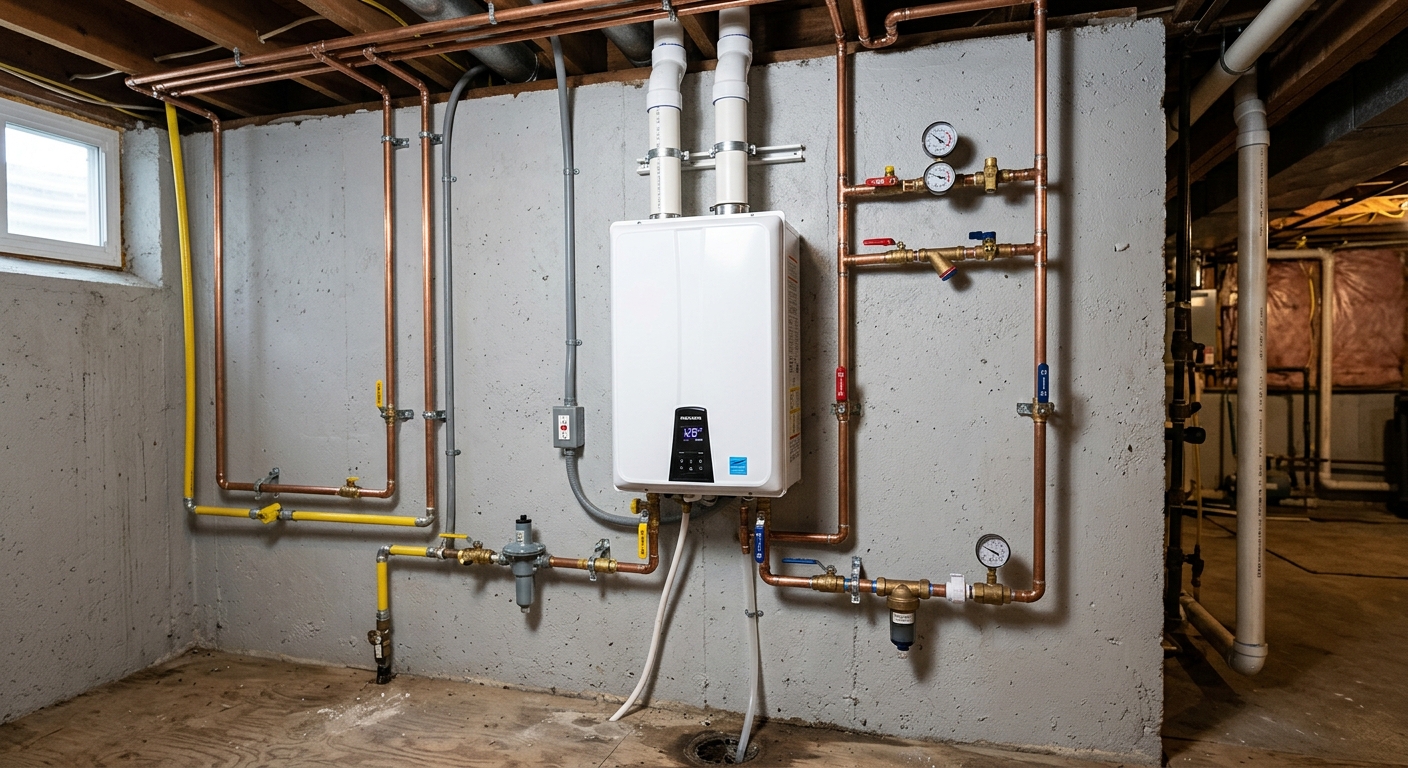
Tankless (on-demand) heaters give you endless hot water, but installation needs to be done right—older homes from the pre-1980 wave may need new gas lines or venting, and many homeowners underestimate that cost jump. Heat pump water heaters are the most efficient to run and can be a clear winner if you have a warm basement with enough space and ventilation. But: they cool the space they sit in (which matters in a finished basement during cold southwest PA winters), and compressor noise is enough to bother some. Not every location works.
Sizing is by first-hour rating: the amount of hot water available in peak demand (think back-to-back showers plus laundry). Every installation should have an expansion tank, an anti-leak pan, and proper drainage. In most breakdowns, the tank fails before electronics do—rust-through or bursting, not just a bad control board.
| Type |
Installed cost |
Service life |
Operating cost |
Best when |
| Gas tank, 40–50 gal |
$1,150–$2,700 |
8–12 yrs |
moderate |
existing gas line, simple swap |
| Electric tank, 40–50 gal |
$1,150–$1,850 |
10–15 yrs |
high |
no gas service, limited demand |
| Gas tankless |
$1,850–$2,700 |
18–25 yrs |
low-moderate |
remodel/new line, endless hot water needed |
| Heat pump water heater |
$1,850–$2,700 |
13–15 yrs |
lowest |
warm room, large household, space for air |
Vetting a plumber in Washington County
Washington County homeowners should start by confirming the contractor’s registration with the Pennsylvania Office of Attorney General (for contracts over $500, verify at hic.attorneygeneral.gov). But more is required. Plumbing licensing is municipal, so always ask if their credentials cover Carroll or your specific town—don’t rely on a generic “licensed and insured” claim. Ask for an insurance certificate with your property named, and check workers’ compensation status through WCAIS (wcais.pa.gov). Find out if the company sends its own crew or uses subcontractors, and how their emergency dispatch pricing works.
- Check HIC registration status on hic.attorneygeneral.gov
- Verify plumber is locally licensed in your municipality
- Request insurance certificate listing your address
- Confirm active workers’ comp with WCAIS
- Ask if work is done by employees or subs
- Get clear up-front emergency rates and trip charges
- Require written contract if job is over $500
- Ask if EPA Lead RRP applies (pre-1978 work)
- Request permit copy if required for your job
- Read what’s covered by the warranty (parts, labor, both?)
- Insist on before-and-after camera footage for sewer/repiping claims
- See recent reviews or Carroll area project references
A key red flag in the moderate-density local market: If anyone tries selling you a whole-house repipe or sewer line replacement with no before-and-after camera inspection and no pressure test, look elsewhere and get another opinion. Too many surprises are buried under Washington County lawns and floors.
Plumbing systems in Carroll homes
Carroll’s housing is a mix, but with 69.6% of homes built before 1980, old-school copper or galvanized supply lines are common. In subdivisions from the 1980s–2000s, you’ll usually find builder-grade copper inside the house, often transitioning to plastic (PEX) on later repipes. Some homes still have cast iron drains and clay sewer laterals—especially in neighborhoods dating back before 1960, when clay tile was the go-to. Water service lines can be copper, plastic, or—with luck, rarely—old lead in the City of Washington; the township areas trend modern, but it’s still worth checking at the meter curb box.
In many older Carroll homes, the original water heater may have already been swapped out twice. In newer subdivisions, you’ll see “original” water heaters lasting until about the 12–15-year mark before rust or leaks force replacement. Polybutylene was less common here than in the deep South, but if your home was built in the late 1980s or early 1990s, it’s worth confirming supply pipe type before any major investment. “Nothing to worry about” rarely applies—newer homes still see pinhole leaks at soldered joints, and older ones have supply pipes that corrode from the inside out. Drain and vent stacks are often under-insulated in the oldest stock, which makes freezing more likely during deep winter snaps.
Detection methods and what they cost
Homeowners in Carroll should first check for hidden leaks with a simple, free meter test. Shut off every faucet, don’t run appliances, and look at your water meter—if the flow indicator keeps spinning, you’ve got a supply leak somewhere between the meter and a fixture inside.
When DIY signs point to a leak, professional plumbers have several detection tools. Acoustic listening devices can hear water where it shouldn’t be, particularly under slabs or inside wall cavities, for about $325–$600 depending on the job. Thermal imaging cameras, at a similar cost, pick up “cold spots” from water leaks behind drywall or under floors. In tough cases, tracer gas systems—injecting a safe, inert gas and using a sniffer—are used to pinpoint the source, with total diagnostic costs sometimes running $600–$1,150 if slab access or complex structures are involved.
Not every method fits every problem: slab leaks are best found with a combination of listening and tracer gas; wall leaks often show themselves with IR imaging. For isolated irrigation or outside lines, a mix of meter isolation and air pressure testing works best. If a plumber says they need to open walls before locating, get a second opinion—professional leak detection aims to minimize damage before repair.
Frequently asked questions — plumbing in Carroll
Are tree roots a common sewer problem in Carroll?
Tree roots are a frequent culprit in sewer backups across Washington County, especially in Carroll homes built before 1980. Older laterals here are often clay tile, which develop cracks at the joints over decades—roots slip in and expand, causing blockage and sometimes breaking the pipe completely. If you’re experiencing repeated backups or slow mainline drains, a camera inspection is the only way to know for sure. Clearing roots is typically done with augering or hydro-jetting, and this main line cleaning costs $200–$500 for a standard call. In severe cases, spot repairs (digging up and replacing a section) can escalate costs into the $1,900–$11,500 range. Prevention: avoid planting fast-growing trees near sewer routes and consider annual cleanouts if you’ve had problems before.
What does drain cleaning cost in Carroll?
In Carroll, main line drain cleaning for a single clog runs $200–$500 for a standard business hours call. This covers augering or snaking the pipe, and may include running a camera to confirm the blockage is gone if the plumber offers that as part of their package. Hydro-jetting is at the upper end (and above) if heavy roots or grease are present. For after-hours service, the same job can jump to $350–$800. If you’re only dealing with a single slow bathroom drain and the rest of the house is fine, you can likely save money by scheduling this work during regular hours. Remember: backups affecting more than one drain almost always signal a main line problem, and urgent service is a must if sewage is coming back up.
Who pays to replace a lead service line in Carroll?
The responsibility for replacing a lead water service line in Carroll is typically shared. Homeowners are usually on the hook for the portion from the property line to the house, while the water utility may handle the street-to-curb section in some areas. In the City of Washington, documented legacy lead services still exist. Replacement costs on the homeowner's side range from $5,300–$11,500 depending on length, material, and yard restoration. Some communities have cost-sharing or reimbursement programs for lead line removal, but these are not guaranteed, so call the Washington District water provider and your local township office to check current options before starting work.
How do I shut off the water to my house?
In nearly every Carroll home, the main water shutoff is in the basement—look for a round or oval-handled valve just inside where the main water line enters from outside. To shut it off, turn the handle clockwise until it stops; lever-style valves should be turned perpendicular to the pipe. Every sink and toilet also has a small shutoff close to the wall (angle stop). Knowing how to turn off these valves can turn what seems like an emergency—a burst pipe or major leak—into a scheduled repair, saving you from emergency rates like $600–$1,150 for immediate dispatch. It’s smart to test shutoffs now so they don’t freeze in place when you need them most.
How deep do water lines need to be buried in Carroll?
Burial depth for water lines in Carroll and the rest of Washington County is governed by local frost depths due to frequent freeze-thaw cycles. Southwestern Pennsylvania’s required frost depth is 36 inches. That means any new water service line should be buried at least three feet deep to avoid winter freezing and pipe damage. If a plumber proposes a water service line replacement (typically costing $5,300–$11,500) or spot repair, make sure this depth is observed—or you’ll risk paying twice if frost heave takes out a shallow line a year or two down the road. Always verify proper permitting for new service installs, too.
Why do plumbers charge a diagnostic fee?
Plumbers in Carroll, like everywhere in Washington County, deal with homes built across at least five decades—sometimes with multiple remodels or hidden surprises behind the walls. Diagnostic fees (often $89–$199, and typically rolled into the repair if you go ahead) cover the cost of driving to your home, assessing the real cause, and using specialized tools (from basic meters to inspection cameras). For emergency calls (like a burst pipe repair, costing $600–$1,150 after hours), the fee can be higher, factoring in overtime and trip charges. Upfront diagnostic fees are a sign the contractor is running a legitimate business and not burying costs elsewhere in the job.
Does Pennsylvania license plumbers at the state level?
No—Pennsylvania does not license plumbers at the state level. In Carroll and the rest of Washington County, plumbing licensing is municipal. This means plumbers must be registered or licensed with your specific city or township, not just anywhere in the state. For jobs over $500, they must also register as Home Improvement Contractors (HIC) with the Pennsylvania Office of Attorney General, which you can verify yourself online. If you’re hiring for a major repair (e.g., whole-house repipe, which can cost $3,400–$8,200), check both local licensing and HIC status, and don’t be fooled by statewide claims with no local credentials.
Is a water softener worth it in Carroll?
Water hardness varies in and around Carroll, but it’s generally rated “moderate” by the Washington District public water supplier. That means a softener is optional—worth it only if you notice significant scale buildup on fixtures, cloudy dishes, or have frequent appliance failures. A softener can extend the life of a new water heater (replacement is $1,150–$2,700) if you have exceptionally hard water, but don’t expect huge savings if scaling isn’t visible. If you’re on a private well, test for hardness and iron before investing. For most homes on public supply here, a softener is a nice-to-have, not a must-have.
What causes low water pressure in Carroll homes?
Low water pressure in Carroll homes is almost always traced to one of three culprits: old, corroded galvanized supply pipes (common in homes built before 1980); mineral buildup in shutoff valves; or issues in the municipal supply. If you have original galvanized pipes, the flow drops as scale builds inside, and it may be time for a partial or whole-house repipe—costs here range from $3,400–$8,200. In newer homes, look to pressure-reducing valves near the main shutoff, or simple debris in aerators and showerheads. If the problem impacts all fixtures, start by calling the water company to rule out area-wide issues before spending on plumbing work.