What plumbers charge in Dover
In Dover, the cost of plumbing repairs and replacement can swing widely depending on the urgency and complexity of the job. Most homes here are detached single-family houses (64.7%) with a high homeownership rate (86.3%), and many properties trace back to York City’s housing stock, which largely dates 1900–1950. That era puts a lot of galvanized steel still in service, which is notorious for pressure loss and corrosion, pushing many owners toward copper or PEX repipes and the accompanying restoration. The type of pipe in your walls determines not just when you’ll need work, but what kind, and how disruptive—and expensive—it’ll be.
Emergency calls command higher prices than planned projects, sometimes double. For example, a typical burst pipe repair during a winter cold snap costs far more after-hours than the same job on a weekday when the water can be shut off and work sequenced. Every price for repairs, heater replacements, or drain cleaning carries an “emergency” premium when you can’t wait.
| Service |
Scope |
Emergency rate |
Standard rate |
| Emergency repair — burst pipe |
locate, open, repair section, restore service |
$600–$1,200 |
$350–$1,200 |
| Water heater replacement (gas, 40–50 gal) |
remove old, install, test, haul away |
$1,850–$2,800 |
$1,200–$2,800 |
| Drain cleaning — main line |
augering or hydro-jet, camera if needed |
$350–$800 |
$200–$500 |
| Sewer line spot repair |
excavate or reline a failed section |
$1,950–$12,000 |
$1,950–$12,000 |
| Whole-house repipe |
replace supply lines throughout, patch and finish |
$3,400–$8,400 |
$3,400–$8,400 |
| Water service line replacement |
street to house, excavation and restoration |
$5,400–$12,000 |
$5,400–$12,000 |
Estimates for a typical Dover home. Access difficulty and pipe material move these figures more than anything else.
When to repipe a Dover home
Deciding to repipe a Dover home isn’t about guesswork—it’s about patterns. If you’ve had two or more leaks from the same type of pipe (especially galvanized or polybutylene) in three years, that’s not coincidence. That’s the pipe telling you its time is up. Other signals include whole-house pressure drop (not just at one faucet), brown or red water on the first morning draw, visible rust or crusty joints in the basement, and persistent pinhole leaks.
Homes in York City and Dover with original 1900–1950s plumbing usually have galvanized steel, which narrows over decades until pressure is a trickle. Copper is durable, but aggressive water can eat through in pinholes. PEX now dominates new installs; it’s less labor-intensive but needs careful handling. Deciding between a whole-house and a partial repipe is partly a math problem, partly a disruption calculation. Older homes with plaster walls see repair costs spike after the plumbing—patching and finishing may rival the pipe job itself.
If you spot one isolated leak on modern copper or PEX and the walls are easy to open, fix that one. But if the leaks keep coming, or if your main supply is old galvanized, consider a full repipe to reset the clock and end persistent repairs. Don’t forget: drywall and painting is part of the real cost here.
| Situation |
Recommendation |
Cost |
Reasoning |
| One leak, accessible, modern pipe |
Spot repair |
$350–$1,200 |
Isolated failure, no systemic risk |
| Two or more leaks in 3 years |
Partial repipe |
$3,400–$5,600 |
Recurring leaks signal failing material |
| Galvanized supply, pressure loss |
Full repipe |
$3,400–$8,400 |
Internal rust narrows pipe, leaks follow |
| Polybutylene anywhere in the house |
Full repipe |
$3,400–$8,400 |
Known failure risk, often not covered by insurers |
| Cast iron drain with root intrusion |
Camera, then reline or replace |
$1,950–$12,000 |
Roots and corrosion can’t be patched out |
| Suspected lead service line |
Test, then replace the lateral |
$5,400–$12,000 |
Full replacement ends risk permanently |
What a plumbing quote should contain
Every plumbing quote in Dover should show you how you’ll be billed, what you’re really paying for, and who stands behind the work. There are two basic ways you’ll see jobs priced: flat rate (you pay the quoted price regardless of hours used) and time-and-materials (you pay for the actual labor and materials used). Flat rate buys you certainty and puts risk on the contractor, but can cost a little more if things go smoothly. Time-and-materials can save you money, but has no ceiling on bigger or unknown jobs. The key is clarity upfront—you should always know which applies.
Check for a diagnostic fee on service calls, and if it’s credited against final work. The quote should state the actual scope (what’s opened or restored), not just a lump sum. Permits, if required, should be called out and priced. Restoration costs (like drywall or paint) are often excluded by default—make sure yours is clear, because in older Dover homes plaster work is not cheap. Finally, separate out warranty terms for labor and parts, and ask about after-hours surcharges before work begins.
| Line item |
What to look for |
Red flag if… |
| Billing model |
flat rate or hourly, stated up front |
unstated |
| Diagnostic fee |
amount, and whether it credits |
vague |
| Scope |
what is opened, repaired and restored |
price with no scope |
| Restoration |
drywall and finish explicitly in or out |
silent |
| Permit |
included and priced |
'not needed' |
| Parts |
brand and model for fixtures |
'standard fixture' |
| Warranty |
labour period stated separately |
parts only |
Water heater replacement decisions
Dover homeowners have three main choices for water heaters: gas tank, electric tank, and either gas tankless or heat pump. Each has pros and cons, and the “upgrade” isn't always worth it.
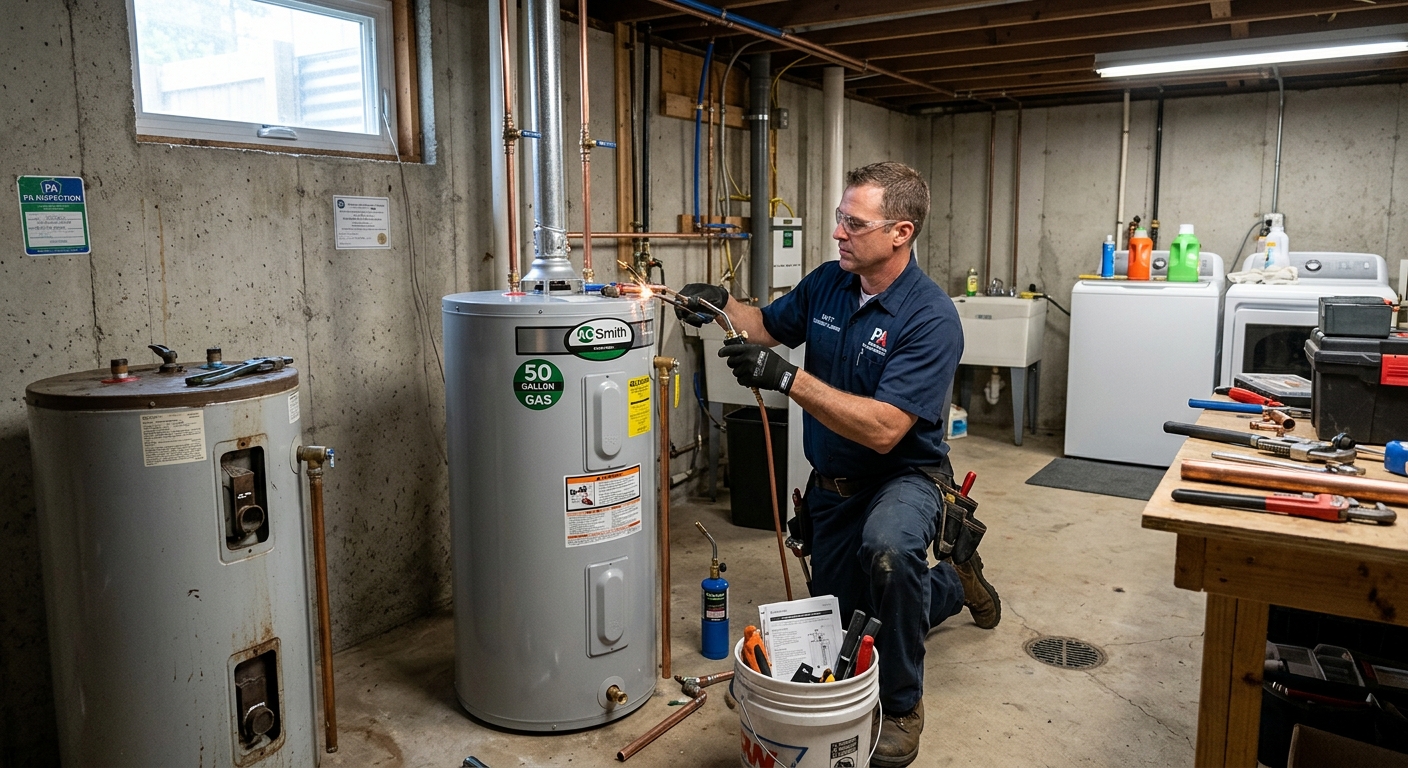
Standard tank heaters (gas or electric) are economical to install (typical $1,200–$2,800), but expect only 8–12 years (gas) or 10–15 years (electric) before the tank gives out. Tankless models deliver endless hot water and last roughly 18–25 years, but in Dover homes with older gas lines or flues, be prepared—new venting and upgraded gas lines can nudge the bill up toward $2,800. Heat pump water heaters have the lowest annual operating cost but cool the room they’re in—a finished basement or utility room in Dover can get uncomfortable, and they’re noisy enough to matter there.
Don’t just pick gallons off the label—size by first-hour rating (how much you can draw in the key morning rush). Always budget for an expansion tank and a drain pan, because insurance won’t care if a leak started slow. In almost every case, failure is tank corrosion, not controls.
| Type |
Installed cost |
Service life |
Operating cost |
Best when |
| Gas tank, 40–50 gal |
$1,200–$2,800 |
8–12 yrs |
moderate |
existing vent/gas, moderate usage |
| Electric tank, 40–50 gal |
$1,200–$1,850 |
10–15 yrs |
high |
no gas available, lower upfront budget |
| Gas tankless |
$1,850–$2,800 |
18–25 yrs |
low-moderate |
long showers, willing to upgrade gas/vent |
| Heat pump water heater |
$1,850–$2,800 |
13–15 yrs |
lowest |
unfinished space, lower utility cost |
Verifying a Dover plumber's credentials
In Pennsylvania, there is no statewide plumbing license. Instead, each municipality sets its own requirements. That means a plumber licensed in York or Dover isn’t automatically licensed in Spring Garden Township—ask directly if they’re licensed for your municipality, not just “in Pennsylvania.” Spring Garden Township keeps its own plumbing license registry, so this question matters at a local level.
If work is more than replacing a fixture in the same spot, a permit is often required, especially within York City and adjacent towns. New water heaters, repiping, or moving any plumbing must be inspected—check with your permit office if unsure. Legitimate contractors should be registered with the Pennsylvania Office of Attorney General for work over $500; you can verify their HIC registration at hic.attorneygeneral.gov.
Pennsylvania contractors must carry workers’ compensation insurance—verify coverage using the state’s WCAIS system (wcais.pa.gov). Also, written contracts are required by law for any job over $500, and you have a three business-day right of cancellation. Don’t sign if there’s no paperwork.
Water quality and what it does to your pipes
Dover and surrounding York County areas largely draw water from the York Water Company system, which supplies treated, tested water and is required to publish an annual water quality report. If you want specifics for your service area, you can request the latest report from the utility.
Water here tends to be moderately hard, which means scale builds up in water heater tanks and fixtures, shortening service life and efficiency. Hard water isn’t a crisis, but it does mean heaters, dishwashers, and valves wear out faster—some Dover homeowners install softeners, but with installation and ongoing salt costs, it usually only pays off if you see visible deposits or have chronic fixture issues. Copper pinholes are sometimes linked to more aggressive water chemistry, but aren’t chronic in this area. Whole-house filtration systems generally aren’t needed unless you have a specific issue; point-of-use filters for drinking water do the job for most.
A private well is another story—no one but you has responsibility for testing and treatment. Expect more expense, but don’t buy every gadget; test first, address only what’s found.
Galvanized, copper, PEX, cast iron
You can tell a lot about Dover’s plumbing by looking at what’s poking out in the basement or under the sink. York City’s old housing stock means plenty of homes still run galvanized steel, first used in the early 20th century. Galvanized pipes feel heavy, gray, and are threaded at the joints—a magnet will stick. When these pipes fail, it happens gradually: pressure drops first, then leaks.
Copper (introduced in the 1950s) is reddish, joined by solder. It can last decades, but pinholes will crop up—especially with aggressive or corrosive water. Polybutylene, used for a brief window (late 1970s–mid-90s), is often blue or gray plastic, with crimped aluminum bands at the joints. It’s failure-prone at fittings—if you spot it, budget to replace; many insurers won’t touch a home with it.
PEX (current standard, from about 2000 on) is flexible plastic tubing, usually red, blue or white, joined with brass or plastic crimp rings. As for drains, cast iron (black, heavy, a magnet sticks) is common in houses built before 1975. It’ll often last 60–75 years, but cracks or roots spell the end. Clay tile—sometimes visible at exterior sewer cleanouts—fails at the joints, inviting root intrusion. PVC/ABS is modern practice and should last decades if installed right.
| Material |
Typical era |
Failure mode |
Service life |
| Galvanized steel supply |
pre-1960 |
internal corrosion, pressure loss |
40–60 yrs |
| Copper supply |
1950s–present |
pinhole leaks, joint failure |
50–70 yrs |
| Polybutylene supply |
late 1970s–1995 |
fitting failure, sudden bursts |
unreliable |
| PEX supply |
2000s–present |
fitting or UV degradation |
40–50 yrs |
| Cast iron drain |
pre-1975 |
corrosion, cracking, scale |
50–75 yrs |
| Clay tile sewer lateral |
pre-1980 |
root intrusion at joints, offset |
50–60 yrs |
| PVC / ABS drain |
1970s–present |
joint separation, crushing |
50+ yrs |
Frequently asked questions — plumbing in Dover
Is Dover on combined sewers or septic?
Dover itself relies on the county’s mix of public sewer and private septic, as detailed in the county-specific facts. York City uses a separated sanitary and storm sewer system, so storm water and wastewater run in different pipes. But outlying homes in Dover Township and much of rural York County still use individual septic systems. If you’re buying a home here, always find out which applies before any plumbing work. If you need a sewer line spot repair or septic tank replacement, the price can run from $1,950–$12,000 depending on scope and access.
Does Pennsylvania license plumbers at the state level?
No. In Pennsylvania—including Dover and all of York County—there is no statewide plumbing license. Each municipality sets its own rules. If your plumber is working in Spring Garden Township, they’ll need a local license there, but the same may not be true in Dover Township or York City. You should also make sure they have a state-issued Home Improvement Contractor (HIC) registration if your job is more than $500, and verify it at hic.attorneygeneral.gov. Do not just ask “Are you licensed?”—always ask, “Are you licensed here?”
How much does sewer line repair cost in Dover?
Sewer line spot repairs in Dover run from $1,950–$12,000, with the most common projects falling closer to $5,400. Access is everything—if the line is deep, runs under a driveway, or needs trenchless technology, costs are at the high end. Simpler repairs for tree root intrusion or collapsed sections near the house are on the lower side. Make sure your quote spells out what’s being replaced and whether restoration of landscaping or hard surfaces is included, as these restoration costs can rival the repair itself.
Is trenchless sewer repair reliable?
Trenchless sewer repair (called pipe relining or bursting) is a good option in much of Dover, especially for 1950s–1970s homes with aging clay or cast iron lines—but only if the existing pipe is in decent enough condition to accept a liner. Modern trenchless methods, when installed correctly, have a service life comparable to new pipe. It’s not a fit for every problem, though: collapsed lines, severe offsets, or bellied sections may require full excavation. The cost is real—expect anything from $1,950–$12,000—but when you’re saving patios or mature plantings, the math often works.
How do I prevent frozen pipes in Dover?
With southern Pennsylvania’s hard freeze-thaw cycles and frost lines around 30 inches, frozen pipes are a winter hazard—especially in older Dover homes with less insulation. First, insulate pipes in crawl spaces, basements, and exterior walls. For problem spots, heat tape can help, but wiring needs to be done safely. On the coldest nights (winter design temp is 12 °F), let a trickle run from taps on pipes at risk. If you do freeze up, call a professional—thawing pipes recklessly can cause them to burst and stick you with a $600–$1,200 emergency repair bill.
What do I do if sewage is backing up?
In Dover, slow drains or a complete sewage backup is often due to root intrusion in older clay or cast iron lines. If all drains are slow or you see water around the basement floor drain, stop running water immediately and call a professional for a main line cleaning. Expect a drain cleaning visit to cost $200–$800 depending on severity and camera inspection needs. Routine clearing can prevent the need for full line replacement, which is much more expensive.
Who owns the sewer lateral, me or the city?
In Dover and most of York County, including York City, the homeowner owns the sewer lateral from the house to the property line or main. Any repairs or replacements on your property are your responsibility. If your old clay tile line fails, you’ll pay for the repair—which can run $1,950–$12,000 depending on depth and length. The city or township only maintains the main in the street.
Why do all my drains drain slowly at once?
If every drain in your Dover home is slow at the same time, it’s usually a clog or failure in the main drain—not a fixture problem. In older homes with cast iron or clay pipes, scale and roots are typical culprits. The fix is usually a mainline cleaning ($200–$800), sometimes with a camera scope to confirm the cause. Don’t waste money on bottle chemicals—they rarely cut through heavy build-up or roots, and can damage pipes.
What does emergency plumbing cost in Dover?
Emergency plumbing repair rates in Dover are higher than scheduled work—especially nights, weekends, or holidays. A typical burst pipe repair is $600–$1,200, while drain clearing can run $350–$800 depending on access and urgency. These rates reflect after-hours labor and the immediate need to restore service. If you can safely shut the water off and wait until morning, your costs will drop to standard rates.