Plumbing costs in Easttown — 2026
Easttown’s plumbing costs are shaped by its housing era and materials—details that matter more here than in many places. With 64.9% of homes built before 1980 and most properties being single-family (U.S. Census Bureau, ACS 2024), repairs and upgrades commonly involve aging copper or old PVC pipes. Large tracts of housing built from 1960 to 2000 mean many of the main repairs in Easttown are copper-to-PEX repipes and fixing worn-out PVC sewer laterals. That drives up frequency—and price range—of major jobs.
In Easttown, the biggest swing in plumbing price comes from whether the work is an emergency call. If a pipe bursts at 2 a.m. or you have water pouring through the ceiling, the same repair will cost more than if it’s scheduled for regular hours. That’s because after-hours dispatch, overtime labor, and emergency diagnostics all come at a premium in Chester County’s dense suburban market.
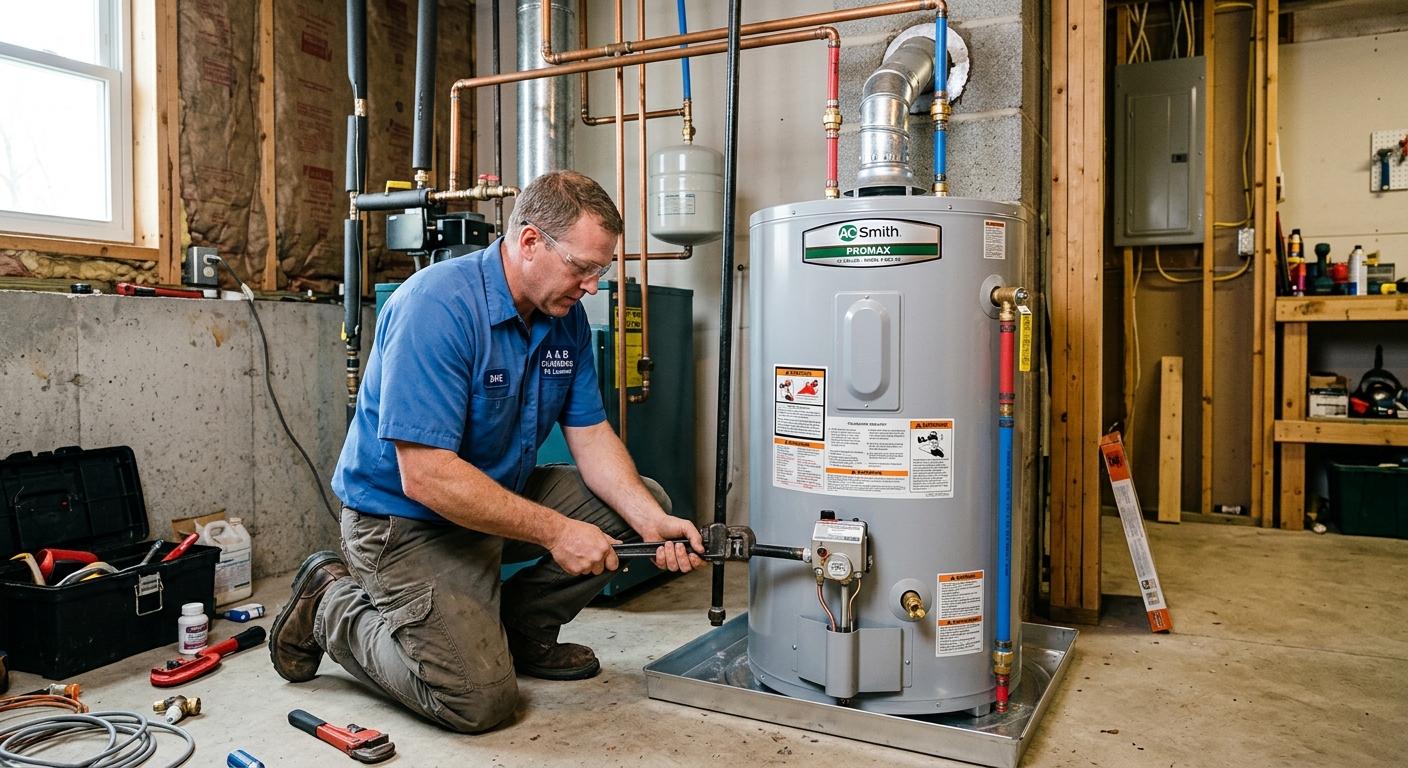
The table below gives 2026 rates typical of Easttown, based on labor, materials, and access for these house types. Emergency premiums can double the bill, especially after normal work hours or on Sundays. Some fixes are always at emergency pricing, some are scheduled, and a few could go either way. For major repairs, like whole-house repipes or new service lines, material and how easily your plumber can access runs beneath finished space matter more than anything else.
| Service |
Scope |
Emergency rate |
Standard rate |
| Emergency repair — burst pipe |
locate, open, repair section, restore service |
$750–$1,550 |
$450–$1,550 |
| Water heater replacement (gas, 40–50 gal) |
remove old, install, test, haul away |
$2,400–$3,600 |
$1,550–$3,600 |
| Drain cleaning — main line |
augering or hydro-jet, camera if needed |
$350–$800 |
$200–$500 |
| Sewer line spot repair |
excavate or reline a failed section |
$2,600–$15,500 |
$2,600–$15,500 |
| Whole-house repipe |
replace supply lines throughout, patch and finish |
|
$4,500–$11,000 |
| Water service line replacement |
street to house, excavation and restoration |
|
$7,100–$15,500 |
Estimates for a typical Easttown home. Access difficulty and pipe material move these figures more than anything else.
Who is allowed to do plumbing work in Pennsylvania
Unlike some states, Pennsylvania does not have a statewide plumbing license. Instead, plumbing is licensed—if required—at the municipal level. What this means for an Easttown homeowner is that a plumber licensed in Philadelphia or Pittsburgh may not be recognized at all in surrounding Chester County townships. For Easttown and neighboring areas, you must ask if your plumber holds a registration or approval from your municipality, not just “are you licensed.” Westtown Township and similar Chester County townships issue their own contractor registrations, and without that, a plumber cannot legally pull permits for your job.
For work connected to public water or sewer—new lines or replacements—permits are required in many Chester County townships. In West Goshen Township, any new or replacement plumbing tied to the public system needs a township plumbing permit and inspection by local code officials. Each municipality enforces the Pennsylvania Uniform Construction Code (UCC) as adopted from the IRC, but permit rules are set locally.
If your contract for plumbing work is over $500, the plumber must have a Pennsylvania Home Improvement Contractor (HIC) registration. You can verify this at hic.attorneygeneral.gov. Insurance and workers’ compensation are both mandatory for employers. You can confirm current coverage at the state’s WCAIS system (wcais.pa.gov). Always get documentation that specifically names your property for liability and compensation coverage. Finally, any disturbance of painted surfaces in homes built before 1978 requires an EPA-certified lead renovator—verify at certifiedrenovatorsearch.epa.gov.
Choosing a plumbing contractor
Hiring a plumber in Easttown means checking credentials more closely than in states with a single licensing system. With licenses and registrations set by each township, always confirm that your contractor is recognized locally—being HIC registered is state-mandatory for jobs over $500, but does not substitute for a township plumbing registration where one is required. Proof of general liability and workers’ compensation must be current and name your address. Ask if they use their own W-2 employees or subcontractors (where risks are higher).
Confirm what’s included if you need emergency work—after-hours rates must be disclosed up front, so you’re not left guessing. Transparency on pricing, personnel, and process is key in a market like Chester County, where the suburban density means competition is strong, but so is the chance to get an out-of-town contractor who cuts corners. A job like a whole-house repipe or a sewer line replacement without camera footage or a pressure test is a red flag worth walking away from.
- Is the plumber HIC-registered (check hic.attorneygeneral.gov)?
- Do they have municipal registration for Easttown or your township?
- Are current insurance and workers’ comp certificates provided, naming your property?
- Will the lead technician be present on-site, or do they send subcontractors?
- Does the quote break down material brands and workmanship warranties?
- Are emergency after-hours charges disclosed before dispatch?
- Does your quote include permit fees and final inspection?
- Is clean-up and finish restoration clearly listed in the scope?
- Do you get a camera inspection or test for sewer line jobs?
- Is payment schedule tied to milestones, not just time?
- Are all assumptions and potential extras listed in writing?
- Can they show work for homes built in your era (pre-1980 vs. newer)?
Red flags in this area include high-pressure sales on major repipes, vague “standard fixture” descriptions, jobs scoped without onsite diagnosis, and any sewer replacement “found” without camera proof or pressure testing. A dense suburban market makes it easy to check local reputation—use it.
Flat rate versus time and materials
Most Easttown plumbers offer either a flat-rate contract (you pay a set amount for the job, no matter how long it takes) or a time-and-materials agreement (you’re billed for the actual hours on site, plus parts). Flat rate gives the most price certainty, with the contractor taking on risk if the job runs long. Time-and-materials may cost less for simple repairs, but on trickier houses—especially older ones with hidden issues—it can become open-ended.
The main point: neither approach is a scam. Problems only arise when customers are left unclear on which model is being used. Always ask if the initial diagnostic fee credits toward the repair. For every quote, get the scope—which parts of your home will be opened, what walls will be restored, what is explicitly left unfinished. Permits should always be included in writing, with restoration work (drywall, flooring) listed as included or not. Ask how warranty coverage is split between parts and labor. Emergency and after-hours rates should be disclosed in advance.
| Line item |
What to look for |
Red flag if… |
| Billing model |
flat rate or hourly, stated up front |
unstated |
| Diagnostic fee |
amount, and whether it credits |
vague |
| Scope |
what is opened, repaired and restored |
price with no scope |
| Restoration |
drywall and finish explicitly in or out |
silent |
| Permit |
included and priced |
'not needed' |
| Parts |
brand and model for fixtures |
'standard fixture' |
| Warranty |
labour period stated separately |
parts only |
The leak you can hear but can't see
Before you call anyone, do this free test: turn off every faucet and appliance, then check your water meter. If the dial is spinning, you’ve got a hidden supply-side leak somewhere in your Easttown home. This simple step can save a costly service call if the problem is really just a leaky toilet or a faucet not fully closed.
When professional leak detection is needed, several methods are available. Acoustic listening for pressurized water leaks inside walls or slabs typically runs $350–$800. Thermal imaging cameras can spot warm or cold spots from leaking hot or cold pipes, especially in finished walls. Tracer gas is used for the toughest cases—gas is introduced into the lines, and a detector sniffs out its escape route (usually for slab leaks or buried lines). For buried lines or slab foundations, plan on higher fees closer to $800. Slab leaks, leaking irrigation lines, or wall-cavity leaks should always be located non-destructively before anyone starts cutting drywall: if a plumber starts tearing into walls or floors without using meters or cameras first, that’s backwards.
In Easttown’s housing stock, leaks are most common at copper joints and around old shutoff valves—especially in homes from the 1960s–1990s. Pinpointing the source before opening walls saves money and unnecessary repairs every time.
When to call now and when to wait until Monday
Emergency plumbing service always costs more. In Easttown, an emergency repair for a burst pipe will typically run $750–$1,550—often double the standard rate—because you’re paying for immediate dispatch, possibly after hours, plus overtime labor. The premium also covers the fact that diagnosis and material runs all happen under time pressure, not ideal for careful troubleshooting.
Call now if you have:
- Active flooding (water coming through the ceiling or floor)
- No water anywhere in the house (not just one fixture)
- Sewage backing up into tubs or toilets
- A gas smell or hissing from the meter or near the water heater
If it’s any of these, don’t wait—shut off the water at the main (usually a round wheel or lever where the pipe enters your basement wall or crawlspace). Then turn off your water heater (gas or electric) and call for help.
But if you have a slow leak under a sink, just one slow drain, a running toilet, or visible but not spreading water stain, you can usually wait for regular business hours and avoid the premium pricing. That turns a $750 emergency call into a $450 scheduled repair. Every Easttown homeowner should know where their main shutoff valve is and how to use it—it’s the cheapest insurance there is.
Lead service lines in Easttown
Easttown draws water service from Aqua Pennsylvania’s southeast division and part of the West Chester Area Municipal Authority. According to Aqua Pennsylvania’s 2024 inventory, less than 1% of active service lines in Chester County remain lead, but that still means some Easttown homes may have them.
The supply line from the street to your house likely has two owners: the utility owns the street-to-curb section, and the homeowner owns from curb to house. Replacements may only address part of the line—fixing just the utility side or the homeowner side. Partial replacement, however, can temporarily increase lead exposure by disturbing pipe scale, so replacement should be all-at-once wherever possible.
To check if your service line is lead, find where it enters before your water meter: scratch the pipe with a coin and see if it reveals a shiny, dull gray (that’s lead), and use a magnet—lead won’t stick. If your house dates from before 1980, especially pre-1950, do this test. For verification or replacement, ask your water provider directly—don’t assume you’re covered by a local programme. Some utilities offer cost-sharing for replacements, but you must inquire directly.
Replacing a water service lateral, curb to house, in Easttown typically runs $7,100–$15,500. If a whole-house repipe is needed to replace all interior lead, expect $4,500–$11,000. Your provider can confirm if your line is on their lead inventory—always ask for written results before any contract is signed.
Frequently asked questions — plumbing in Easttown
Does insurance cover a burst pipe in Easttown?
Homeowners insurance in Easttown will typically cover sudden and accidental water damage from a burst pipe, as long as it wasn’t due to homeowner neglect (like failing to heat a home during a freeze). The policy generally pays for water damage to walls, floors, and belongings, but not the plumbing repair itself. For example, if a pipe bursts in January and soaks your finished basement, insurers cover water damage cleanup and drywall, but you’ll pay the plumber—costs for the repair itself usually run $450–$1,550 depending if it's an emergency. Always take photos and start mitigation (such as turning off the main) right away. If you’re unsure, call your insurance agent before hiring a restoration company or plumber. Never agree to waive your deductible—it’s against Pennsylvania law.
What do I do about a burst pipe right now?
Turn off the main shutoff valve, usually found where your water line enters the house—often in the basement on an outside wall. Then shut off your water heater. Next, open a faucet on the lowest floor to drain down the pipes. This limits damage. Do not start cutting drywall or pulling down ceiling sections; leave that to a professional. Call an Easttown-area plumber for emergency repair. Costs for this service will likely be $750–$1,550 if after-hours. Waiting until business hours, if possible, brings the bill down to $450–$1,550. Have photos ready for your insurer and keep all receipts. If water is flowing onto electrical, leave the power off and call both a plumber and an electrician.
What does discoloured water on first draw mean?
Discoloured water from your tap on first draw in Easttown homes, especially yellow or brown, usually means harmless iron or sediment that’s built up in older galvanized or iron pipes, common in some pre-1980 housing here. Run the water for several minutes to see if it clears. However, if you see white particles, blue-green stains, or a metallic taste, test for copper or lead—which calls for a plumber and possibly a water service line replacement. That job usually runs $7,100–$15,500 curb to house. Always check with your water utility if the issue persists, and ask about the latest service line material inventory for your address.
What does emergency plumbing cost in Easttown?
In Easttown, emergency plumbing repairs—like stopping an active leak, restoring flow after a total blockage, or fixing a broken water heater at night—generally cost more than scheduled work, sometimes double. For example, the typical emergency rate to repair a burst pipe here is $750–$1,550, while the same fix during regular hours might be $450–$1,550. Charges rise for immediate response, overtime labor, and after-hours dispatch. For jobs like drain clearing or water heater replacements on nights or weekends, expect a premium. Always ask for the emergency rate and what’s included before authorizing any work.
How much does sewer line repair cost in Easttown?
Sewer line spot repairs in Easttown generally fall between $2,600–$15,500, with the cost depending on line depth, access, and whether the repair is inside or beyond your property line. Most local replacements target PVC or terra cotta sewer laterals from the 1960–2000 building boom. Camera inspection before any quote is vital—no reputable contractor should offer a price without it. Repairs in a finished basement or beneath landscaping will run higher toward the upper end of the range. A simple spot dig may cost far less if access is easy and no restoration is needed.
Is trenchless sewer repair reliable?
Trenchless sewer repair is widely used in Easttown, especially for PVC or old terra cotta lines, and is considered reliable when done by a qualified contractor. This technique relines or bursts pipe beneath the yard or driveway, minimizing excavation. Expect to pay the same broad range—$2,600–$15,500—depending on depth and complexity. Trenchless isn’t right for every line; it can’t fix major pipe collapses or severe misalignments. Always demand before-and-after camera footage and written warranty terms. In some cases, traditional open trench repair may be the only safe approach, but for many homes here, trenchless is faster and less invasive.
What do I do if a pipe is frozen but not burst?
If you suspect a frozen pipe in your Easttown home—maybe one faucet won’t run but others are fine—first, gently open the faucet. Then warm the pipe gradually with a hair dryer or heat tape, working from the faucet back toward the coldest wall or crawlspace. Don’t use an open flame. Leave the main water supply on so you’ll hear water flow resume and can spot a leak if the pipe cracks when thawing. If the pipe is in a spot you can’t reach, call a plumber for professional help; typical thawing service costs in the emergency range (about $750–$1,550) if it’s after hours. Don’t wait until it bursts.
Are tree roots a common sewer problem in Easttown?
Yes, tree roots are a frequent cause of sewer line blockages in Easttown, mainly because many older homes have vitrified clay or PVC laterals from street to house. These pipes develop separations at joints over time, letting roots enter (especially in areas with mature trees planted near driveways or rear yards). Clearing a root blockage professionally with augering or hydro-jetting runs $200–$800 depending on emergency callout. If the line is blocked repeatedly, camera inspection followed by spot repair is wise—replacement may cost $2,600–$15,500 for a section.
Do I need a permit for plumbing work in Easttown?
In much of Chester County—including Easttown—permits are required for plumbing connected to public water or sewer, especially for new installations or replacements. Each township sets its own rules, so always check before hiring a plumber; in West Goshen Township, for example, a permit is mandatory for any public water or sewer work. The inspector comes from your township’s code office. If the job is over $500, the contractor must hold a valid Home Improvement Contractor registration (verify at hic.attorneygeneral.gov), and their insurance and workers’ compensation should be up-to-date and cover your property. Failing to get proper permits can void warranties and stall resale.