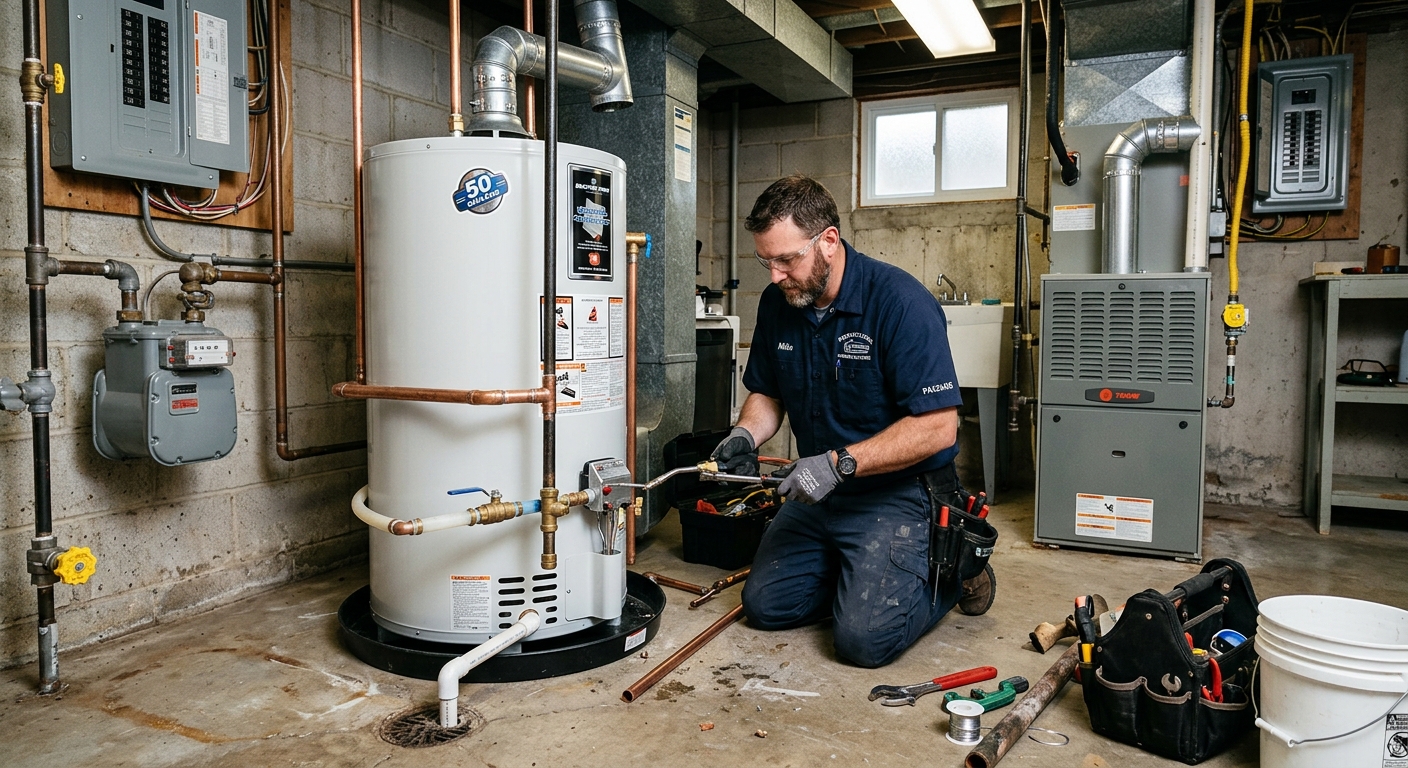
What plumbers charge in Summit
In Summit, the cost of plumbing work depends heavily on whether you’re facing an active emergency or have time to plan. This is especially true in older homes: more than a third of Summit homes were built before 1980 (U.S. Census Bureau, ACS 2024), and with so many owner-occupied (81.1%), residents are usually the ones footing the bill for repairs. The era when your house was built is critical—it predicts your pipe materials, and those materials predict both the types of problems you’ll face and how costly they are. Erie and Millcreek, with their significant 1900–1950 housing stock, see a lot of calls for burst galvanized supply lines or cast iron waste pipes that have reached the end of their useful life.
Emergency calls are always more expensive because plumbers have to drop everything to get there, often after hours or on weekends. For non-emergency work, you can schedule at a lower rate and sometimes get a better repair, as the plumber isn’t racing the clock or working with water spraying everywhere. The following table shows what you should expect to pay for common jobs in Summit, with different costs for emergencies versus planned work:
| Service |
Scope |
Emergency rate |
Standard rate |
| Emergency repair — burst pipe |
locate, open, repair section, restore service |
$600–$1,150 |
$325–$1,150 |
| Water heater replacement (gas, 40–50 gal) |
remove old, install, test, haul away |
$1,850–$2,700 |
$1,150–$2,700 |
| Drain cleaning — main line |
augering or hydro-jet, camera if needed |
$350–$800 |
$200–$500 |
| Sewer line spot repair |
excavate or reline a failed section |
$1,900–$11,500 |
$1,900–$11,500 |
| Whole-house repipe |
replace supply lines throughout, patch and finish |
|
$3,400–$8,200 |
| Water service line replacement |
street to house, excavation and restoration |
|
$5,300–$11,500 |
Estimates for a typical Summit home. Access difficulty and pipe material move these figures more than anything else.
Is your water line lead? How to find out
In Summit and across Erie County, thousands of older homes get their water from Erie Water Works, which serves most of the urbanized area and some nearby townships. Erie Water Works has reported a high number of inventoried lead service lines still in use, so checking yours is important for health and resale value.
The water service line has two parts: the utility’s side (usually from the main in the street to the curb box or property line) and the homeowner’s side (from there into your basement). Most replacement programs only cover the utility-owned side, leaving homeowners responsible for the rest. If you want to check your own line, locate where the pipe enters your basement. Scratch it gently with a key or coin—if it’s lead, it will turn shiny silver. Try a magnet: if it sticks, you’re looking at galvanized steel rather than lead.
Partial replacement is sometimes riskier than none in the short term. When part of a lead line is replaced, the protective mineral scale inside gets disturbed, which can actually increase lead levels in your water for weeks or months after the work is done.
To check whether Erie Water Works believes your property is affected, look up their public service line inventory online or call their customer service for clarification. If there’s any confusion or if you need their help with any program, always reach out directly—don’t assume coverage or cost sharing. A full water service line replacement in Summit typically falls in the $5,300–$11,500 band, similar to other involved jobs like a sewer lateral spot repair ($1,900–$11,500). If you confirm you have lead, get quotes for full replacement on your side before the problem becomes urgent.
The point where patching stops making sense
In Summit, knowing when to stop patching and start planning a repipe comes down to evidence—not guesswork. If you’ve had two or more leaks on the same type of pipe in three years, especially with original galvanized or cast iron, it’s not just bad luck—it’s a system wearing out. Clues include falling pressure in every faucet, not just one; water that comes out brownish after sitting overnight; visible white or green corrosion around pipe joints; and multiple tiny pinholes that get “fixed” only to spring up elsewhere.
With Summit’s mix of older homes (many from 1900–1950 in Erie and Millcreek as well), there’s a population of houses where galvanized pipes and cast iron waste lines are overdue for replacement. Today’s choices are either copper or PEX; copper costs more up front but lasts the longest, while PEX is flexible and easier to route but requires care near heat.
The biggest cost that surprises homeowners here is the drywall and plaster work—the patching, sanding, and repainting after plumbing is done. In homes with original plaster, finish work can approach the price of the plumbing itself. You can spot-repair a single accessible leak for $325–$1,150, but a true repipe—addressing all problem areas—runs $3,400–$8,200 for most homes in Summit.
| Situation |
Recommendation |
Cost |
Reasoning |
| One leak, accessible, modern pipe |
Spot repair |
$325–$1,150 |
Singular event, not a pattern |
| Two or more leaks in 3 years |
Partial repipe |
$3,400–$5,500 |
Repeated failure—system issue |
| Galvanized supply, pressure loss |
Full repipe |
$3,400–$8,200 |
Obstructed pipe throughout home |
| Polybutylene anywhere in the house |
Full repipe |
$3,400–$8,200 |
Material recall—unsafe over time |
| Cast iron drain with root intrusion |
Camera, then reline or replace |
$1,900–$11,500 |
Root growth indicates system breach |
| Suspected lead service line |
Test, then replace the lateral |
$5,300–$11,500 |
Health hazard and resale risk |
Who is allowed to do plumbing work in Pennsylvania
Plumbing is not licensed at the state level in Pennsylvania. Instead, licensure is handled municipally—each city or township decides who is qualified. This means a plumber could be approved to pull permits and do work in the City of Erie but might hold no credential for Summit or its neighboring townships. When you ask a plumber if they're "licensed," the real question is whether they're authorized to work in your municipality—not somewhere else.
In this part of Erie County, each township, including Summit, operates its own code office to issue permits and perform inspections. In the City of Erie, any addition, alteration, replacement, or relocation of plumbing piping needs a building permit, while jobs like reglazing a tub don’t require one. Always ask your plumber or the local office directly if your specific job needs a permit.
Beyond permits, Pennsylvania law requires any home improvement contract over $500 to be in writing under the Home Improvement Consumer Protection Act (HICPA). Confirm registration at the hic.attorneygeneral.gov lookup. Workers’ compensation coverage is mandatory for all employers and can be checked through the state WCAIS system (wcais.pa.gov). This protects you as a homeowner in case of injury.
Summit's housing stock and its plumbing
Summit’s homes are mostly single-family, with a high homeownership rate and just under 40% built before 1980 (U.S. Census Bureau, ACS 2024). That means Summit is a mix of classic midcentury and newer suburban builds. In homes constructed before 1980, you’ll often encounter galvanized steel or copper supply lines, with cast iron or possibly clay tile for waste lines and sewer laterals. These materials have been workhorses, but by now, galvanized and cast iron are well into their vulnerable years—expect scale build-up, corrosion, and the risk of leaks or sewage backups.
For the newer end of Summit’s housing stock, you’re likely to see original builder-grade fixtures and supply lines made of copper, PEX, or in some 1980s and early 1990s homes, polybutylene (a material now known to fail). In these homes, water heaters are often near or just past their first life expectancy—if your heater is original to a 1990s or 2000s build, it’s probably due for replacement. Clay sewer laterals remain likely outside the core city, so regular camera inspections are smart even in newer construction.
Bottom line: Newer houses mean fewer surprises in some ways, but no house in Summit is immune—especially with the area’s tough winters and heavy Lake Erie snow load stressing foundation walls and underground lines.
Comparing plumbing estimates in Summit
When you request plumbing quotes in Summit, you’ll see two main kinds: flat rate, where you know the price up front no matter what, and time-and-materials, where you pay for labor and parts as the job goes. Flat rate gives you certainty but builds in the contractor’s risk—they have to assume the worst. Time-and-materials can save money on straightforward repairs but can run higher if your home’s pipe routing or condition makes for complications. The real problem isn’t picking one or the other; it’s not knowing how you’ll be billed until your job is underway.
Other things to check: whether a trip or diagnostic fee gets credited if you hire them; that the stated price is tied to a specific, written scope (not just “replace water heater” but how, what’s included, what gets patched); if wall and floor restoration after the repair is in or out; and whether the quote mentions required permits. Parts and fixtures should list brand and model number, not just “standard,” and the warranty should state a labor period apart from equipment. Finally, always ask about after-hours rates, especially since emergencies in Summit do happen after office hours.
| Line item |
What to look for |
Red flag if… |
| Billing model |
flat rate or hourly, stated up front |
unstated |
| Diagnostic fee |
amount, and whether it credits |
vague |
| Scope |
what is opened, repaired and restored |
price with no scope |
| Restoration |
drywall and finish explicitly in or out |
silent |
| Permit |
included and priced |
'not needed' |
| Parts |
brand and model for fixtures |
'standard fixture' |
| Warranty |
labour period stated separately |
parts only |
Sewer line problems in Summit
If you’re a homeowner in Summit, it’s important to know you typically own the full sewer lateral from your house all the way to where it connects to the main in the street—sometimes even under the pavement. This point of ownership leads to most disputes and all of the repair costs when something goes wrong. In the city, the public system is separate for sanitary and storm, but in Summit and other rural Erie County townships, septic systems are still common. If you’re not on public sewer, maintenance and repair are a different animal.
Typical sewer problems start with one slow drain, then progress to multiple fixtures draining poorly. Gurgling from a toilet or backup at your lowest-level tub or floor drain are serious—these mean your main line may be blocked or failing. The right next step is always a camera inspection, not jumping straight to digging. With so many old clay tile lines in Summit, root intrusion and misaligned joints (“bellies” and “offsets”) are common, and those can sometimes be solved with trenchless relining instead of a full excavation. A spot repair for a failed section can run $1,900–$11,500, so knowing the problem up front is essential.
If you have a septic system, plan for tank pumping every 3–5 years; slow drains or bad smells could indicate a failing drainfield, which is a distinct (and often more involved) project. No matter what: never accept a sewer repair or replacement quote until the contractor has shown you the camera footage from your own line. It’s your best leverage to avoid needless excavation.
Frequently asked questions — plumbing in Summit
Do I need to drain outdoor spigots in Summit?
Yes, every homeowner in Summit should drain and shut off their outdoor spigots before winter hits. With our frost depth at 36 inches and typical winter lows of 5 °F, any water left in exterior lines can freeze and burst the pipes inside your basement or walls. It’s not uncommon to see calls in January for a burst hose bib that leads to water flooding inside finished basements—an emergency fix here often costs $600–$1,150. Your best defense is a dedicated shutoff valve inside, drained out before hard freezes arrive. Always disconnect hoses and drain down, even if you have “frost-free” spigots, since these can fail if left pressurized or improperly installed.
Does Pennsylvania license plumbers at the state level?
In Pennsylvania, there’s no statewide plumbing license—each city or township decides its own requirements. This means a plumber licensed in one town, even around Erie County and Summit, may not be qualified to pull permits or work in another. There is no statewide board or registry for plumbers; instead, always ask, “Are you licensed to work in Summit?” rather than just “Are you licensed?” For jobs over $500, all contractors must be registered with the Pennsylvania Office of Attorney General, which you can verify at hic.attorneygeneral.gov. For major plumbing work in Summit, contractors should also hold valid workers’ compensation coverage, since emergency repairs can easily exceed $325–$1,150 and involve opening up finished spaces.
Should I wait until business hours to call?
If you have an active leak or a burst pipe in Summit, call right away—waiting can double or triple your repair costs due to flood damage and mold. Emergency plumbing rates here start at $600–$1,150, but the real kicker is secondary damage to drywall or floors if you delay. If you can shut off the water and contain the problem safely, you might save money by scheduling for regular hours, as non-emergency repairs are often $325–$1,150 in Summit. But if you can’t isolate the leak, or if it’s your main line or water heater spraying, don’t wait—your insurance won’t thank you for letting water pour in overnight.
How hard is the water in Summit?
Like much of Erie County, water in Summit supplied by Erie Water Works is considered moderately hard. This means it contains enough dissolved minerals—mainly calcium and magnesium—to leave scale inside pipes, fixtures, and especially water heaters. While not the worst in Pennsylvania, the buildup is enough over time to shorten the life of your heater and restrict older galvanized supply lines, especially in homes built before 1980. If you notice white spotting on faucets or scale inside kettle spouts, it’s typical for this area. Water-softening is optional but can help keep newer plumbing and appliances running well. After all, a water heater lost to scale will set you back between $1,150–$2,700 in Summit.
Should I repipe my Summit home or keep repairing?
If your Summit home has seen two or more leaks over a few years—especially with galvanized, polybutylene, or old copper—you’re likely better off investing in a whole-house repipe. The repair bills add up quickly, and ongoing leaks mean more drywall, paint, and possible mold remediation. A full repipe here typically falls in the $3,400–$8,200 range, while single “band-aid” repairs can run $325–$1,150 each. With nearly 40% of homes built before 1980 in Summit, aging pipes are no surprise, and repiping can actually add value if you’re thinking about resale. If your pipes are copper and in good shape, spot repairs are fair—otherwise, it’s usually time to repipe.
Is a sewer line replacement covered by homeowner's insurance?
Most standard homeowner’s insurance policies in Summit—and throughout Pennsylvania—exclude “wear and tear” to underground sewer lines. That means if your clay or cast iron lateral fails from old age or root intrusion, coverage is unlikely. Some policies offer optional add-ons for “service line” coverage, which might kick in for sudden collapses or major breaks. Check your policy and talk to your agent specifically about lines on your property. A full sewer line replacement can cost $5,300–$11,500 in Summit, so it’s worth knowing your risk ahead of time. Always get a camera inspection as documentation for any claim or policy discussion.
How do I find a hidden water leak?
Hidden leaks in Summit homes—especially those with finished basements or slab foundations—can be tricky. Clues include unexplained higher water bills, spots of mold or musty odors, warped flooring, or damp drywall. Listen for running water when all faucets are off. Most plumbers here will do a meter test (shut off all fixtures, then monitor the water meter for movement), and can use thermal imaging or acoustic leak detectors to zero in. Expect to pay a diagnostic or leak detection fee, often around $200–$500, especially if the source isn't obvious. Catching a leak early can save thousands versus waiting for major damage in a cold Erie County winter.
What does drain cleaning cost in Summit?
For a single main line blockage in Summit, professional drain cleaning typically falls in the $200–$500 range for standard (scheduled) calls and $350–$800 for emergency after-hours work. This covers snaking or hydro-jetting and a basic camera inspection if needed. Drain clearing is more expensive in homes with multiple cleanouts, stubborn roots, or heavy build-up from years of hard water. If a plumber quotes far more, make sure you’re not being quoted for a line repair or full excavation unless they’ve actually run a camera—cleaning and line replacement are very different cost bands here.
How much does a water heater replacement cost in Summit?
In Summit, replacing a standard 40–50 gallon gas water heater (removal, installation, haul away, and new connections) generally costs $1,150–$2,700, depending on accessibility, brand, and whether code upgrades are needed for venting or earthquake straps. Average jobs come in around $1,850. Costs spike for emergencies, old homes with tight basement stairs, or houses that need new shut-offs. For any fix over $500, get a written contract under the Home Improvement Consumer Protection Act, and always verify that the registered contractor is actually authorized to work in Summit, not just Erie.