Plumbing costs in Shaler — 2026
Shaler homeowners face some of the highest plumbing variability in Allegheny County, largely because 82.8% of local homes were built before 1980 and most are single-family houses (U.S. Census Bureau, ACS 2024). Older homes—especially from the 1900–1950 Pittsburgh building boom—were plumbed with galvanized and cast-iron pipes, which are now reaching the end of their lifespan. This history directly impacts what repairs you’ll need and what you’ll pay. For example, a burst pipe in a 1950s basement full of galvanized lines usually means both patching a leak and working in tight, corroded spaces, driving labor costs up.
Costs also hinge on whether you’re calling during an emergency. Scheduled work—planned in advance, during normal hours—runs at standard rates. If you have active flooding or no water, emergency service comes with a premium for after-hours labor, immediate dispatch, and higher diagnostics pressure. Below are the typical 2026 price bands for the Shaler area, reflecting both scenarios:
| Service |
Scope |
Emergency rate |
Standard rate |
| Emergency repair — burst pipe |
locate, open, repair section, restore service |
$600–$1,200 |
$350–$1,200 |
| Water heater replacement (gas, 40–50 gal) |
remove old, install, test, haul away |
$1,950–$2,900 |
$1,200–$2,900 |
| Drain cleaning — main line |
augering or hydro-jet, camera if needed |
$350–$800 |
$200–$500 |
| Sewer line spot repair |
excavate or reline a failed section |
$2,000–$12,000 |
$2,000–$12,000 |
| Whole-house repipe |
replace supply lines throughout, patch and finish |
|
$3,600–$8,700 |
| Water service line replacement |
street to house, excavation and restoration |
|
$5,600–$12,000 |
Estimates for a typical Shaler home. Access difficulty and pipe material move these figures more than anything else.
Choosing a plumbing contractor
For Shaler, picking a plumber is more than price shopping. Allegheny County is a crowded market, with union and non-union shops competing for the same projects. In this region, plumbing licenses and permits are handled municipally—not at the state level. That means a plumber’s license might be valid only for specific townships or Pittsburgh. You should verify that the contractor is both registered as a Home Improvement Contractor (HIC) through the Pennsylvania Office of Attorney General (hic.attorneygeneral.gov), and that their license applies in your part of Allegheny County. For jobs over $500, state law requires contractors to provide a written contract and proof of workers’ compensation, which you can check at WCAIS (wcais.pa.gov).
Don’t be afraid to ask if the company uses their own crews or subs. Be sure any insurance certificate names your property specifically. If you need emergency work, make sure you’re told how after-hours rates and trip charges are handled up front. Dispatch fees are common on emergencies—and can make a $350 job cost over $1,000 if you’re not careful. And never accept a sewer or repipe quote unless the contractor has inspected and documented camera footage or test results; in a saturated market like Allegheny County, this is where padding happens.
- Verify HIC registration at hic.attorneygeneral.gov
- Confirm municipal license is valid for your address
- Check for a written contract if over $500
- Ask for an insurance certificate naming your home
- Check workers’ compensation via wcais.pa.gov
- Ask if employees are W-2 (not all subs are insured)
- Request camera footage for drain or sewer replacements
- Get a clear bid with scope and rates for after-hours calls
- Clarify who pulls required permits (not just “we handle it”)
- Demand a pressure test before major repipes
- Ask about EPA Lead RRP certification if your home is pre-1978
- Be wary of aggressive up-selling on emergency calls
Red flags: Skipping permits, refusing to show footage, or giving high-dollar repipe/sewer quotes without actual test results. In a dense contractor market, one call is rarely enough—always get a second opinion for major work.
Pipe materials in Shaler homes and how they fail
Many Shaler homes were built during the same era as much of Pittsburgh’s 1900–1950 stock, which means if you have an older home, you likely have galvanized steel or cast iron pipes somewhere in the system. These materials predict not just what kind of problems you’ll see, but roughly when you’ll see them. Galvanized steel pipes, for instance, close up from the inside long before they actually spring a leak; you’ll notice steadily decreasing water pressure, especially when more than one fixture is running. Copper became popular in the 1950s and can last decades, but it’s not immune—pinhole leaks are a real concern in Western PA if the water chemistry is aggressive. Polybutylene pipes from the late 1970s and 1980s are notorious for catastrophic fitting failures and many insurers won’t cover them.
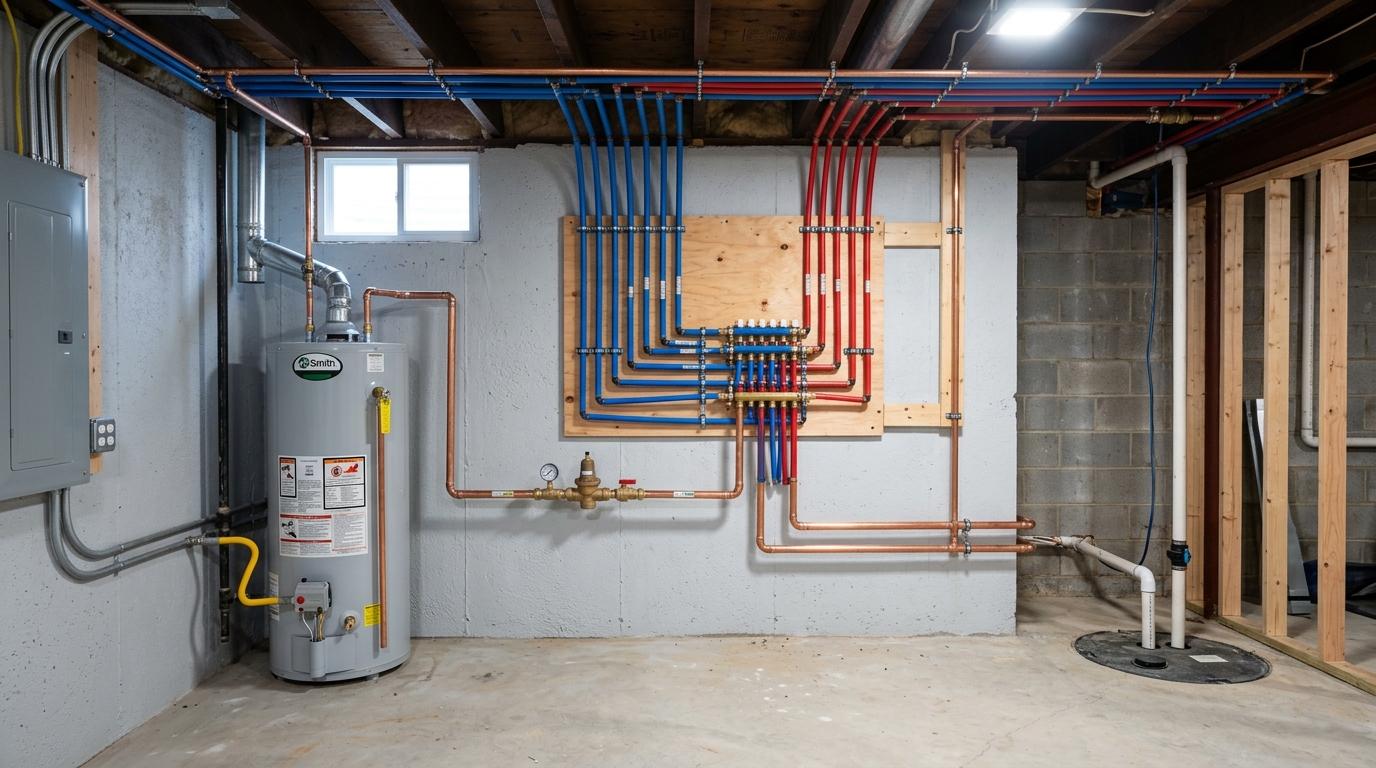
PEX is the common material in remodels and new construction after 2000—these are flexible, color-coded (red for hot, blue for cold), and joined with crimp rings or plastic fittings. For drains, cast iron was standard until the mid-1970s, typically black or dark brown and very heavy, with a bell-and-spigot joint. Clay tile appears on old sewer laterals, with terracotta color and wide, easily root-intruded joints. PVC and ABS (white or black plastic) took over in the 1970s and are used in most visible replacement work.
To identify what you have: scratch an exposed pipe with a screwdriver (galvanized reveals shiny silver, copper is reddish), test with a magnet (galvanized is magnetic; copper, plastic, and polybutylene are not). Threads mean galvanized or steel; soldered joints indicate copper. Use era and service life below to estimate your system’s remaining runway.
| Material |
Typical era |
Failure mode |
Service life |
| Galvanized steel supply |
pre-1960 |
internal corrosion, pressure loss |
40–60 yrs |
| Copper supply |
1950s–present |
pinhole leaks, joint failure |
50–70 yrs |
| Polybutylene supply |
late 1970s–1995 |
fitting failure, sudden bursts |
unreliable |
| PEX supply |
2000s–present |
fitting or UV degradation |
40–50 yrs |
| Cast iron drain |
pre-1975 |
corrosion, cracking, scale |
50–75 yrs |
| Clay tile sewer lateral |
pre-1980 |
root intrusion at joints, offset |
50–60 yrs |
| PVC / ABS drain |
1970s–present |
joint separation, crushing |
50+ yrs |
Shaler's housing stock and its plumbing
With 82.8% of Shaler homes built before 1980 (U.S. Census Bureau, ACS 2024), most plumbing is a mix of aging galvanized steel on water supply and cast iron on drain lines. If your house was built before 1960, you probably have galvanized or early copper supply lines and cast iron drains, with a high chance that your sewer lateral is clay tile—meaning root intrusion and joint separation is a question of when, not if. Service lines from the street are commonly older metals, sometimes even lead if the home is very old, which the Pittsburgh Water and Sewer Authority has been steadily replacing in this part of Allegheny County.
For homes built between 1970 and 1990, builder-grade copper, polybutylene, or early PEX may be present, depending on remodel history. Polybutylene in particular (common in late 1970s–1980s construction) has a bad record for sudden, uninsured failures and warrants inspection by a plumber. Original water heaters in post-1990 homes are almost always past their prime, so if you haven’t replaced yours, a proactive changeout avoids a possible flood. The age of the house sets your priorities—if it’s old, your biggest concern is corrosion or root damage; if it’s newer, it’s aging fixtures and the risks tied to less reliable plastics of the era.
Emergency rates versus scheduled work in Shaler
In Shaler, the same plumbing job jumps in price when it’s an emergency—sometimes double or more. The emergency premium comes from several sources: after-hours or weekend labor rates, a trip or “dispatch” charge, and the reality that plumbers must diagnose fast, sometimes under flooded floors or in bad weather. There’s also opportunity cost; a company interrupts scheduled work to rush your call, and that speed carries a cost.
It’s natural to panic at the sight of a leak, but not every problem means you need to pay emergency rates. Here’s a triage:
- True emergencies: active flooding (burst pipe), no water (main line break), sewage backing into drains, or the smell of gas. Call immediately; expect a bill from $600–$1,200 just for a typical emergency leak.
- Can wait for business hours: a slow drip (catch it in a bucket), one drain running slow (so long as others are clear), a running toilet, minor fixture leaks, or a water heater that just won’t light. By waiting, you’re likely to pay the standard rate ($350–$1,200 on leak repairs) and cut your costs in half.
For homeowners, the most valuable tool is knowing how to turn off your own water. The main shutoff is often by the meter or where the supply enters your basement. Every major fixture also has a local valve—turn it clockwise to shut water. If you stop the flow, you usually turn a panic call into scheduled work, and save real money in the process.
Who is allowed to do plumbing work in Pennsylvania
Pennsylvania does not issue a statewide plumbing license. Instead, plumbing is licensed and inspected municipally. In Allegheny County, this means permitting and licensing is handled by the Allegheny County Health Department Plumbing Program for Pittsburgh and some surrounding municipalities, and by local governments elsewhere. So, it’s not enough for a plumber to say they’re “licensed”—they must be able to prove they’re allowed to pull permits and work legally specifically in your part of Shaler or the surrounding township.
Any new or altered plumbing system—like adding a bath, moving a kitchen, or replacing a sewer—requires a plumbing permit in most Allegheny County municipalities. Minor fixture swaps, like just changing a faucet, ordinarily do not (as noted in county facts). Final inspection comes from local plumbing inspectors, not the state. All contractors taking on jobs over $500 must be HIC-registered through the Office of Attorney General, and have written contracts that mention your right to cancel within three business days. Insurance and workers’ comp can be checked at WCAIS.
The bottom line: always confirm where the contractor’s license is valid, don’t take “yes, we’re licensed” as enough, and ask to see the actual permit before work begins.
Finding a hidden leak in Shaler
Before calling in a pro, you can check for hidden leaks yourself with the meter test: shut off every tap and appliance, then read your water meter (usually at the main in the basement). If the dial moves when nothing should be running, you’ve got a supply-side leak somewhere in the system. For older Shaler homes with original lines, this is a smart first move.
Professionals can go further—using acoustic listening devices to “hear” leaks inside walls ($350–$800 including diagnosis), thermal imaging cameras to look for cold spots from leaking lines, tracer gas for tough-to-find leaks, and specialized sensors for slab foundations. For sewer or drain line leaks, a camera inspection is the gold standard, and should be your proof before accepting a major repair bid.
Hidden leaks crop up in slab floors, inside finished walls, and outdoors on irrigation lines. In all cases, opening walls or floors should come only after the leak is precisely located—if a plumber wants to demo first and diagnose after, get a second opinion. Precise location not only saves on repair costs, it’s a sign the contractor knows local construction eras and materials in Shaler.
Frequently asked questions — plumbing in Shaler
What does emergency plumbing cost in Shaler?
Emergency plumbing in Shaler ranges from $600–$1,200 for a typical burst pipe or active leak response. If you call after hours, the bill covers not only labor but an emergency dispatch and sometimes a trip fee due to heavy contractor demand in Allegheny County. For more extensive work that goes beyond a spot fix—like an after-hours water heater replacement—charges can rise. For homes built before 1980 (over 80% in Shaler), these calls often take longer since aging galvanized or cast iron pipes make repairs trickier, which can push you toward the high end of the band. Whenever safety allows, shutting off your water buys you time to wait for normal hours and a lower rate.
What do I do if sewage is backing up?
If sewage is backing up in your Shaler home, stop using any water immediately and check if it’s isolated to one fixture or affecting multiple drains. In this region, older homes often connect to clay tile or cast iron laterals that can clog quickly with roots or sediment. If multiple drains are backing up, you’re facing a main line obstruction and should call a plumber right away—emergency drain clearing in Shaler may run $350–$800 depending on time of day and camera use. For localized blockages, try a plunger or snaking, but don’t flush more water down. If you have a sanitary backflow preventer, check it for blockages. Health risk is real—don’t delay calling for help if sewage is present.
How do I prevent frozen pipes in Shaler?
In Shaler, deep freezes and heavy overnight temperature swings are common, and many homes have supply pipes that run close to exterior walls or through unheated basements. Insulating pipes, sealing basement drafts, and letting faucets drip on the coldest nights works well for most homes here. If your plumbing is exposed in crawlspaces, consider heat tape. Should your pipes freeze and burst, Shaler emergency repair is typically $600–$1,200—worth preventing. Find your main shutoff now so you can respond quickly in an emergency. Homes built before 1980 often have pipes routed in less protected locations, which makes preventive care all the more important.
How much does a water heater replacement cost in Shaler?
For a standard 40–50 gallon gas water heater replacement in Shaler, expect to pay $1,200–$2,900 in 2026. The higher end reflects removal of an old unit in a tough-to-access basement, common in pre-1980 construction around here, plus haul away and testing. If you call after hours, rates can climb toward $2,900 with travel and overtime fees. Planning your replacement before failure is usually cheaper than waiting for an emergency—plus it allows you to shop around among Allegheny County’s many contractors and get the most for your money.
Is a sewer line replacement covered by homeowner's insurance?
In most cases, a standard homeowner’s policy in Shaler does not cover the cost of replacing a failed sewer line, which can run from $2,000–$12,000 for a spot repair or full replacement in this area. Some insurers offer “service line coverage” as an optional rider that specifically covers buried pipes damaged by root intrusion or collapse. It’s worth checking if you have this add-on, especially in homes built prior to 1980 with original clay tile laterals; those are at higher risk. Always review your policy or contact your agent—don’t assume you’re covered and be surprised after a failure.
How long should a water heater last in Shaler?
Water heaters in Shaler, especially in homes with pre-1980 plumbing, typically last 8–15 years. Hard water and neglected maintenance (flushing, anode replacement) can shorten this. If your heater is approaching 10 years old and you’ve noticed less hot water or rust in the tank, start planning. Replacing before a major leak means you’ll likely pay the standard rate ($1,200–$2,900) instead of an emergency premium. With so many Shaler homes built before 1980, it’s common to see water heaters already on their second or third replacement.
Can I do my own plumbing work in Shaler?
In Shaler and most of Allegheny County, minor work—like swapping out a faucet—can be done by the homeowner without a permit. But for new or altered plumbing systems, the Allegheny County Health Department typically requires a permit, and some municipalities require a licensed plumber for certain categories of work. For any project over $500, state law demands a written contract if you hire it out, and most insurance companies won’t cover water damage from unpermitted DIY mistakes. If your project involves lead paint or pre-1978 plumbing, you’ll also need to comply with EPA standards or risk fines. Professional repairs can cost $350–$1,200 for a typical small job, but weigh that against the risk and potential cost of incorrect work.
How hard is the water in Shaler?
Shaler, like most of Allegheny County served by the Pittsburgh Water and Sewer Authority, has moderately hard water. While it’s not as extreme as some U.S. regions, mineral scaling still happens, especially on heating elements and inside older galvanized or copper pipes. Over years, this contributes to pipe narrowing and early water heater failure. If you notice white build-up on faucets, you have classic hard water symptoms. Professional water heater replacement—including scaling cleanup—runs $1,200–$2,900. For most, a simple sediment flush each year keeps things running, but consider a softener if you want to maximize appliance life.
Is a tankless water heater worth it in Shaler?
Tankless water heaters are attractive for efficiency, but in Shaler the value depends on your home’s age and piping. Installation costs are notably higher than standard tanks and can run above $2,900 if major gas or venting upgrades are needed (common for pre-1980 structures). If space is tight or you use a lot of hot water, tankless has advantages, but in many homes here, piping modifications and the electrical/gas requirements make payback lengthy. Unless you’re already planning extensive upgrades or a remodel, sticking with a quality tank model—costing $1,200–$2,900—often makes more sense for established Shaler properties.