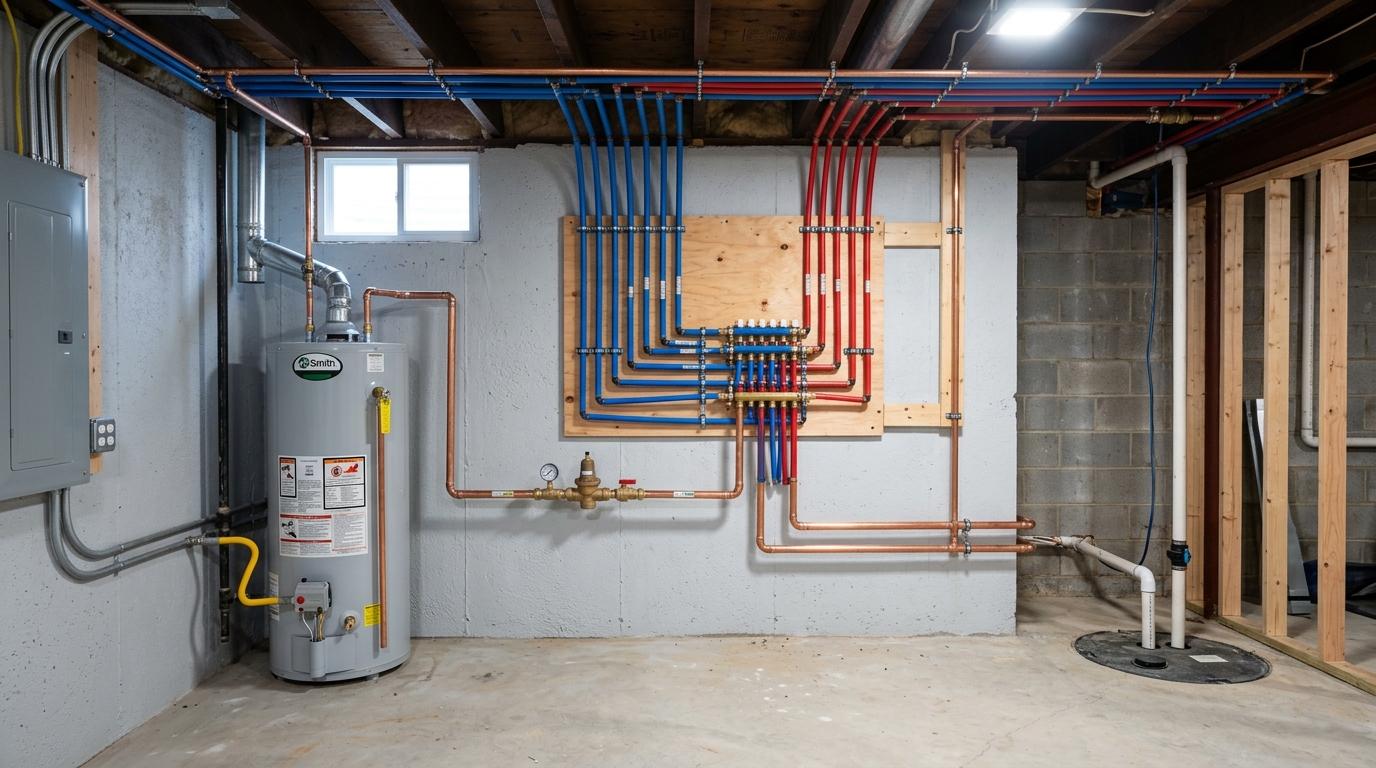
Prospect Park plumbing prices by job type — 2026
In Prospect Park, plumbing costs swing sharply based on whether you book in a crisis or can plan ahead. For emergency jobs like a burst pipe, rates are higher—no surprise to anyone who’s called after hours. About 90.0% of local homes were built before 1980 (U.S. Census Bureau, ACS 2024), and in large tracts built between 1945 and 1975—common in neighboring Upper Darby—the original pipes are now decades past their expected service life. That means more galvanized-to-copper swap-outs, constant drain replacements, and sometimes a whole-house repipe when repairs start piling up.
Material and access have the largest impact on price. Galvanized steel and cast iron—routinely found in homes of this era—tend to fail along seams, corrode internally, or clog with mineral buildup, pushing costs higher than similar jobs in houses piped with copper or PEX. Homeownership is 60.0% here (U.S. Census Bureau, ACS 2024), so most folks here are on the hook for repairs and upgrades themselves, not landlords. Below you’ll find up-to-date price bands for 2026 based on typical situations in Prospect Park. Emergency rates reflect call-outs at night or on weekends, while standard rates are what you’d pay for scheduled work during business hours.
| Service |
Scope |
Emergency rate |
Standard rate |
| Emergency repair — burst pipe |
locate, open, repair section, restore service |
$600–$1,150 |
$350–$1,150 |
| Water heater replacement (gas, 40–50 gal) |
remove old, install, test, haul away |
$1,850–$2,700 |
$1,150–$2,700 |
| Drain cleaning — main line |
augering or hydro-jet, camera if needed |
$350–$800 |
$200–$500 |
| Sewer line spot repair |
excavate or reline a failed section |
$1,950–$11,500 |
$1,950–$11,500 |
| Whole-house repipe |
replace supply lines throughout, patch and finish |
— |
$3,400–$8,200 |
| Water service line replacement |
street to house, excavation and restoration |
— |
$5,300–$11,500 |
Estimates for a typical Prospect Park home. Access difficulty and pipe material move these figures more than anything else.
Is your water line lead? How to find out
Lead contamination from old service lines remains a real concern in Prospect Park. According to Aqua Pennsylvania, Inc.—your water supplier—thousands of potential lead or galvanized service lines still exist across Delaware County as of 2024. The service line leading from the curb to your house is split: Aqua usually owns the segment up to the curb stop, and you own the portion from the curb into your home (the “lateral”).
If a replacement program is underway, it often only covers the utility-owned side. That leaves homeowners on the hook for the final stretch. To check material type, locate your water’s point of entry inside the basement or crawl space. Clean a small pipe section, scratch it with a coin—lead is soft, shiny, and won’t attract a magnet. Copper is orange-brown, and galvanized steel is a dull gray that will attract the magnet.
Aqua Pennsylvania maintains a service line inventory—search their 2024 listings to see if your address is flagged. If your lateral’s material isn’t listed, or you’re unsure, call the utility directly and ask for guidance on their findings and replacement programs. Never assume yours is covered; these programs vary block by block.
If your portion is lead or galvanized, full replacement is often safest—partial swaps can actually raise lead exposure short-term by disturbing mineral scale inside older pipes. The cost for a water service line replacement in Prospect Park runs $5,300–$11,500, depending on length and surface restoration. If you opt for a full home repipe at the same time, add $3,400–$8,200. These are considerable numbers but protect health and pass future code inspections if you sell. At a minimum, get your line checked if your house was built before 1980.
Spot repairs or whole-house repipe?
If your Prospect Park home has sprung two or more supply leaks in three years—and all on old galvanized steel or polybutylene—it’s more than just bad luck. That’s a pattern old houses in this area face, especially those 1945–1975 builds that drove ongoing galvanized-to-copper swaps in Upper Darby and Lansdowne. One isolated leak in a modern copper or PEX line? Fix it and move on.
Other warning signs: whole-house pressure drops at every tap, off-color water on first draw (brownish if scale breaks loose), and visible rust or corrosion at joints. Repeated pinholes and frequent repairs are nature’s way of telling you to stop patching and start planning.
Copper is longer-lasting but costs more and takes longer to install than PEX. PEX saves time (and drywall) on snaking lines through tight spots. Both are code-approved. Don’t forget the big budget buster: patching up old plaster or drywall after the new pipe goes in. In pre-1970s homes, walls often cost as much as the new plumbing to repair. If you’re facing a drain issue, cast iron with tree root intrusion usually means relining or line replacement, not snaking for the hundredth time.
| Situation |
Recommendation |
Cost |
Reasoning |
| One leak, accessible, modern pipe |
Spot repair |
$350–$1,150 |
Isolated issue, no sign of system-wide failure |
| Two or more leaks in 3 years |
Partial repipe |
$3,400–$5,500 |
Pattern of failure—sections are nearing end of life |
| Galvanized supply, pressure loss |
Full repipe |
$3,400–$8,200 |
Internal corrosion is systemic, not fixable by patch |
| Polybutylene anywhere in the house |
Full repipe |
$3,400–$8,200 |
Material is failure-prone; insurers dislike it |
| Cast iron drain with root intrusion |
Camera, then reline or replace |
$1,950–$11,500 |
Roots keep returning; repair is short-lived |
| Suspected lead service line |
Test, then replace the lateral |
$5,300–$11,500 |
Health risk; replacement raises property value |
Emergency rates versus scheduled work in Prospect Park
When you book a plumber in Prospect Park, a 3:00 a.m. call for a burst pipe is a world away from scheduling a weekday repair. Here’s why: emergency rates include after-hours or weekend dispatch, a trip charge just to get someone on site, overtime labor, and all diagnosis under a tight clock. Insurance may or may not cover the premium, but the bill is steeper up front.
What’s an actual plumbing emergency? Flooding from an active leak, absolutely no water in the house, sewage backing up in a basement, or a smell of gas—call right away. But a dripping faucet, a lone slow drain, or a running toilet: these can almost always wait until business hours, maybe saving you hundreds. If you pay $600–$1,150 for a burst pipe after hours versus $350–$1,150 scheduled, that’s money in your pocket.
If you have a leak, learn this now: the main water shutoff is almost always where the line enters the basement—wheel or lever type. Quarter-turn shuts off fastest. For sinks or toilets, small shutoff valves are usually just below or behind the fixture. Shutting off water to the affected area can stop active flooding, convert an emergency into a scheduled visit, and put you back in control of the repair timeline.
Detection methods and what they cost
Before calling a Prospect Park plumber, you can do a basic leak check for free. Shut off all fixtures and appliances that use water, then check your water meter—a moving dial with everything “off” usually means a leak somewhere on the supply side.
If the meter test shows a leak, professionals use specialized tools. Acoustic listening devices find leaks in pressurized lines behind walls or under slabs. Thermal cameras reveal cold spots and hidden water escaping in building cavities. Tracer gas detection is less common in homes, but shines for finding leaks under concrete by tracking where a safe, pressurized gas escapes. Each method costs differently. For a basic acoustic or thermal search, expect a charge between $350–$1,150 in addition to any repair. Locating a slab leak or complex concealed line may climb to the high end.
Slab leaks (common in certain 1950s-1970s builds) are usually pinpointed with sound and infrared before a tile or floor is touched. If someone wants to start opening finished walls without diagnosing, stop and ask for a second opinion—most leaks can be squared away with targeted investigation and minimal cutting.
Frozen pipes in Prospect Park: prevention and thaw
With a frost depth of 30 inches and a winter design temperature of 14°F, Prospect Park gets genuine freeze-thaw cycles every winter. Bursts don’t happen at the frozen section but between that ice plug and a closed faucet, as water pressure builds up behind the blockage. That’s why you often find the split downstream from where the pipe iced up.
Most vulnerable: pipes in exterior walls, crawlspaces, unheated garages, and unfinished attics. Hose bibs left undrained are also common trouble spots after the first deep freeze. To prevent headaches, start by insulating exposed pipes, applying low-wattage heat tape, and opening cabinet doors beneath sinks on exterior walls. When extreme cold hits, a slow faucet trickle keeps water moving and reduces freeze risk. Shutting off and draining outside spigots before winter is the minimum.
If you do have a frozen pipe, never use an open flame—it’s a fire hazard. Use a hair dryer, heat gun on low, or wrap the pipe in warm, damp towels and apply heat gradually. Don’t try to force the thaw suddenly, and keep the nearest shutoff valve in mind. An unaddressed freeze can mean a burst and a repair bill of $600–$1,150 if emergency service is needed. Prevention costs a fraction: pipe insulation is cheap, and time spent preparing saves water damage and dollars.
Who is allowed to do plumbing work in Pennsylvania
In Pennsylvania, plumbing licensing is local, not statewide. Delaware County municipalities—including Prospect Park—do not issue a countywide plumbing license, and Philadelphia’s separate registry does not apply here. That means a plumber licensed in one township may hold zero credentials just over the border; always confirm they’re recognized where your house sits.
Permit requirements differ by town. In Upper Darby, moving or adding any plumbing piping or new fixtures almost always means you’ll need a building permit, and the job will be inspected by either the local department or their contracted firm. In Media and similar boroughs, minor fixture repairs (like faucet or toilet internal parts) usually don’t require a permit. Ask your plumber which code applies to your home before work starts—this avoids headaches at resale.
For contracts over $500, every plumber must have Home Improvement Contractor (HIC) registration from the Pennsylvania Office of Attorney General. You can verify this at hic.attorneygeneral.gov. By law, workers’ compensation coverage is mandatory for all employers—check this at WCAIS. Make sure insurance is in place before work begins, and get a written contract as required by the Home Improvement Consumer Protection Act.
Frequently asked questions — plumbing in Prospect Park
How do I verify a plumber's licence and insurance?
In Pennsylvania—and in Prospect Park specifically—plumbing contractors for any job over $500 must be registered as a Home Improvement Contractor (HIC) through the Pennsylvania Office of Attorney General. You can check credentials yourself by searching your contractor’s name or registration number at hic.attorneygeneral.gov. For worker’s compensation, which is required for all employers statewide, you can look up coverage at WCAIS, Pennsylvania’s compensation insurance system. Licensing for plumbing is handled locally—so always ask your pro if they’re licensed in your particular municipality, not just somewhere else in Delaware County. A reputable contractor won’t hesitate to provide this paperwork before any major repair. For example, a whole-house repipe running $3,400–$8,200 should always be documented with proper permits, contract, and proof of insurance.
What do I do about a burst pipe right now?
If you’re in Prospect Park and a pipe bursts, turn off the main water shut-off immediately—it’s often by where the line enters your basement. If you can’t find it, shut off water at the affected fixture or call a neighbor for help. Shut off your furnace or heater if there’s standing water nearby to avoid electrical risks. Only after the water stops spreading should you call a plumber; emergency burst pipe repairs here cost $600–$1,150 after hours, and $350–$1,150 if you wait until business hours. Take photos for insurance and start mopping up to prevent further damage. Know that in Delaware County, large numbers of homes were built pre-1980 and have older galvanized pipe, so more sections may be at risk. If this is your second burst in the last couple years, also see the advice on repiping versus more patches.
How do I find a hidden water leak?
Start with a meter test: turn off all taps and appliances, then see if your meter’s dial keeps spinning. If so, a leak is somewhere on the supply line. In Prospect Park’s pre-1980 homes, those supply pipes are often buried behind old plaster or in crawlspaces. Plumbers here use acoustic listening devices, infrared cameras, and sometimes tracer gas to pinpoint leaks before making a single cut. This kind of detection typically costs $350–$1,150, depending on whether the leak is under slab, in a wall, or behind a finished ceiling. Opening up walls without solid diagnosis is old-school and often unnecessary. Once the leak is located, your plumber can minimize how much wall or ceiling gets torn out and repaired, saving you money and mess.
Is a water softener worth it in Prospect Park?
In Prospect Park, most homes are on Aqua Pennsylvania water, not a private well. Hardness levels here are typically moderate, not extreme like parts of the Midwest. A water softener can prevent scale in appliances and make soap work better, but you’ll want to get a lab or home test kit first to check the hardness at your tap before spending the money. Installation of a professional-grade softener system is often bundled into a plumbing contract and could add $1,150–$2,700 if replacing a water heater or repiping. If your big problem is red or brown water, that’s probably old galvanized pipes—not hard water—so focus your dollars on pipe replacement first.
Who owns the sewer lateral, me or the city?
In Prospect Park—and nearly everywhere in Delaware County—the homeowner owns the sewer lateral from the house to the street connection. The utility or the municipality owns only the main under the street. So if your sewer clogs or collapses on your property or yard, you’re responsible for all repair costs, including excavation and restoration. Spot repairs of a failed section typically run $1,950–$11,500 depending on how deep and how far from the curb the issue lies. Before authorizing any dig, ask about trenchless reline options, which can sometimes reduce disruption and restore flow without full excavation.
What does emergency plumbing cost in Prospect Park?
Emergency plumbing in Prospect Park commands a higher rate—usually for nights, weekends, or same-day rapid response. For a burst pipe or active leak, expect a charge of $600–$1,150. Water heater emergencies or total sewer clogs also carry a premium, with jobs running anywhere from $1,850–$2,700 for a heater to $1,950–$11,500 if you need spot repair on a main sewer. If you can safely isolate the problem or shut off the main, you can often reschedule and save a substantial amount, as standard rates are lower outside the emergency window.
What do I do if a pipe is frozen but not burst?
In Prospect Park’s winters, frozen pipes are a real risk in exterior walls and unheated spaces. If a pipe is frozen but not ruptured, first open the affected faucet to relieve pressure. Then, apply gentle heat—a hairdryer, heat lamp, or warm towels—not an open flame. Start at the faucet end and slowly work toward the blockage. If you’re overtime, have someone keep watch for leaks as warming progresses, since a burst usually makes itself known just as ice starts to melt. Calling a plumber to thaw the line, plus repair if needed, will run between $350–$1,150 depending on timing. Prevention—pipe insulation and opening cabinets during cold snaps—costs much less.
How much does a plumber cost in Prospect Park?
Plumbing rates in Prospect Park closely track the rest of Delaware County due to the shared housing stock and competitive contractor market. For a basic scheduled repair, like fixing a leaking pipe or clearing a main drain, the bill will usually be $350–$1,150. Emergency calls—after hours or for big failures—can push even routine work to the higher end. A whole-house repipe or water service line swap will run much more: $3,400–$8,200 or even $5,300–$11,500. Always ask for a written estimate up front, especially on jobs over $500, where Pennsylvania law requires a detailed contract.
Which utility supplies water to Prospect Park?
The main water utility in Prospect Park is Aqua Pennsylvania, Inc., covering nearly all of Delaware County and the surrounding townships. They’re responsible for the water main and sometimes the portion of the service line up to your curb—your responsibility begins from the curb into your house. If you need to check if your service line is lead or galvanized, Aqua Pennsylvania maintains a published service line inventory. For water main issues, billing, or quality reports, they’re your go-to contact. Replacing the homeowner-owned portion of a water service line typically costs $5,300–$11,500 in this area; for anything on the utility’s side, contact Aqua directly—they handle their own maintenance and replacement programs.