What plumbers charge in Salisbury
Salisbury homeowners will find that plumbing service costs here are tightly tied to two drivers: whether the job is an emergency, and the age and layout of your home. About 46.4% of Salisbury homes were built before 1980 (U.S. Census Bureau, ACS 2024), part of a local pattern that lines up with Lancaster city’s housing stock—lots of pre‑1940 row and twin homes packed with galvanized steel and early copper pipes. Construction era predicts pipe material, and pipe material predicts what goes wrong, how fast, and what it costs to fix.
If you wake up to a burst pipe or a sudden, active leak, you’ll pay an emergency rate. The same repair scheduled during normal business hours often runs hundreds less. Emergency calls mean drop-everything scheduling, after-hours work, and sometimes extra damage control.
Below is what you should expect to pay for typical residential services in Salisbury, based on observed prevailing rates. These figures reflect both the dense blocks of older homes in Lancaster’s urban core and thinner, newer builds in outlying areas. Access difficulty, pipe runs, and the exact materials can still swing these numbers.
| Service |
Scope |
Emergency rate |
Standard rate |
| Emergency repair — burst pipe |
locate, open, repair section, restore service |
$600–$1,250 |
$350–$1,250 |
| Water heater replacement (gas, 40–50 gal) |
remove old, install, test, haul away |
$1,950–$2,900 |
$1,250–$2,900 |
| Drain cleaning — main line |
augering or hydro-jet, camera if needed |
$350–$800 |
$200–$500 |
| Sewer line spot repair |
excavate or reline a failed section |
$2,000–$12,500 |
$2,000–$12,500 |
| Whole-house repipe |
replace supply lines throughout, patch and finish |
|
$3,600–$8,700 |
| Water service line replacement |
street to house, excavation and restoration |
|
$5,600–$12,500 |
Estimates for a typical Salisbury home. Access difficulty and pipe material move these figures more than anything else.
Who is allowed to do plumbing work in Pennsylvania
Pennsylvania does not issue a statewide plumbing license. In practice, that means each municipality decides who is qualified to pull permits and perform plumbing work. For Salisbury, that’s relevant because a plumber “licensed” in Lancaster, Philadelphia, or Pittsburgh may not legally perform work in your township unless they’re also registered or recognized by the local code office. Here, the core question isn’t “are you licensed?” but “are you properly registered in this township?”
Permit requirements also change across Lancaster County. In Lancaster city, any job that physically alters, expands, or adds value to your property—think new piping runs, fixture relocations, or major repairs—needs a permit and inspection. Small, like-for-like repairs (such as swapping a faucet cartridge or flapper) are generally exempt. Outside Lancaster city, township codes may differ, so always check before any work starts.
Pennsylvania’s Home Improvement Contractor (HIC) registration is required for any work that totals over $500. This protects homeowners by requiring written contracts and granting you a 3 business-day right of cancellation. To check a contractor’s HIC status, search hic.attorneygeneral.gov. For workers’ compensation insurance, use the WCAIS system at wcais.pa.gov. Always verify both; it helps prevent liability issues if someone gets hurt on your property.
If your home was built before 1978 and work disturbs painted surfaces, federal EPA Lead RRP rules apply. Verify your contractor’s certification at certifiedrenovatorsearch.epa.gov.
Service line material and drinking water in Salisbury
Most Salisbury properties are served by the City of Lancaster Water Bureau, with some suburban areas using their local municipal authorities. If you’re in Lancaster city, thousands of homes have been flagged as having potential lead service lines, and there’s an ongoing inventory and replacement program. Here’s what that means to you: your water service line (the pipe running from the street or curb to your home) is split—part may belong to the utility, part to you. Most replacement programs only cover the utility’s side unless the program specifically states otherwise.
To find out what your service line is made of, locate where it enters your basement or crawlspace. Clean a section, scratch it with a coin, and check with a magnet. Lead is dull gray and soft, and a magnet will not stick to it. Copper is reddish and non-magnetic, galvanized steel is gray and will hold a magnet. If you have lead, replacing only part of the line can actually increase lead levels for some time—disturbing decades of built-up scale.
To check whether your address is on the utility’s inventory, refer directly to their public listings or call them. No blanket replacement cost-sharing program is named for Salisbury or Lancaster in the current block, so don’t assume—ask your utility about available cost sharing or reimbursement. If it falls to you, a water service line replacement in Salisbury runs $5,600–$12,500. If you opt for a whole-house repipe alongside, budget another $3,600–$8,700.
If you have lead pipes, filtered drinking water or bottled water is smart until every part—both utility and homeowner side—is replaced.
Pipe materials in Salisbury homes and how they fail
Much of Salisbury’s housing mirrors Lancaster city’s pattern: a generous share of pre‑1940 homes built with galvanized steel supply lines, cast iron drains, and clay tile sewer laterals. Newer sections brought copper, then, for a short period, polybutylene, and now PEX and PVC/ABS plastic. Each material can be identified and has its own ways of failing.
If you see gray, threaded pipe, check if it attracts a magnet—this is galvanized steel, common before 1960, which narrows and rusts from inside, killing water pressure before it eventually leaks. Copper (always non-magnetic, usually with soldered joints) will often show pinhole leaks if your water chemistry is aggressive. Polybutylene (bluish-gray flexible plastic, joined by metal bands) was popular from the late ‘70s to 1995 and is now largely considered unreliable due to fitting failures. PEX (colored flexible plastic) is the modern standard.
For drains, cast iron is heavy and dark, often in stacks or major drain lines of older homes, while white PVC and black ABS signals post-1970s construction. Clay tile, found in older sewer laterals, is recognizable by its brownish-orange color and segmented joints.
If your house dates to the pre-1980 wave, expect galvanized or early copper for supply and cast iron or clay tile for drainage. Most of those systems are past—or near—their intended service life. If you’re in a newer build, check for PEX or PVC/ABS and expect less dramatic failures but still the usual wear-and-tear.
| Material |
Typical era |
Failure mode |
Service life |
| Galvanized steel supply |
pre-1960 |
internal corrosion, pressure loss |
40–60 yrs |
| Copper supply |
1950s–present |
pinhole leaks, joint failure |
50–70 yrs |
| Polybutylene supply |
late 1970s–1995 |
fitting failure, sudden bursts |
unreliable |
| PEX supply |
2000s–present |
fitting or UV degradation |
40–50 yrs |
| Cast iron drain |
pre-1975 |
corrosion, cracking, scale |
50–75 yrs |
| Clay tile sewer lateral |
pre-1980 |
root intrusion at joints, offset |
50–60 yrs |
| PVC / ABS drain |
1970s–present |
joint separation, crushing |
50+ yrs |
What construction era means for your pipes
In Salisbury, almost half the housing—46.4%—was built before 1980. That means the odds are good you’ve got either galvanized steel or older copper supply pipes, and cast iron or clay for drainage. In the oldest homes, galvanized pipes are now past their expected lifespan, likely showing low pressure and rust. Clay tile sewer laterals—common before 1980—are highly susceptible to root intrusion at the joints. Many homes that started with galvanized have already been repiped with copper or PEX in waves as failures happened, which is why repiping is so common in nearby Lancaster city.
For newer Salisbury construction, you’re more likely to see builder-grade copper or even polybutylene supply lines (if built in the 1980s or 1990s), plus PVC/ABS for waste. Polybutylene, while hidden and flexible, isn’t trustworthy over time. Most water heaters in homes built before 1980 are on their second or third unit by now; in newer homes, you’ll find the original water heater reaching end of service life at around 10–15 years, meaning a replacement is coming due. So, newer homes trade the urgent failures of old steel for the less catastrophic—but still real—risks of aging plastics and builder-grade copper.
Choosing a water heater in Salisbury
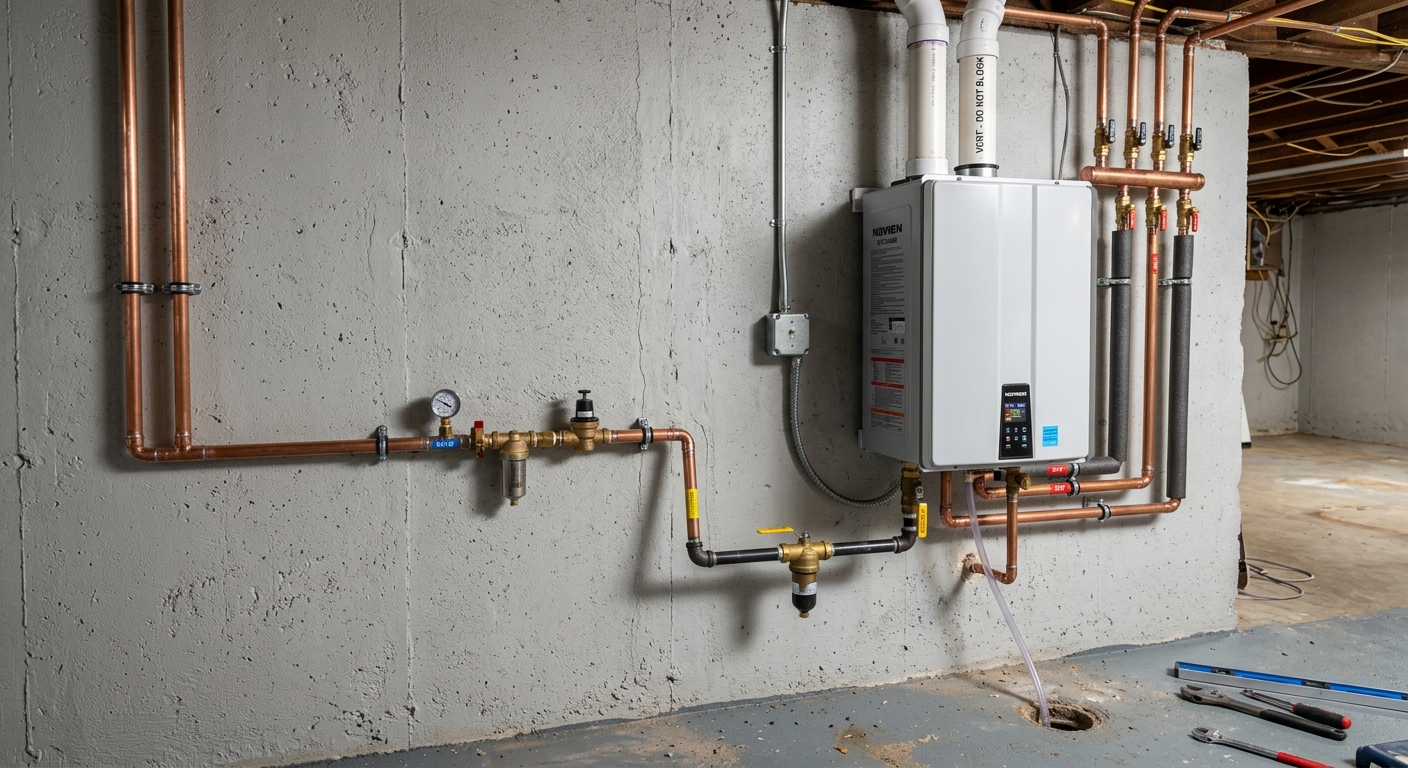
When replacing a water heater in Salisbury, most homeowners are deciding between a standard gas or electric tank, a tankless (on-demand) unit, or a heat pump water heater. The cheapest first cost is a traditional tank—quick install, off-the-shelf, but shortest life and the highest operating cost for electric models. Gas tanks are common, but a tankless option gives endless hot water while adding the need for a bigger gas line and upgraded venting—hidden costs that can surprise you and make installation more invasive, especially in older homes.
Heat pump water heaters use electricity and the surrounding air to function, which saves the most on your bill. The tradeoff: they draw heat from the room (so basements get cooler), need a good size space, and make distinctive noise—not ideal under living areas or in a tiny mechanical room.
A properly sited water heater should be sized by first-hour rating, not just gallons—how much hot water you can draw in one stretch. Current state code expects an expansion tank on closed systems for safety. Always drain pans on finished floors, and make sure drains are clear.
| Type |
Installed cost |
Service life |
Operating cost |
Best when |
| Gas tank, 40–50 gal |
$1,250–$2,900 |
8–12 yrs |
moderate |
existing gas line, moderate demand |
| Electric tank, 40–50 gal |
$1,250–$1,950 |
10–15 yrs |
high |
no gas available, low upfront need |
| Gas tankless |
$1,950–$2,900 |
18–25 yrs |
low-moderate |
endless supply, willing to upgrade gas/venting |
| Heat pump water heater |
$1,950–$2,900 |
13–15 yrs |
lowest |
ample basement space, high energy savings |
Detection methods and what they cost
The first step in finding a hidden water leak in your Salisbury home is free: shut off all fixtures and appliances, then check your water meter. If the meter dial still moves, you have a supply-side leak somewhere on your property.
Professional leak detection starts with acoustic listening—special microphones that pick up the sound of leaks in pipes behind walls, under floors, or underground. For slab leaks or cases where water doesn't visibly appear, thermal imaging cameras spot temperature differences and can map leak pathways. Tracer gas (usually a harmless gas pumped into the pipes and traced with detectors) pinpoints leaks in especially stubborn situations. For slab leaks and buried lines, dedicated slab leak detectors are used for non-invasive pinpointing.
Acoustic listening and thermal imaging generally run $350–$800 depending on home access and complexity. Tracer gas is less commonly needed, but priced in the same neighborhood. Always avoid any plumber who wants to start opening walls and floors before using these locating methods—skilled leak detection means finding the exact spot before making any holes, not after.
Frequently asked questions — plumbing in Salisbury
Who inspects plumbing work in Salisbury?
Inspections depend on exactly where you live in Lancaster County. For Salisbury and most surrounding townships, plumbing permits and inspections are handled by the township code office. In Lancaster city itself, it’s the Bureau of Building Code Administration that sends inspectors. Regardless of location, any project that alters, adds, or significantly repairs a plumbing system—such as water heater swaps, repiping, or sewer work—requires an inspection. The inspector’s job is to verify compliance with the Pennsylvania Uniform Construction Code (UCC), which follows the International Residential Code. If you hire a contractor, make sure you’re both clear on who is pulling the permit and scheduling the inspection. Permit fees are generally moderate, but be wary if a plumber offers to work “off the books” to save cost—it rarely ends well. Typical inspection-triggering jobs, like a water heater replacement, run $1,250–$2,900 installed.
Should I leave a faucet dripping in cold weather?
In south-central Pennsylvania, including Salisbury, winter temperatures routinely drop below freezing, and we see pronounced freeze-thaw cycling. If your home has uninsulated pipes in a crawlspace, exterior wall, or over a garage, it’s smart to let the coldest running faucet drip during the deepest cold spells. This keeps moving water through the line, reducing freeze risk. Remember, older homes here often have pipes in exposed or weakly insulated areas—especially those with pre-1940 layouts common in the Lancaster area. Insulate first if you can, but dripping just one faucet is cheaper than paying $600–$1,250 for a burst pipe emergency repair. Open under-sink cabinet doors, keep indoor heat consistent, and watch out for north-facing rooms where pipes freeze quickest.
Who owns the sewer lateral, me or the city?
In Salisbury and Lancaster County, you as the homeowner own the lateral—the portion of pipe running from your house to the property line or street—unless your local authority states otherwise. The City of Lancaster maintains its sanitary and storm sewers beyond the curb, but anything on your property, including failures and blockages, is your responsibility. That means if your clay or cast iron lateral fails, you’ll pay for repairs. Spot repairs for a sewer lateral in Salisbury typically cost $2,000–$12,500, depending on access and length. Always check with your municipal sewer authority to confirm the handoff point before work. In outer townships, especially those on septic systems, the entire system belongs to the homeowner.
What does repiping a house cost in Salisbury?
Repiping means replacing all of your home’s water supply pipes—usually swapping out galvanized or aging copper for modern PEX or copper. In a typical Salisbury home, you should expect to pay $3,600–$8,700 for a whole-house repipe. Cost swings depend on house size, access to pipes (finished basements and lots of drywall patching cost more), and whether the job is scheduled or urgently needed after a failure. Salisbury’s mix of pre-1980 homes means lots of past patchwork repairs, but sooner or later, multiple leaks or rusty, low pressure often force a complete repipe. While it’s a major job, it usually increases home value and reliability. Always request a clear estimate with all patching and finish restoration described up front—hidden repair costs can surprise you otherwise.
How much does a water heater replacement cost in Salisbury?
For a standard replacement, expect to pay between $1,250–$2,900 in Salisbury. This range covers a gas 40–50 gallon tank installed by a qualified plumber, including removal of the old unit, setting the new one, reconnecting lines, and hauling away debris. If your home needs extra work—like a vent upgrade, expansion tank, or bringing connections up to code—costs may rise toward the upper end. Gas tankless and heat pump water heaters are also in this range but can edge higher if significant updates are needed. Older homes, especially those with limited access or unusual venting, may see more surprises. Always get a written breakdown and ask if permit and inspection fees are included—Lancaster city and its townships require it for replacements.
How do I find a hidden water leak?
To spot a supply-side leak in your Salisbury home, do the meter test: turn off all faucets and water-using appliances, then check the water meter. If the dial still moves, you have a leak. For pinpointing, plumbers use acoustic listening equipment (listening for the sound of water escaping pipes in walls, floors, or slabs), thermal imaging to spot cool, wet spots, and sometimes tracer gas to find the exact leak point. In our area, where pipes often run under slabs or through unheated crawlspaces, these methods help avoid unnecessary demolition. Locating a concealed leak professionally costs $350–$800. Any plumber who just wants to start opening up walls before locating isn’t working in your best interest; demand detection first. If you suspect a slab leak (puddling, warm spots, or unexplained bills), act quickly, as leaks here can travel and do more damage.
Should I repipe my Salisbury home or keep repairing?
If your home was built before 1980, and you’re dealing with repeated leaks, rusty water, or rapidly dropping pressure, it’s worth considering a full repipe. In Salisbury, where so many houses still have sections of galvanized or early copper, ongoing repairs often add up to a significant fraction of whole-house replacement over a few years. Spot repairs can get you by in the short term—each runs $350–$1,250 on the supply—but when leaks become frequent or you have several “Frankenstein” sections patched together, it’s time to look at a full swap. A repipe increases reliability, cuts water bills, and adds value, especially compared to recurring emergencies. Still, if failures are rare and you’re not planning to sell soon, repair and monitor. Ask for a full pipe assessment before deciding.
Do older Salisbury homes have galvanized pipes?
Yes, many Salisbury homes built before 1960—especially those in the heavy pre‑1940 row and twin housing stock typical of Lancaster city—were originally plumbed with galvanized steel pipes. About 46.4% of local homes are pre-1980 (U.S. Census Bureau, ACS 2024), and a significant number still have at least some original galvanized, though many have undergone partial updates. Galvanized pipe corrodes from the inside, causing low water pressure and rusty water before it finally gives way to leaks. If your water pressure drops, or you see discolored water after the tap’s first run, remaining galvanized is likely. Spot repair is possible (costing $350–$1,250), but sooner or later a full repipe becomes inevitable—especially if you plan to sell, since buyers and insurers increasingly push for updated supply lines.
Should I wait until business hours to call?
If you have water pouring from a pipe, ceiling, or wall, don’t wait—this is what emergency service is for, even if it lands closer to $1,250 on a weekend. Every minute that water runs, damage multiplies. Shut off the house main if you can, then call a plumber. For non-emergencies—small leaks, slow drains, water heater pilot going out—wait for regular hours when you’ll pay the standard rate. Salisbury homeowners with aging pipes and freeze-prone areas are wise to act fast on midsize leaks, as a small problem can quickly ruin much more than a pipe. For anything that’s not immediately damaging floors, walls, or ceilings, calling during business hours will keep your cost at the lower end of the band.