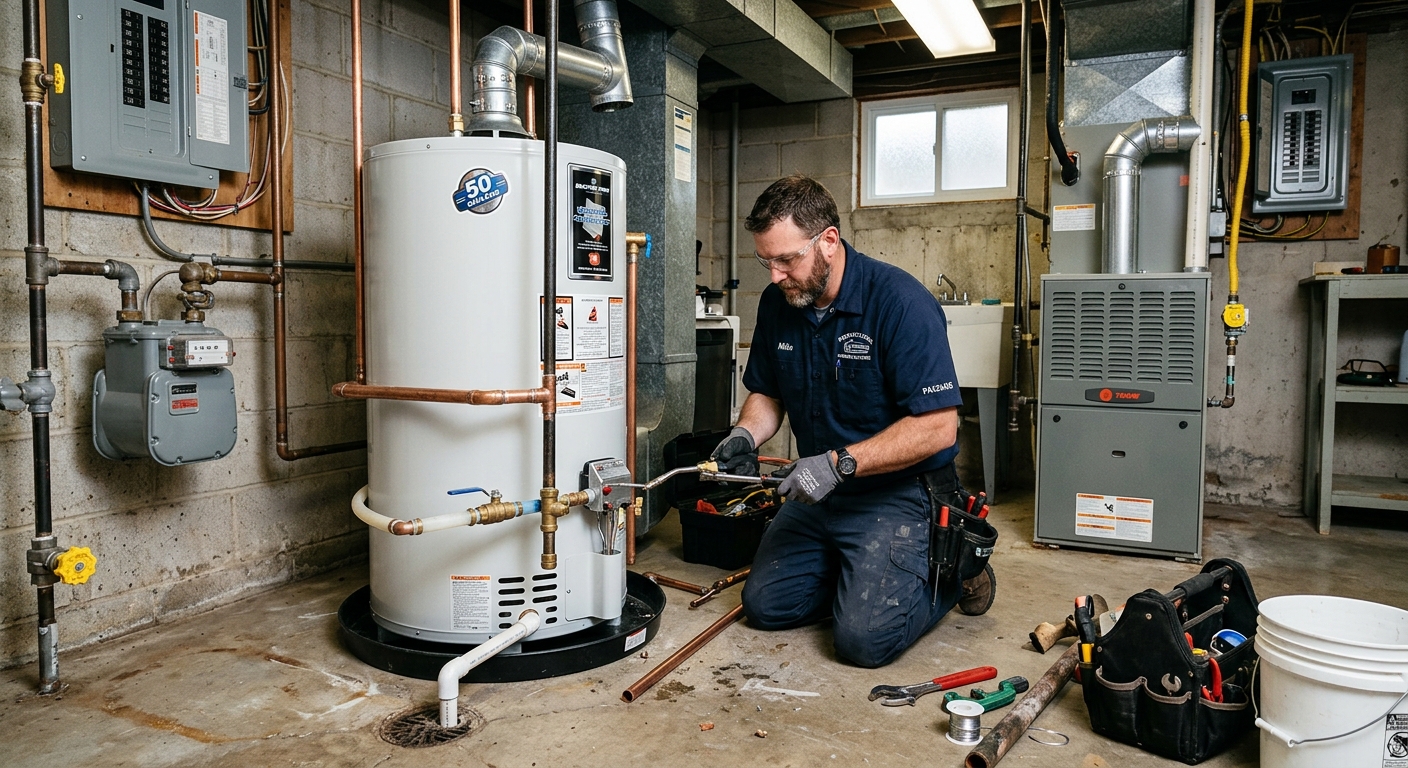
Plumbing costs in Millcreek — 2026
Plumbing costs in Millcreek can swing sharply depending on whether you’re in an emergency or not, and the age of the home is a major factor in what work is likely to be needed. With a population of 53,840 and a homeownership rate of 71.6% (U.S. Census Bureau, ACS 2024), most residents face the realities of the area’s housing era when plumbing trouble strikes. Erie and Millcreek have a deep stock of houses built between 1900 and 1950, which means plenty of aging galvanized and cast-iron pipes behind the walls. If a pipe bursts or a sewer backs up, the emergency rate for prompt service is always going to be higher: you’re paying for fast response, off-hours labor, and a fix that happens under pressure.
For any project here, there’s a two-track price structure. Take a burst pipe: if it’s flooding now, emergency service will range from $600–$1,200. If you can safely shut off the water and wait, the same repair may be $350–$1,200. Water heater replacement, drain cleaning, and bigger jobs like sewer or service line work all price out this way. The older the house and the harder the access, the more these brackets matter.
| Service |
Scope |
Emergency rate |
Standard rate |
| Emergency repair — burst pipe |
locate, open, repair section, restore service |
$600–$1,200 |
$350–$1,200 |
| Water heater replacement (gas, 40–50 gal) |
remove old, install, test, haul away |
$1,900–$2,800 |
$1,200–$2,800 |
| Drain cleaning — main line |
augering or hydro-jet, camera if needed |
$350–$800 |
$200–$500 |
| Sewer line spot repair |
excavate or reline a failed section |
$2,000–$12,000 |
$2,000–$12,000 |
| Whole-house repipe |
replace supply lines throughout, patch and finish |
|
$3,500–$8,400 |
| Water service line replacement |
street to house, excavation and restoration |
|
$5,400–$12,000 |
Estimates for a typical Millcreek home. Access difficulty and pipe material move these figures more than anything else.
Millcreek's housing stock and its plumbing
Millcreek’s homes are a cross-section of northwestern Pennsylvania’s residential history. Over 58.3% were built before 1980 (U.S. Census Bureau, ACS 2024), and that statistic says a lot about what’s behind the walls and beneath the lawn. In homes built between 1900 and 1950, galvanized steel was the standard for water supply lines, while cast iron served for drains. By the 1970s, some PVC for drains and copper for supply started making inroads—if your house is from that era, odds are good you’ve still got some of the original system, and original builder-grade fixtures may also be reaching the end of their life.
The sewer lateral in these homes is almost always clay tile or cast iron—both prone to root intrusion and breaks at around the 50- to 75-year mark. Erie Water Works has reported thousands of lead service lines in the city and surrounding areas, so if your home predates 1950 and hasn’t had the line replaced, it’s worth asking the question. Water heaters generally last about 10–15 years here due to mineral content and the age of the systems, meaning most pre-1980 homes are on their third or fourth unit. By contrast, newer homes in Millcreek’s developments often have builder-grade copper or even polybutylene supply lines (if from the late 1970s to 1995), and PVC drains—these might just be facing their first round of major plumbing replacements now.
In short: the older the house, the more likely you’ll deal with failing galvanized, lead, or cast iron. For newer homes, it’s time to watch out for polybutylene and builder-grade original fixtures.
Emergency rates versus scheduled work in Millcreek
In Millcreek, the difference between an emergency call and scheduled work can mean hundreds of dollars—sometimes more. Emergency rates cover more than just fast labor: they combine after-hours dispatch, a trip charge to cover mileage across Erie County’s spread-out towns, overtime pay, and the reality that diagnosis has to be done fast, sometimes before anyone really knows what’s behind that wet ceiling. For a homeowner, understanding this is crucial. The same burst pipe repair that might run $350–$1,200 during business hours quickly jumps to $600–$1,200 when an emergency crew is on their way at night or on a weekend.
But not every sudden surprise is a true emergency. Here’s a quick rundown:
- Emergencies: Active flooding (fast leak spraying or gushing), a total loss of water service, sewage backing up into the home, or any gas smell require immediate attention—pay for the emergency response.
- Not an emergency: A slow drip, a single slow drain (if all others are working), a running toilet, or a water heater that’s not leaking but just lost heat can wait until business hours, saving well over $200–$500 on response fees alone.
Know your shutoffs: there’s a main water shutoff where the service line enters—usually in the basement or utility area. Every fixture (toilet, sink) has a localized shutoff. Closing these can halt a crisis and move your job from “emergency” to “scheduled”—and that one step can save you real money and stress.
Verifying a Millcreek plumber's credentials
Pennsylvania does not issue a statewide plumbing license—each municipality calls the shots. Erie handles its plumbing permits and licenses through the City of Erie Bureau of Code Enforcement; surrounding townships like Millcreek have their own code offices or default to enforcement by the state if they opt out. That means you need to ask, “Are you licensed to work in Millcreek Township?” Not every plumber from Erie is automatically allowed to do work in your house if you’re outside those city limits.
Home improvement contractors for jobs over $500 must register with the Pennsylvania Office of Attorney General, and you can verify registration at hic.attorneygeneral.gov. Pennsylvania also requires a written contract for jobs over $500 and a three-day right to cancel under the Home Improvement Consumer Protection Act. Make sure you get both—waiving insurance deductibles is not allowed. For workers’ compensation insurance, every employer must have coverage—confirm with the WCAIS system at wcais.pa.gov.
In Erie, any replacement, addition, or alteration of plumbing piping requires a permit; in Millcreek Township, check directly with your township office. Inspections are carried out by either the local code enforcement office or, if your township opts out, the PA Department of Labor & Industry. Always ask for a certificate of insurance showing your address: “insured” is not enough until your property is named.
The point where patching stops making sense
A good rule for Millcreek homeowners: if you’ve had two or more leaks on the same type of pipe in three years, it’s no longer “bad luck”—it’s aging out. This is common with the area’s 1900–1950 galvanized supply and cast iron drain pipes, which are now decades past their intended lifespan. Warning signs include widespread pressure drop (not just at one fixture), rusty or brown water on first draw, corrosion at visible joints, or a string of pinhole leaks. Keep an eye out if you have polybutylene, too—just its presence means it's time to budget for a replacement, regardless of leaks.
Replacing everything can feel big, but the drywall, plaster, and finish repairs after piping can be as costly as the new plumbing, especially in older homes with original plaster. Copper is durable and time-tested but pricier and needs to be soldered. PEX is flexible, cheaper on labor, and works well unless exposed to UV or rodent risk. In Millcreek and Erie, many homes are reaching that “whole house” threshold—fixing one leak is throwing good money after bad if you’ve got loss of pressure through corroded galvanized or the drain lines are down to a trickle from scaling.
| Situation |
Recommendation |
Cost |
Reasoning |
| One leak, accessible, modern pipe |
Spot repair |
$350–$1,200 |
Isolated issue, modern material is sound |
| Two or more leaks in 3 years |
Partial repipe |
$3,500–$5,600 |
Pattern of failure, older pipe likely widespread issue |
| Galvanized supply, pressure loss |
Full repipe |
$3,500–$8,400 |
Corrosion chokes supply house-wide—needs total replacement |
| Polybutylene anywhere in the house |
Full repipe |
$3,500–$8,400 |
Known defect, insurance risk, should be replaced throughout |
| Cast iron drain with root intrusion |
Camera, then reline or replace |
$2,000–$12,000 |
Roots cause blockages; video confirms extent, relining or dig-up needed |
| Suspected lead service line |
Test, then replace the lateral |
$5,400–$12,000 |
Lead exposure risk, must confirm and replace if present |
Vetting a plumber in Erie County
In Erie County, and especially Millcreek, it’s the township or city that authorizes plumbing work, not the state. Always verify that your plumber is permitted to work in your municipality—not just Erie, but Millcreek or the relevant township. Check HIC registration status for jobs over $500 at hic.attorneygeneral.gov, and request proof of workers’ compensation by looking them up at wcais.pa.gov. Each job should be covered by its own certificate of insurance, showing your address—don’t settle for a generic binder.
Ask whether the company uses its own employees or subs out work, especially for sewer line or repiping jobs. Confirm after-hours or emergency pricing in writing up front. A reputable plumber in this market explains what you’ll pay if things get complicated, not just the cost if everything goes right.
- Confirm the plumber is authorized for Millcreek or your township
- Check HIC registration at hic.attorneygeneral.gov
- Verify active workers’ compensation at wcais.pa.gov
- Get a current insurance certificate showing your address
- Ask if the crew are employees or subcontractors
- Request a copy of the actual township permit if one’s required
- Require before/after video for any drain or sewer scope work
- Demand a pressure test for repipe recommendations
- Review the written contract and cancellation rights for jobs over $500
- Know who provides after-hours coverage and at what emergency rate
- Ask for references from recent jobs in Millcreek
- See if they’ve worked with Erie Water Works if you’re replacing a service line
Red flags: In a moderate-density, spread-out market like Erie County, beware the “one-call repipe” or sewer job quoted without any inspection footage or pressure readings—you’re being sold a bill, not a solution.
Pipe materials in Millcreek homes and how they fail
What’s under the floors in Millcreek usually matches the era of construction—Erie and Millcreek have substantial 1900–1950 housing stock with aging galvanized and cast-iron plumbing needing replacement. Galvanized steel, used up to the late 1950s, corrodes from the inside out, slowly narrowing the pipe until pressure drops and leaks follow. You’ll spot it as silvery-gray, threaded pipe—try a magnet, it’ll stick. Copper, common from the 1950s onward, is reddish and smooth, with soldered or pressed joints. It’s durable but can develop pinhole leaks thanks to water chemistry or stray current from old wiring.
Polybutylene was used from the late 1970s to mid-1990s—usually gray or blue plastic, often marked “PB.” It’s now uninsurable in many places because the fittings fail unpredictably, sometimes with catastrophic bursts. PEX (flexible, color-coded plastic) is current practice and most reliable for modern replacements. On the drain side, cast iron is the heavy, black pipe found in pre-1975 homes. It corrodes and forms crusty deposits, eventually cracking or leaking at the joints. Clay tile, used mainly for sewer laterals until the 1980s, is brittle and easy for roots to infiltrate at the joints, especially as freeze-thaw cycles open them over time.
PVC and ABS have been around from the late 1970s onward, bright white (PVC) or black (ABS), assembled with glued joints. These are more durable against chemical corrosion but can suffer crushing or joint separation, especially in shallow, unsupported runs under driveways or yards.
| Material |
Typical era |
Failure mode |
Service life |
| Galvanized steel supply |
pre-1960 |
internal corrosion, pressure loss |
40–60 yrs |
| Copper supply |
1950s–present |
pinhole leaks, joint failure |
50–70 yrs |
| Polybutylene supply |
late 1970s–1995 |
fitting failure, sudden bursts |
unreliable |
| PEX supply |
2000s–present |
fitting or UV degradation |
40–50 yrs |
| Cast iron drain |
pre-1975 |
corrosion, cracking, scale |
50–75 yrs |
| Clay tile sewer lateral |
pre-1980 |
root intrusion at joints, offset |
50–60 yrs |
| PVC / ABS drain |
1970s–present |
joint separation, crushing |
50+ yrs |
Frequently asked questions — plumbing in Millcreek
Who inspects plumbing work in Millcreek?
The answer depends on your exact address in Millcreek. In the City of Erie, the Bureau of Code Enforcement handles plumbing permits and inspections. If you’re in Millcreek Township or another municipality, you’ll typically work with the township’s own code office. Some rural townships may have opted out, in which case the Pennsylvania Department of Labor & Industry oversees enforcement under the state’s Uniform Construction Code. No matter where, any substantial work—like relocating, replacing, or altering piping—requires a permit and an inspection before work is covered up. It’s always smart to confirm your plumber is familiar with these local steps before starting, since finishing work without proper inspection can make it tricky if you sell or refinance later. For permitted projects, inspection is included in your quoted price, which for a pipe replacement might run $3,500–$8,400.
How much does a water heater replacement cost in Millcreek?
Water heater replacement costs in Millcreek reflect not just the new tank but the labor, haul-away, and any needed code upgrades. For a standard gas 40- to 50-gallon unit, you can expect to pay between $1,200–$2,800, with a typical job coming in around $1,900. The older the home, particularly if it dates to before 1980, the more likely it is that additional work will be needed—like new shutoffs, venting corrections, or upsizing the supply lines. If you need this as an emergency (the tank has burst and is flooding), the price rises toward the top of the range due to after-hours and urgent service charges. Always get a fixed quote that spells out haul-away and any permit fee.
Which utility supplies water to Millcreek?
Most homes in Millcreek are served by Erie Water Works, which also supplies the City of Erie and some surrounding municipalities in Erie County. Water source and supply matter: Many of the area’s water mains were laid in the era when lead service lines were common, and Erie Water Works continues with an active replacement program. If you’re on well water, that’s more typical in the rural townships (like Summit and Harborcreek) rather than in Millcreek proper. If you’re considering work on your service line, know that the cost for replacing it—street to house—can range from $5,400–$12,000 in this area, depending on distance and the restoration needed after excavation.
Who owns the sewer lateral, me or the city?
In Millcreek and the City of Erie, the property owner is responsible for the entire sewer lateral running from the house to the tap at the main in the street. The city or township only manages what’s in the public right-of-way. If a tree root breaks into an old clay or cast iron line, the inspection, repair, or replacement is on the homeowner. Typically, spot repairs or relining a failed section start at $2,000–$12,000. Always get a camera inspection before authorizing any digging—a reputable local plumber will provide before and after video.
What do I do about a burst pipe right now?
The first priority is to shut off the water. Find your main shutoff (usually near where the water line enters the basement or crawl space). Turn it clockwise until fully closed. This turns many “emergencies” into scheduled jobs, saving you the emergency premium—often over $200–$500. Once the water is off, mop up what you can and call a plumber to assess. If it’s after hours and you can contain the leak, wait until morning for cheaper rates. If shutting off doesn’t stop the flow (like a leaking heater or service line in the yard), call for emergency service at once. Keep photos for insurance, and don’t attempt repairs on old galvanized or lead lines—they’re too brittle and require proper replacement.
How do I prevent frozen pipes in Millcreek?
With a winter design temperature of 5°F and a frost depth of 36 inches, frozen pipes are a real concern in Millcreek. To avoid burst pipes, insulate any lines running through unheated spaces—the crawl space, garage, and along exterior walls. On bitter nights, let a slow trickle run from faucets on outside walls and keep cabinet doors under sinks open to bring warmth in. If you’ll be away, keep the thermostat at 55°F or higher and shut off the main if practical. Even with best efforts, older homes with drafty walls or original construction are at higher risk. If it does freeze and thaw leads to a burst, emergency repair typically costs $600–$1,200. Prevention is almost always cheaper than cure.
Repair or replace a leaking water heater?
In Millcreek, your decision usually comes down to the age of the unit and the specifics of the leak. If the tank itself is leaking from the bottom (not just a fitting or valve), replacement is the only safe call—patching a failing tank is throwing money away. For small leaks at the drain valve or temperature/pressure relief, repairs can be attempted if the unit is newer (under 8 years). Water heater replacement in Millcreek ranges from $1,200–$2,800. Given water quality and the area’s housing stock, most heaters rarely last beyond 10–15 years; by that age, replacement is nearly always the smarter, safer (and often cheaper) choice.
What does discoloured water on first draw mean?
In Millcreek’s older housing, brownish or rusty water when you first turn on the tap (especially after it’s been off for a while) usually points to corrosion inside galvanized pipes or at old iron mains—with so many homes built pre-1980, this is common. The discoloration is oxidized iron or rust breaking loose, and while not generally harmful, it signals piping reaching the end of its life. If the color clears after a minute or two, that supports this diagnosis. A single leak repair might run $350–$1,200, but if you’re seeing this symptom throughout the home, replacing old galvanized lines could be necessary for consistent water quality.
What does repiping a house cost in Millcreek?
Repiping a whole house—removing old galvanized, polybutylene, or failing copper supply lines and installing new copper or PEX—runs from $3,500–$8,400 in Millcreek, typically averaging around $5,600 for a standard two-bath, single-family home. This estimate includes labor, material, wall patching, and retesting, but can move upward for difficult access, plaster walls, or larger homes. Homes built between 1900 and 1950 are at or past the tipping point for these repairs. When you get quotes, confirm that all finish work (patching, painting) is spelled out—drywall and plaster repair often rival the plumbing cost if your house has complex finishes or finished basements.