West Caln plumbing prices by job type — 2026
In West Caln, plumbing repair costs can swing widely depending not just on the job, but whether you need a fix in an emergency or can schedule it out. Local households are mostly owned (88.2%) and single-family (79.8%), so you’re looking at projects sized for detached homes, not apartments. Here, when a pipe bursts or a water heater quits, you pay more for immediate response—sometimes double. That urgency sets the stage for every other price you’ll see below.
The era a home was built shapes what kinds of plumbing jobs pop up most. In Chester County’s 1960–2000 housing swath, copper-to-PEX repipes are regular business and failing PVC or clay sewer lines aren’t rare. If your place is pre-1980 (about 31.7% are), you’re more likely to have galvanized steel and aging sewer materials, which both cost more to diagnose and repair. Newer homes, meanwhile, reflect a different set of material headaches—polybutylene supply on the tail end, builder-grade fixtures, and original water heaters just now aging out.
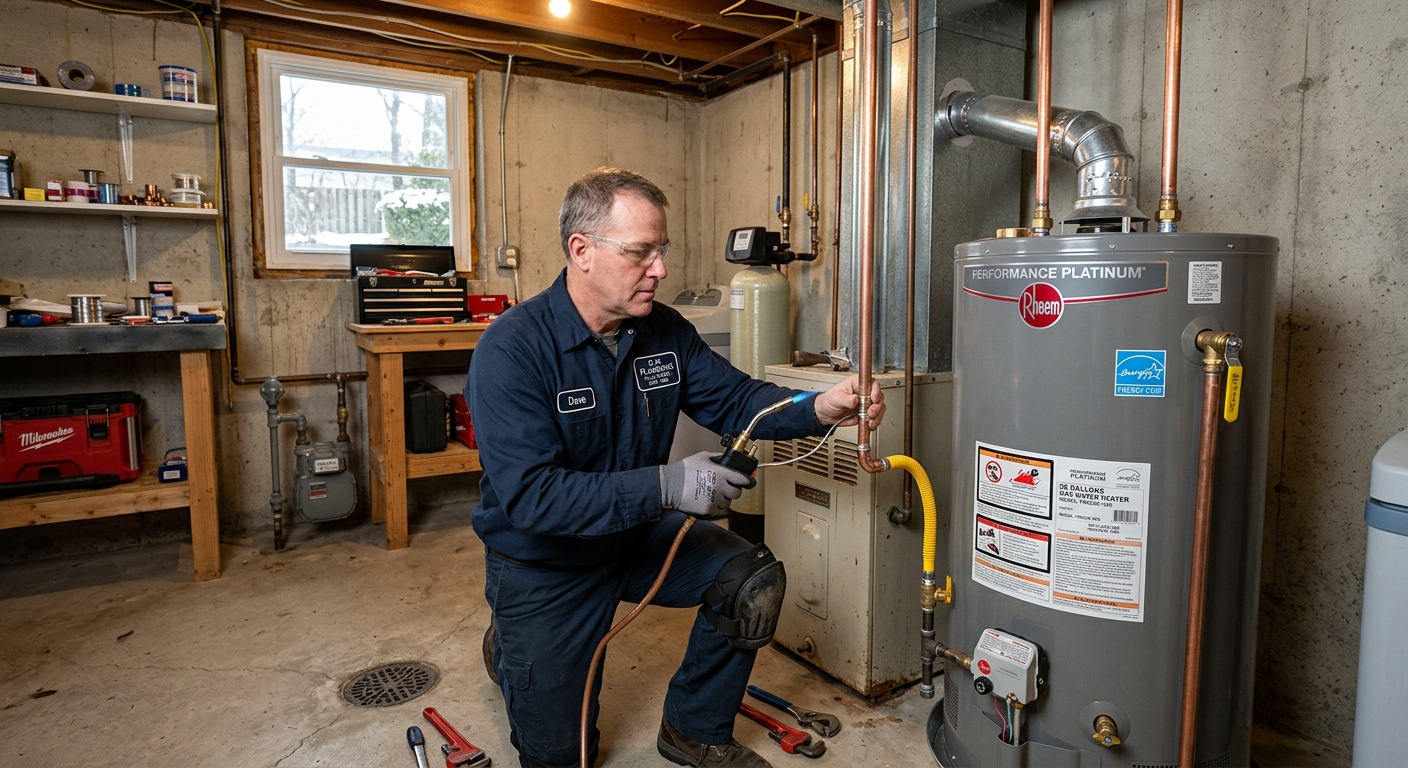
The table shows ballpark prices. For emergencies—burst pipes, late-night leaks—expect the “emergency” rate. For replacements or non-urgent fixes, rates settle lower. What moves the price most in West Caln? Access: if your shutoff is buried, or your pipes are under slab, expect the high side. Pipe material comes next—PEX replacements are cheaper than copper.
| Service |
Scope |
Emergency rate |
Standard rate |
| Emergency repair — burst pipe |
locate, open, repair section, restore service |
$650–$1,300 |
$375–$1,300 |
| Water heater replacement (gas, 40–50 gal) |
remove old, install, test, haul away |
$2,100–$3,100 |
$1,300–$3,100 |
| Drain cleaning — main line |
augering or hydro-jet, camera if needed |
$350–$800 |
$200–$500 |
| Sewer line spot repair |
excavate or reline a failed section |
$2,200–$13,000 |
$2,200–$13,000 |
| Whole-house repipe |
replace supply lines throughout, patch and finish |
|
$3,800–$9,300 |
| Water service line replacement |
street to house, excavation and restoration |
|
$6,000–$13,000 |
Estimates for a typical West Caln home. Access difficulty and pipe material move these figures more than anything else.
What a plumbing quote should contain
Plumbing quotes in West Caln use two basic billing models. A flat-rate quote means the contractor’s taking on the risk: if the job runs long, they eat it, and you get price certainty. Time-and-materials (hourly), on the other hand, can come out cheaper for small, clear-cut fixes—if you’re confident there won’t be surprises. The problem isn’t either model; it’s not understanding which you’re agreeing to. So always ask which type it is.
Look for a clear diagnostic fee and whether it gets rolled into the job if you hire them. Every real quote should spell out the scope: what’s getting opened, what’s being replaced, and what they’ll restore—especially patching of drywall or flooring. If you’ll need a permit (required for most new or replacement plumbing tied to public water), make sure it’s included and priced, not shrugged off as “not necessary.” Warranties should spell out labor (their work) separately from parts (manufacturer’s). If a job might run after hours, you want to see any overtime or emergency surcharge quoted up front.
| Line item |
What to look for |
Red flag if… |
| Billing model |
flat rate or hourly, stated up front |
unstated |
| Diagnostic fee |
amount, and whether it credits |
vague |
| Scope |
what is opened, repaired and restored |
price with no scope |
| Restoration |
drywall and finish explicitly in or out |
silent |
| Permit |
included and priced |
'not needed' |
| Parts |
brand and model for fixtures |
'standard fixture' |
| Warranty |
labour period stated separately |
parts only |
West Caln's housing stock and its plumbing
With nearly 80% single-family homes in West Caln and only about 31.7% built before 1980, most properties here fall into the late 20th-century construction boom typical of Chester County. That means you’ll usually find copper supply lines as original equipment in homes from the 1960s through the 1990s, PVC or ABS for drainpipes, and the strong possibility your main sewer lateral, if original, is clay tile up until the 1980 cutoff.
Polybutylene—a gray plastic supply pipe notorious for sudden failures—can crop up in homes from the late 1970s to mid-1990s, though by the early 2000s, PEX became standard in the area for remodels and new installations. If your house was built after 2000, chances are you have PEX supply lines and PVC drains. The common thread is this: “newer” doesn’t mean bulletproof. Builder-grade fixtures and first-generation water heaters are at or beyond their expected life now, and we see repiping jobs prompt up thanks to hard water scaling or pinhole leaks in original copper pipes.
For anyone with part of the house dating pre-1980, galvanized steel might lurk behind a finished wall. Those pipes close up from corrosion, killing water pressure well before they spring a visible leak. If your sewer line hasn’t been dug up, clay tile joints are vulnerable to root intrusion. Water heaters in West Caln’s typical post-1960s homes are often on their second or even third replacement. What’s in your walls traces straight back to your home’s era—runway left depends on it.
Pipe materials in West Caln homes and how they fail
In West Caln, you can often trace your pipes by your address’s age. With most local building clustered from the 1960s through 2000s, copper and PVC or ABS drains dominate, but the edges of this window might bring headaches typical of the original materials used then.
Galvanized steel, found in pre-1960 homes, can be picked out by a gray metallic look and the fact that a magnet sticks. Corrosion chokes these pipes from the inside, causing pressure drops. Copper lines—reddish, non-magnetic, soldered at joints—were common from the 1950s on. While robust, they’re vulnerable to pinhole leaks where water chemistry is aggressive. Polybutylene, hid under plastic, blue or gray, with crimped bands at joints, was used from the late 1970s up to mid-1990s but proved unreliable; fitting failures mean bursts, and insurance companies often won’t cover water damage from these pipes. PEX, a flexible colored plastic, so the pipe itself isn’t brittle, has led the way since the 2000s.
For drains, cast iron—thick, black, heavy, and magnetic—predates 1975. It rusts inside and cracks with age (50–75 years tops). Clay tile sewer laterals, pre-1980, are brown-orange and easily split at joints, letting in roots. PVC and ABS, now standard since the 1970s, are white or black; these pipes don’t corrode, but can be crushed by settling soil or separated at joints. Use a scratch test or a magnet to verify material if you’re unsure.
| Material |
Typical era |
Failure mode |
Service life |
| Galvanized steel supply |
pre-1960 |
internal corrosion, pressure loss |
40–60 yrs |
| Copper supply |
1950s–present |
pinhole leaks, joint failure |
50–70 yrs |
| Polybutylene supply |
late 1970s–1995 |
fitting failure, sudden bursts |
unreliable |
| PEX supply |
2000s–present |
fitting or UV degradation |
40–50 yrs |
| Cast iron drain |
pre-1975 |
corrosion, cracking, scale |
50–75 yrs |
| Clay tile sewer lateral |
pre-1980 |
root intrusion at joints, offset |
50–60 yrs |
| PVC / ABS drain |
1970s–present |
joint separation, crushing |
50+ yrs |
Who is allowed to do plumbing work in Pennsylvania
Pennsylvania does not issue a statewide plumbing license. Instead, licensing is handled by each municipality. That means a plumber licensed in Philadelphia or Pittsburgh may hold no credential in West Caln or even in the neighboring township—every municipality sets its own rules. Here in Chester County, some townships like Westtown issue local plumbing contractor registrations; in others, you should check directly with your township office to confirm what’s required.
For most work on public water or sewer (including replacements and major repairs), you’ll need a permit—a township plumbing permit is standard in some places. Work is inspected by the township or, if they’ve opted out, by the Pennsylvania Department of Labor & Industry. Always ask your contractor if your job needs a permit and who will pull it; that cost should be on your quote.
Home improvement jobs over $500 require the contractor to be registered with the Pennsylvania Office of Attorney General; you can confirm this at hic.attorneygeneral.gov. For jobs where workers are on site, your plumber must carry workers’ compensation insurance—check their insurance certificate, and you can verify coverage using the WCAIS system at wcais.pa.gov. For homes built before 1978, any work that disturbs painted surfaces must comply with the federal EPA Lead RRP Rule, so ask about their renovator certification if you have an older home.
How to find a good plumber in West Caln
In West Caln’s part of Chester County—a suburban plumbing market with plenty of active companies—start by making sure any plumber you’re screening meets local requirements, not just the state minimums. Municipal licensing means you must verify whether the company is registered right here, not just “somewhere in PA.” Look up their Home Improvement Contractor (HIC) registration for jobs over $500 and check active workers’ compensation insurance through WCAIS.
Ask if the company uses its own crews or subs out the work. Request their insurance certificate with your property named, and confirm the plumbing permit and restoration scope is clear on paper. A reputable company should spell out emergency and after-hours rates before the van rolls. Beware if a plumber tries to sell you a whole-house repipe or sewer replacement without first providing camera footage or a pressure test summary; that is a common sign of a sales-first contractor in dense local markets like Chester County.
- Check HIC registration at hic.attorneygeneral.gov
- Verify workers’ comp on wcais.pa.gov
- Ask if licensed specifically in West Caln or your township
- Request insurance naming your property
- Get a written quote that spells out billing (flat or hourly)
- Confirm diagnostic fee and if it applies to the repair
- Demand scope, not just a price
- Ask if permits and restoration are included and listed
- Check if their warranty covers workmanship, not just parts
- Ask if they use employees or subcontractors for major work
- Be very cautious if no camera or pressure test is offered for drain or sewer jobs
- Get emergency/after-hours surcharges in writing up front
Red flags in West Caln’s market: no local credential, cash deals over $500 without a contract, repipe proposals based only on age, and anyone unwilling to provide footage or a test report for major repairs. With so many working plumbers in Chester County, the best don’t hide their paperwork.
What's in the water here
Public water for most West Caln homes comes from Aqua Pennsylvania’s southeast division or the West Chester Area Municipal Authority. Both must provide an annual water quality report (“Consumer Confidence Report”) you can request directly. In this region, hardness is common, putting scale in water heaters and fixtures—shortening their life. For homes with copper pipes, aggressive (slightly acidic) water may also bring pinhole leaks, though this is less pronounced in newer supply districts.
Whole-house water softeners can reduce scale, but the economics are marginal unless you keep burning through water heaters—between replacement cost and operating expense, the payoff can be slow. If “rotten egg” odors or staining show up, point-of-use filtration at the kitchen sink usually gives better bang for buck than a full-home system. West Caln’s public water is generally considered safe, and unless you have a specific quality concern or immune issue, most treatment gear sold door-to-door is oversold for local needs.
If your property runs a private well, you’re on your own for water quality—no report, no guarantee. Yearly testing for bacteria, nitrates and lead is good practice. For public systems, request and review the local report before spending on any new filter.
Frequently asked questions — plumbing in West Caln
Am I responsible for the water line under the street?
Under most circumstances in West Caln and greater Chester County, homeowners are responsible for the water service line from the house all the way to the curb stop, which is typically at or near the street. The utility generally owns and maintains the main in the roadway, but if your service pipe between the main and your house develops a leak—even under a sidewalk or driveway—you are responsible for repairs. If you have to replace the entire service line (from street to house), you should budget $6,000–$13,000 in this area, especially if significant excavation and restoration are needed. It's important to check with your water provider (like Aqua Pennsylvania) for any local exceptions, but as a rule, the cost and responsibility for private line repair or replacement in West Caln fall to the homeowner.
Should I leave a faucet dripping in cold weather?
In West Caln, where the frost depth reaches about 30 inches and winter temps can dip well below freezing, homeowners sometimes resort to leaving a faucet dripping to prevent pipes from freezing. This tactic can work, but it’s usually most effective in older homes with supply lines in uninsulated spaces—think crawlspaces or exterior walls, common in the township’s pre-1980 stock. If your home is newer or has pipes tucked away from cold drafts, this measure is rarely needed. A leak caused by a burst pipe will easily run $375–$1,300 for repairs, so protecting vulnerable pipes is reasonable. Instead of leaving water running all winter, insulate pipes in unconditioned areas and keep cabinet doors open under sinks backed up to exterior walls during the coldest nights for local peace of mind.
Is a tankless water heater worth it in West Caln?
Tankless water heaters are marketed heavily in West Caln, but whether they pay off depends on your home and usage. They save space and, with proper installation, can last longer than tank-style heaters. However, the up-front installed cost is higher in Chester County—often far more than the $1,300–$3,100 range for a 40–50 gallon tank replacement. In homes with hard water (common here), extra maintenance is needed to avoid lime scale. If you have a large family with frequent hot showers, they can be a fit; if not, payback for the average homeowner is slow. For most in West Caln, a quality tank water heater is still the most cost-effective and hassle-free swap.
Why do plumbers charge a diagnostic fee?
Plumbers in West Caln, like elsewhere, charge a diagnostic fee to cover the time and expertise required to find the source of a problem before repairs begin. It typically ranges from call-out costs for a minor leak all the way up to portion of a full emergency service charge (which might be $650–$1,300 for major leaks). This fee is not just for showing up, but for tracking down the fault, sometimes requiring use of specialized tools or camera equipment. Most reputable local plumbers will credit all or part of this fee toward the final repair if you proceed with their proposal. Always check up front whether the diagnostic charge is a separate bill or applied to the work, so you’re not surprised.
How do I shut off the water to my house?
In nearly all West Caln homes, your main water shutoff valve is located where the service line enters the basement or crawlspace—usually along a front wall or sometimes right next to your water meter. Turn the valve clockwise to cut water to the entire house. If you have an emergency, like a burst pipe (which can cost $650–$1,300 to repair in a hurry), this is step one. If the valve is stuck or corroded—common in homes with original plumbing—you might not be able to close it fully. In that case, call your plumber straight away. Knowing the location and function of your shutoff before you need it can save thousands in water damage and emergency service costs.
Do older West Caln homes have galvanized pipes?
Homes built in West Caln before about 1960 often used galvanized steel pipes for water supply. About 31.7% of local housing stock is pre-1980, so there’s a decent chance your older property could have these pipes hiding behind walls and ceilings. Galvanized steel corrodes from the inside, causing reduced water pressure and, eventually, leaks. Replacement with copper or PEX is a common repair in these houses, running $3,800–$9,300 for a full repipe. If you’re noticing rusty water or poor pressure, or see gray threaded pipes where your water enters, it’s worth an inspection.
What does repiping a house cost in West Caln?
For a whole-house repipe in West Caln—replacing all supply lines with either copper or PEX—you should expect to pay between $3,800–$9,300. The actual cost depends on access (finished basements, location of fixtures, and if you have to open a lot of walls), as well as pipe material. PEX generally lands at the lower end of this range, while copper is higher. Many Chester County homes from the 1960–2000 boom are hitting the age where repiping becomes smart money, especially if you have leaks or pressure issues with galvanized steel. Always demand a clear written scope (and, ideally, camera footage of issues if you’re also redoing drains) before booking large work.
Who inspects plumbing work in West Caln?
Plumbing inspections in West Caln are generally handled by the township code office. Chester County municipalities each run their own code offices, and the Pennsylvania Department of Labor & Industry steps in only if the township has opted out. When a permit is required—like for replacement of pipes tied to public water or sewer—the work is inspected to ensure it meets the Pennsylvania Uniform Construction Code (based on the IRC). For major water line work (costing $6,000–$13,000), you’ll get a township inspection before backfilling a trench. Always verify that your contractor has pulled the right permit and scheduled final sign-off—you’re the one left holding the bag if there’s no record.
How do I tell what my pipes are made of?
To identify your pipe material in a West Caln home, check any exposed pipes where they enter in the basement or crawlspace. Galvanized steel is gray and magnetic, often with threaded joints; copper is reddish and joined with soldered (not threaded) joints; PEX is flexible plastic in red, blue, or white; and polybutylene is gray or blue plastic, with crimped metal bands at the joints. For drains: cast iron is black and heavy, PVC is white plastic, and ABS is black plastic. If you have no visible clues—say, all pipes are hidden—ask a plumber to inspect, especially if your house is near 50 or more years old. The era of your home often points the way, too: in West Caln, homes built 1960–2000 usually have copper supply lines, while those pre-1980 might have galvanized, and newer builds almost always use PEX. If repairs are coming up, knowing your material can shift costs from $375–$1,300 for a fix to a full repipe.