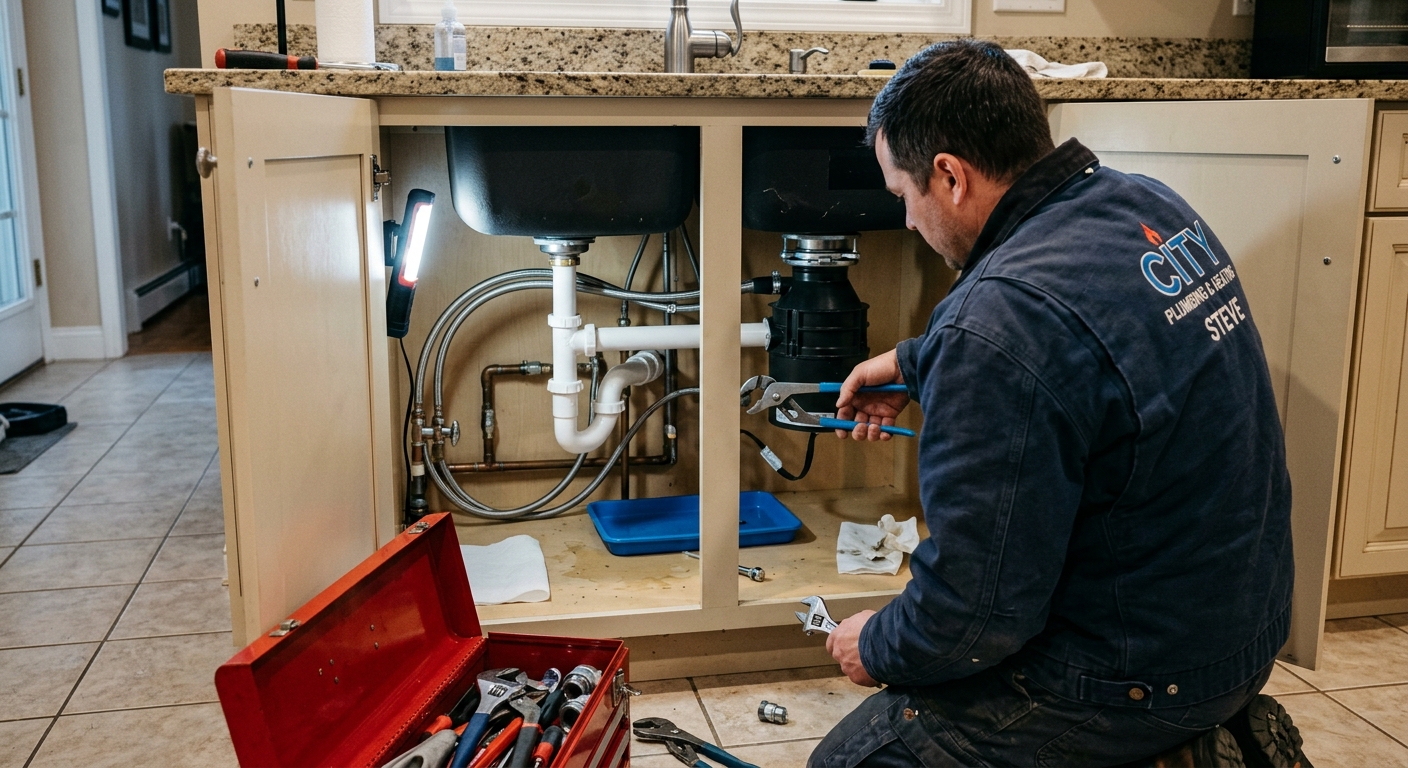
Plumbing costs in Greenville — 2026
In Greenville, where 87.5% of homes were built before 1980 and most are single-family houses (U.S. Census Bureau, ACS 2024), plumbing system age and material have a direct impact on repair frequency and cost. The era when a house was built predicts the original pipe material — and that determines what’s likely to go wrong and what it’ll cost to fix. For example, Hermitage and Sharon’s 1950–1980 subdivisions often see copper-to-PEX retrofits and failing clay sewer laterals, with older galvanized lines cropping up in pre-war homes and newer PEX in more recent builds.
Every plumbing job in Greenville carries two possible prices: one if it’s an emergency — outside business hours, active leaking, loss of water — and one if it’s a planned or scheduled repair. Emergency calls cost more, just from the logistics of dispatch, overtime, and the potential need for same-day restoration. A burst pipe on a freezing night gets you a different bill than scheduling next week, and the same goes for most repairs and replacements.
| Service |
Scope |
Emergency rate |
Standard rate |
| Emergency repair — burst pipe |
locate, open, repair section, restore service |
$550–$1,100 |
$325–$1,100 |
| Water heater replacement (gas, 40–50 gal) |
remove old, install, test, haul away |
$1,700–$2,500 |
$1,100–$2,500 |
| Drain cleaning — main line |
augering or hydro-jet, camera if needed |
$350–$800 |
$200–$500 |
| Sewer line spot repair |
excavate or reline a failed section |
$1,800–$11,000 |
$1,800–$11,000 |
| Whole-house repipe |
replace supply lines throughout, patch and finish |
— |
$3,200–$7,700 |
| Water service line replacement |
street to house, excavation and restoration |
— |
$5,000–$11,000 |
Estimates for a typical Greenville home. Access difficulty and pipe material move these figures more than anything else.
Is your water line lead? How to find out
Sharon and adjoining Shenango Valley systems, including those served by the Shenango Valley Water Company, maintain partial lead service line inventories — but there’s no county-wide count for Mercer County. Water lines are split: from the street to the curb stop is usually utility-owned, and from the curb to your house is yours. Replacement programs, when they exist, may only cover the utility-side—leaving you responsible for the rest.
To check your line’s material, find the main pipe where it enters your basement or crawlspace. Carefully scratch it with a coin or screwdriver: lead is silky gray and easy to mark, copper turns bright orange, galvanized steel is dull gray and rough. Test with a magnet: lead and copper are nonmagnetic, steel is magnetic. Never rely only on the era of the house—a previous replacement is always possible, especially with Greenville’s housing turnover.
If part of your service line is lead, replacing only your side can sometimes be worse than doing nothing—disturbing old pipes can release scale and temporarily raise lead levels. Always coordinate with the utility if your line is lead or unknown. The utility’s published service line map, if available, may note suspected lead lines; otherwise, call the Shenango Valley Water Company and ask directly. Don’t assume there’s a replacement program—Mercer County’s record is incomplete, so check with the utility about any cost sharing or eligibility for assistance.
Homeowners in older Greenville neighborhoods can expect a replacement cost between $3,200–$7,700 for a full repipe and $5,000–$11,000 for a water service line from house to curb. If you confirm lead, get several quotes and discuss safest replacement timing with both a plumber and your water provider.
Licensing and permits for plumbing work in Greenville
Pennsylvania does not issue a statewide plumbing license; instead, plumbing is licensed municipally. This means a plumber properly licensed in one city, like Philadelphia, may have no credentials at all in Mercer County. The right question in Greenville is not “Are you licensed?” but “Are you allowed to work here?”
Mercer County municipalities issue their own permits and may set different rules. If you live in Hermitage, for example, the City of Hermitage Building, Planning & Zoning Office handles permitting and inspections. Outlying townships around Greenville manage their own codes, inspecting work for compliance with the Pennsylvania Uniform Construction Code (UCC), which is based on the IRC and enforced either by the municipality or by the PA Department of Labor & Industry if the town has opted out.
For any plumbing job over $500, you must have a written contract, and the contractor must be registered as a Pennsylvania Home Improvement Contractor (HIC). You can verify a HIC at hic.attorneygeneral.gov. For larger jobs, expect the plumber to pull a permit; municipal code inspectors check work before it’s closed up.
All Pennsylvania employers must have workers’ compensation insurance. Homeowners can verify coverage through the WCAIS database (wcais.pa.gov). Before work starts, ask for proof of workers’ compensation and a certificate of insurance in your name — not just a photocopy.
Vetting a plumber in Mercer County
Because plumbing licensing in Pennsylvania is handled by each city or township, always confirm that a contractor is approved to work in your specific municipality. For jobs over $500, Pennsylvania requires Home Improvement Contractor (HIC) registration—verify it directly at hic.attorneygeneral.gov. Insurance verification is just as critical: require a certificate from their agent, with your address as certificate holder, and check workers' compensation status at wcais.pa.gov, since all employers must carry it in Pennsylvania.
Ask if the company uses its own licensed crews or subs out the work. For emergency repairs, nail down rates and after-hours surcharges up front. In areas like Mercer County, where the plumbing contractor market is moderate and spread between cities like Hermitage, Sharon, and Greenville, never accept a high-dollar repipe or sewer job without proof: that means camera footage and a pressure test if recommending a replacement.
- Verify HIC registration at hic.attorneygeneral.gov
- Check municipal licensing for Greenville or your township
- Get an insurance certificate naming your property
- Confirm workers’ comp on wcais.pa.gov
- Ask if crews are employees or subcontractors
- Insist on written estimates detailing the work
- Require camera footage for sewer or main drain jobs
- No main line replacement without a pressure test or camera*
- Know emergency rates and how they're charged
- Ask about permit responsibilities and inspection scheduling
- For pre-1978 homes, confirm EPA Lead RRP certification if disturbing paint
- Avoid up-front payments exceeding contract limits
Red flags: high-pressure sales, recommending a repipe or main line replacement without inspection, refusing to provide proof of registration or insurance, or subcontracting work without disclosure. In this market, there’s no reason to hire a contractor who withholds a camera view of your drain or fails to explain their pricing.
Plumbing systems in Greenville homes
Most Greenville homes were built before 1980, with nearly three out of four being single-family houses (U.S. Census Bureau, ACS 2024). In these older homes, you’ll commonly find galvanized steel or early copper supply lines and cast iron or clay tile sewer lines. While some original systems remain intact, most have seen at least one round of upgrades or spot repairs—especially in Hermitage, Sharon, and the subdivisions built during the 1950–1980 boom, which often have copper pipes running to bathrooms and kitchens and clay tile sewers to the street.
For homes built in the 1970s and 1980s, copper and early PVC/ABS drain lines are typical, though sewer laterals can still be clay. Post-1990 houses are more likely to have PEX supply lines and all-PVC drains. Water heaters in Greenville are generally on their second or third replacement cycle, meaning if yours is original to a home this age, you’re overdue.
Common trouble spots: original clay sewers (prone to root intrusion and bellied joints), aging galvanized supply lines (pressure loss and rust), early copper with pinhole leaks, and polybutylene if present (uncommon here, but possible in late-70s to early-90s homes). Most homes have had at least some supply pipes upgraded to PEX or copper, but complete replacements aren’t universal. If your home has never had a full repipe or sewer lateral replacement since construction, both are at or near the end of their expected service life.
Freeze risk and what to do about it
In northwestern Pennsylvania, including Greenville, the winter design temperature is 5 °F with a frost depth of 36 inches, and long, severe winters are the norm. Lake Erie’s lake-effect belt brings deep freezing spells and heavy snow, making pipe freezes a top concern every year.
The most common freeze failures are on supply pipes in exterior walls, unheated crawlspaces, garages, under cabinets along outside walls, and even in attics of older homes. Once a pipe freezes, the actual burst usually occurs between the ice plug and a closed faucet; when the ice expands, pressure builds up in the trapped water, causing a split somewhere downstream—not necessarily at the frozen point.
To prevent freezing, start with insulation on exposed and vulnerable pipes, particularly in crawlspaces and exterior walls. Add heat tape where insulation isn’t enough—especially for pipes running through garages or basements with marginal heating. In extreme cold snaps—single digits or lower—let one faucet drip slowly to keep water moving. Open cabinet doors under sinks on outside walls so room heat can reach hidden pipes. Before the first hard freeze in October or November, turn off and drain outdoor spigots.
If a pipe does freeze, use a hair dryer, space heater, or heat lamp—never a propane torch or open flame. Slow, gentle heat prevents pressure spikes and pipe damage. The cost of an emergency repair in Greenville for a burst pipe, including locating, opening the wall, and restoring service, ranges from $550–$1,100 (emergency rate). Spending an hour on prevention is the best investment you can make.
Galvanized, copper, PEX, cast iron
In Greenville, pipe material is written into the history of each home. Hermitage and Sharon’s postwar subdivisions (1950–1980) are thick with copper supply lines and clay tile sewer laterals, both now at or past their prime. Earlier homes use galvanized steel for supply—a magnet sticks, the bore narrows with rust, and water pressure dwindles until leaks or brown water force a change. By the late 1970s, some builders used polybutylene for its low cost, though it proved notorious for sudden failure at the plastic fittings—identifiable as flexible, gray-blue, stamped "PB." PEX, the current standard, is flexible, plastic, and color-coded, installed since the 2000s; it resists freezing well but needs protection from sunlight and relies on secure fittings.
Drain pipes show their own eras. Cast iron is unmistakable—thick, black, and heavy with leaded joints—lasting 50 to 75 years before corroding or cracking near fittings. Most houses built before 1980 with municipal sewers have clay tile laterals—tan-brown, brittle, with joints spaced every 3–4 feet. These often fail at the seams, letting roots in. Modern PVC and ABS, used since the 1970s, are white or black, lightweight, and easy to replace, but joints can separate if not glued right or may collapse if unsupported.
To check what you have, scratch an exposed pipe under a sink or near the water meter: bright orange is copper, gray and rough is steel or galvanized, dull gray and soft is lead. Use a magnet to confirm steel, and look at fitting types—threaded for galvanized, soldered for copper, plastic clamps for PEX. Knowing your home’s original build date and spotting past repairs lets you estimate how much life your plumbing has left.
| Material |
Typical era |
Failure mode |
Service life |
| Galvanized steel supply |
pre-1960 |
internal corrosion, pressure loss |
40–60 yrs |
| Copper supply |
1950s–present |
pinhole leaks, joint failure |
50–70 yrs |
| Polybutylene supply |
late 1970s–1995 |
fitting failure, sudden bursts |
unreliable |
| PEX supply |
2000s–present |
fitting or UV degradation |
40–50 yrs |
| Cast iron drain |
pre-1975 |
corrosion, cracking, scale |
50–75 yrs |
| Clay tile sewer lateral |
pre-1980 |
root intrusion at joints, offset |
50–60 yrs |
| PVC / ABS drain |
1970s–present |
joint separation, crushing |
50+ yrs |
Frequently asked questions — plumbing in Greenville
Who inspects plumbing work in Greenville?
In Greenville and other Mercer County towns, plumbing inspections are handled by the local municipal authority—never the state. That means if you’re in Hermitage, inspections come from their Building, Planning & Zoning Office, while outlying boroughs and townships have their own permit offices. If your municipality has opted out of code enforcement, the Pennsylvania Department of Labor & Industry takes over using the Pennsylvania Uniform Construction Code. Always ask your plumber to pull the necessary permits and coordinate inspection. Inspections check that all work follows the current code, especially material and venting, and that everything is safe before being covered up. For major work—like sewer line repairs, water service replacement, or whole-house repiping, which can cost $3,200–$7,700—get confirmation in writing that inspections are included and final sign-off will be provided.
How much does sewer line repair cost in Greenville?
Sewer line spot repair in Greenville typically runs from $1,800–$11,000, driven mostly by access difficulty, the type of failure, and how deep your line is buried. Clay tile is common in the area, especially in Hermitage and Sharon’s 1950–1980 subdivisions, and failures often mean digging through concrete, landscaping, or tree roots. Sometimes a repair is possible if the problem is just one section; in other cases, a full replacement is needed, especially if multiple joints have failed. Always insist on a camera inspection with video proof. If a plumber quotes you a replacement in the $5,000–$11,000 range without any evidence, get a second opinion—don’t trust anyone pushing unnecessary work.
Is trenchless sewer repair reliable?
In Greenville, trenchless sewer repair is a real option for homes with accessible pipe runs and compatible failures—like a single broken section, offset joint, or root-intruded clay tile (common before 1980). Pipe bursting or lining avoids most digging, saving landscaping and driveway surfaces. When done right, a trenchless spot repair can run $1,800–$11,000 and hold up just as long as a full replacement. However, not all pipes qualify—collapsed or back-pitched lines and excessive joint offsets still require excavation. Always verify that your plumber does a camera inspection before quoting trenchless work, and ask about the warranty terms. Done right, trenchless technology is both reliable and minimize disruption—but don’t let anyone sell you a repair without video evidence of what’s going on.
Is a sewer line replacement covered by homeowner's insurance?
Homeowner’s insurance in Pennsylvania, including Greenville, generally does not cover sewer line replacement due to age, corrosion, or root intrusion—those are considered normal wear. Some plans offer an add-on for “service line coverage” that pays for external line failures or accidental damage, but you need to add this before anything bad happens. For a typical replacement running $5,000–$11,000, out-of-pocket costs are the rule. Always ask your agent if you have (or can get) service line coverage and what’s excluded. For inside-the-home sewage backups, you may get partial coverage on cleanup or repairs if it’s a sudden event, but the source pipe repair itself is almost always on you. Confirm your own policy in writing before a big project.
Is Greenville on combined sewers or septic?
Greenville uses separated municipal sewers within borough boundaries, similar to Hermitage and Sharon, but in the outlying townships of Mercer County, individual septic systems are still widespread. If your home is inside Greenville’s limits, you’re most likely on municipal sewer and pay a quarterly bill; step into neighboring areas, and you could find yourself responsible for your own septic maintenance and replacement. Many older homes outside town are still on the original tanks or fields. For a failed sewer, spot repairs cost $1,800–$11,000, while full septic replacement can easily match those totals or exceed them. If you’re not certain, check your utility bills or local records before assuming which you have.
What does emergency plumbing cost in Greenville?
Emergency plumbing repairs in Greenville carry a premium: typical burst pipe response, including shutoff, finding and fixing the break, and getting water back on, starts at $550–$1,100 during an emergency call and may drop to $325 if scheduled. That extra cost goes to rapid response—after-hours dispatch, priority over other work, and the need to restore essential services before any further damage happens. Emergency rates are also common for major leaks, failed sump pumps during storms, and water heater blowouts. Always ask about after-hours charges up front, and if the emergency can wait until morning, you may save several hundred dollars just by being patient.
What do I do about a burst pipe right now?
If you have a burst pipe in your Greenville home, first turn off the main water shutoff—the valve is usually in the basement near where the line comes in. Open nearby faucets to relieve residual pressure and let any remaining water drain out. Move valuables and electric cords away from the leak. Call a plumber and clearly explain it’s an active leak—they’ll prioritize you. For an emergency repair, expect costs of $550–$1,100, depending on the extent and when it happens. If you can catch the leak early—like from a single frozen pipe in a crawlspace—sometimes a plumber can isolate and repair just that section. Never try to thaw a frozen pipe with an open flame; use gentle heat instead, like a hair dryer, and keep an eye out for additional leaks as the ice melts.
What does discoloured water on first draw mean?
Discolored water coming out of your faucet after it hasn’t been used for a while, especially in older Greenville homes, usually points to aging galvanized steel pipes or a corroding supply line. If it clears up after a minute, it’s likely from rust and minerals shaken loose overnight—not an active health hazard, but a warning flag your pipes are at or past their service life. Replacement costs can range from $3,200–$7,700 for a whole-house repipe. If you see black, gray, or milky water consistently, or particulate that doesn’t clear up, have a plumber inspect both your supply lines and water heater for failing materials. In rare cases, utility work or hydrant flushing can stir up sediments, but persistent discoloration is a sign your system needs attention.
How deep do water lines need to be buried in Greenville?
In Greenville, Mercer County and surrounding townships, water service lines must be buried deep enough to avoid freezing, which means at least 36 inches below grade—the local frost depth. With a winter design temperature of 5 °F and persistent snow, anything shallower risks freezing solid and bursting during the coldest spells. If you need a service line replacement, excavation and restoration typically range from $5,000–$11,000 depending on length and access. Good contractors in Greenville always install below frost depth and insulate exposed sections at the entry. If you see surface-grade lines or shallow runs, it’s a shortcut and needs correcting before the next hard freeze does the job for you.