What plumbers charge in Whitehall
In Whitehall, plumbing costs are shaped by the area’s older housing, with 84% of homes built before 1980 (U.S. Census Bureau, ACS 2024). This means galvanized or cast iron pipes are common, often hidden behind plaster or drywall, so access and material both push up repair costs. Much of Pittsburgh’s housing stock dates 1900–1950, increasing replacement work for aging galvanized and cast-iron piping—and Whitehall follows that pattern.
What you pay hinges on whether it’s an emergency call. The same repair is pricier after-hours, on weekends, or when water is running everywhere—a burst pipe at 2 a.m. costs more than a slow leak Tuesday at noon. Emergency work brings higher rates for labor and sometimes expedited access fees from supply houses for parts.
Older homes also drive higher replacement rates: it’s not unusual to replace a water heater or supply lines two or three times in a home’s life here. With 74.2% homeownership in Whitehall (U.S. Census Bureau, ACS 2024), most calls are for owner-occupied single-family homes, with buried lines and hard-to-access basements. That shapes how big the job—and the bill—might get.
| Service | Scope | Emergency rate | Standard rate |
|---|
| Emergency repair — burst pipe | locate, open, repair section, restore service | $600–$1,200 | $350–$1,200 |
| Water heater replacement (gas, 40–50 gal) | remove old, install, test, haul away | $1,900–$2,800 | $1,200–$2,800 |
| Drain cleaning — main line | augering or hydro-jet, camera if needed | $350–$800 | $200–$500 |
| Sewer line spot repair | excavate or reline a failed section | $2,000–$12,000 | $2,000–$12,000 |
| Whole-house repipe | replace supply lines throughout, patch and finish | | $3,500–$8,400 |
| Water service line replacement | street to house, excavation and restoration | | $5,400–$12,000 |
Estimates for a typical Whitehall home. Access difficulty and pipe material move these figures more than anything else.
Verifying a Whitehall plumber's credentials
Plumbing in Pennsylvania is licensed locally—never at the state level. There’s no statewide plumbing license; instead, cities and counties set their own rules. This means a plumber working legally in nearby Pittsburgh may not be authorized to work inside your Whitehall home unless they hold the right credential for your municipality. In Allegheny County, the Health Department handles journeyman and master plumber licensing for Pittsburgh and some nearby towns, but not everywhere. So don’t just ask, “Are you licensed?”—ask, “Are you licensed to work here, in Whitehall or my township?” It makes a difference.
If your project means new or altered plumbing systems—a new bathroom, replacing supply lines, or a water service line—you’ll need an Allegheny County Health Department plumbing permit. Inspections are carried out by the County. For minor fixture swaps, like faucets, most homeowners don’t need a permit; bigger changes always do.
If you’re signing a contract over $500, Pennsylvania requires your plumber to hold Home Improvement Contractor (HIC) registration, issued by the Attorney General. You can verify HIC status at hic.attorneygeneral.gov. Workers’ compensation is mandatory for all employers; check coverage via WCAIS at wcais.pa.gov. Always ask to see their insurance certificate with your property named, not just “blanket” coverage. That way you know you’re protected should anything go wrong during the job.
The point where patching stops making sense
If you’ve had two or more leaks in the same section of pipe within three years, patching has usually run its course. This is especially true in older Whitehall homes, where much of the original material is galvanized steel or cast iron. The other sure signals: drop in water pressure across the entire house (not just one fixture), reddish or brown tint in water after sitting, visible rust or corrosion at exposed joints, or repeated pinhole leaks. One-off leaks happen, but multiple failures are a system warning.
With these older materials, ongoing patchwork is like bailing out a boat with a hole in it. Replacement makes more sense. For supplies, you’ll generally choose between copper and PEX; copper lasts long but costs more, while PEX is flexible, faster to install, and easier on the budget—both are code-compliant under the Pennsylvania UCC. For a whole-house repipe, what homeowners sometimes forget is the cost and hassle of wall and ceiling repairs after the pipes are replaced. In pre-1950s homes with plaster, patching and repainting often costs as much as the plumbing itself, especially if access is tight.
| Situation | Recommendation | Cost | Reasoning |
|---|
| One leak, accessible, modern pipe | Spot repair | $350–$1,200 | Leak is isolated, material is sound |
| Two or more leaks in 3 years | Partial repipe | $3,500–$5,600 | Leaks are a pattern, pipe is failing |
| Galvanized supply, pressure loss | Full repipe | $3,500–$8,400 | Galvanized clogs and restricts flow |
| Polybutylene anywhere in the house | Full repipe | $3,500–$8,400 | Material prone to failure, insurers don’t like it |
| Cast iron drain with root intrusion | Camera, then reline or replace | $2,000–$12,000 | Roots indicate opening or collapse; camera confirms scope |
| Suspected lead service line | Test, then replace the lateral | $5,400–$12,000 | Lead line must be fully removed for safety |
What construction era means for your pipes
Whitehall housing is mostly older, with 84% of homes built before 1980. In this era, supply lines are usually galvanized steel or copper; drains are cast iron; and mains feeding the house are often lead, galvanized, or copper. Many laterals from the street, especially pre-1950, were lead or galvanized. Clay sewer laterals are also common, and are notorious for root intrusion. If your main drain backs up or you see orange-brown water after sitting, it’s likely these aging pipes acting up.
In these older homes, water heaters are rarely original—most are on their second or even third replacement by now. Insulation, and sometimes access, is also worse than modern builds, making every plumbing job a little more involved. You’re less likely to have builder-grade fixtures, but more likely to find legacy surprises behind the walls—like mixed materials or unexpected transitions.
If you’re in newer pockets of Whitehall (post-1980), you may have copper or early PEX for supply lines, ABS or PVC drains, and probably a “builder special” water heater reaching its first replacement. Polybutylene can show up in homes built late 1970s through the 1990s, and should be proactively checked and replaced, as insurance companies often require it upon discovery.
Service line material and drinking water in Whitehall
The Pittsburgh Water and Sewer Authority supplies most of Whitehall, including the lines under both public streets and your front yard. The water service line is divided: the utility owns the portion from the main to the curb stop, but the homeowner owns from curb stop into the house. Replacement programs usually cover only the public side, leaving the private lateral your responsibility in most cases. The utility has identified and is replacing thousands of lead service lines in Allegheny County, but unless you receive a direct notice, don’t assume yours is covered—call to check or consult their online inventory.
You can check your line’s material by finding where the pipe enters your basement. Use a scratch test—a dull scraper reveals gray and soft for lead, shiny silver for galvanized, and copper for, well, copper. A magnet won’t stick to lead or copper. If you find a lead or galvanized line, full replacement is needed for safe water; partial replacement, where only the public or private side is changed, can actually increase short-term lead levels as old scale is disturbed.
The cost for a full water service line replacement, street to house with excavation and restoration, generally falls between $5,400–$12,000. If you only need to replace the lateral from curb to house, expect $5,400–$12,000. If your sewer line also needs spot repair in the process, add $2,000–$12,000. Always verify with the Pittsburgh Water and Sewer Authority whether cost share or reimbursement is available—in some years, they offer it, but don’t count on it unless confirmed in writing.
How to find a good plumber in Whitehall
In Whitehall, where licensing is municipal, you can’t assume every plumber advertising in Allegheny County has the right credential for your address. Always confirm they’re licensed for Whitehall or your specific municipality—especially since the Allegheny County Health Department handles licensing for some areas, but not all. Pennsylvania requires Home Improvement Contractor (HIC) registration for any job over $500; check this at hic.attorneygeneral.gov. Insist on a current insurance certificate naming your address and verify workers’ compensation at wcais.pa.gov.
Whitehall is part of the Pittsburgh metro’s crowded plumbing market with union and non-union contractors. Ask if the company uses its own employees or subs out work. Emergency rates should be disclosed clearly in writing, not vague phone quotes. If a contractor recommends a whole-house repipe or sewer replacement without camera inspection or pressure tests, it’s time to call someone else—especially when market competition is high.
- Confirm license is valid for Whitehall or your specific municipality
- Check HIC registration at hic.attorneygeneral.gov
- Ask for insurance certificate naming your property
- Verify workers' comp via wcais.pa.gov
- Find out if crews are employees or subcontractors
- Require detailed, written emergency and off-hours pricing
- Get contract terms in writing (required by state law over $500)
- Require camera footage before authorizing sewer work
- Insist on a pressure test for supply leaks or repiping
- Ask who is responsible for wall/drywall repair after plumbing
- Request local, recent references in Whitehall
- Check for clear written estimate with scope and exclusions
Red flags in Whitehall’s busy market: high-pressure sales for big jobs without proof, no written contract, vague warranty details, or reluctance to provide licensing or insurance paperwork. A reputable firm never shies from documentation or describing the exact scope to justify a price.
Frozen pipes in Whitehall: prevention and thaw
Whitehall winters are real: the local frost depth runs 36 inches, with winter design temps dropping to 8 °F and plenty of freeze-thaw cycles. Most piping failures don’t happen where the ice is—they burst between the freeze plug and a closed valve, as built-up pressure splits the line. That’s why water floods a room when the thaw comes, not while the pipe is still frozen.
In this region, the riskiest spots are pipes running through exterior walls (bathroom sinks and kitchens on outside walls are classics), unheated basements or crawlspaces, garages, and any water line running through an attic or under-insulated area. Outside spigots and hose bibbs are early victims if they aren’t drained before the first hard freeze.
Prevention, in order of cost: plug air leaks in foundations and walls, insulate all exposed supply pipes, use heat tape (thermostat-controlled, not the basic stuff), open cabinet doors under sinks in extreme cold, let a trickle run at the furthest faucet overnight on the coldest nights, and shut off and drain outdoor spigots well before December. Safe thawing is slow and steady: a hair dryer, space heater, or warm towels—never an open flame, which is how fires start in these old houses.
If a pipe bursts, you’re looking at $600–$1,200 for emergency repair, before the cost to patch walls or fix water damage. Spending a weekend insulating and prepping can save a major bill—and a much bigger headache—when temperatures plunge.
Frequently asked questions — plumbing in Whitehall
Is a sewer line replacement covered by homeowner's insurance?
Homeowner’s insurance in Pennsylvania—and specifically in Whitehall—usually does not cover sewer line replacements when it’s due to wear and tear, age, or root intrusion. If there’s damage from accidental causes, like a sudden collapse from earth movement, a specific policy rider might help. But most claims for failed, cracked, or root-intruded pipes are denied because these are seen as maintenance issues, especially in older areas like Whitehall, where 84% of homes stand pre-1980 and pipes are aging. Expect to pay for the work yourself; sewer line spot repairs regularly cost $2,000–$12,000. Always check your specific policy and ask your agent in advance—better to know before the problem hits.
Is Whitehall on combined sewers or septic?
Whitehall sits in central Allegheny County, which means wastewater arrangements are mixed. Pittsburgh proper—and many nearby older suburbs—use combined sewer systems that carry stormwater and sewage in the same pipe. However, outlying townships in Allegheny County still have a mixture of separated sewers and private septic. If you’re in Whitehall, you’re almost certainly tied into the local central sewer system maintained by the Pittsburgh Water and Sewer Authority or a municipal system, with only rare exceptions. If you’re not sure, call the water authority or check your property records. Issues with combined sewers may explain backups during storms, and repairs here run $2,000–$12,000 for a spot fix.
Should I wait until business hours to call?
If you have a slow, contained leak or dripping fixture, it’s usually safe to wait and call a plumber during normal business hours—the emergency rate isn’t worth it for a non-urgent job. But if you have a burst pipe, sewer backup, or active water leak threatening structure or property, don’t wait—even overnight or on weekends. In Whitehall, emergency repair rates for a burst pipe run $600–$1,200, but water damage from delay can be far more costly. If you’re unsure, shut off water to the house and assess. Never risk major damage to save a few hundred bucks; but for non-safety issues, daytime makes sense.
What causes low water pressure in Whitehall homes?
Low water pressure in Whitehall is most often linked to old galvanized or partially-blocked supply pipes—especially in homes built before 1980. As galvanized steel pipes age, they choke down with rust and mineral buildup, reducing flow across the entire house. Sometimes pressure problems are at just one fixture (likely a blocked aerator), but if it’s everywhere, it’s likely the main supply. A partial or full repipe typically costs $3,500–$8,400. Pressure regulators sometimes fail too, so a plumber will generally check both the regulator and main lines before recommending replacement.
How much does a water heater replacement cost in Whitehall?
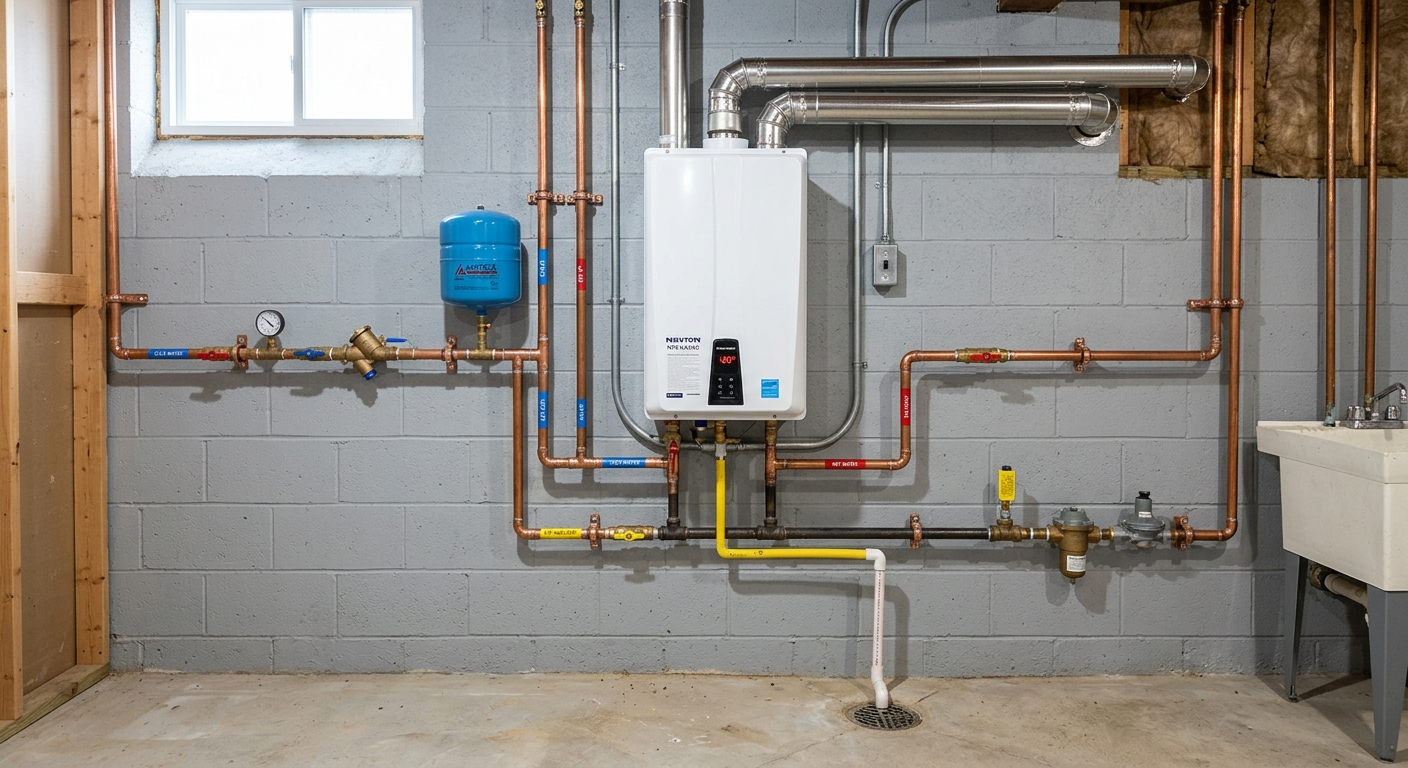
In Whitehall, replacing a standard 40–50 gallon gas water heater—including removal of the old tank, installation, testing, and haul away—costs between $1,200–$2,800, with many typical jobs around $1,900. Older homes with tight basements or tricky venting may push toward the top of the range. Swapping electric for gas or vice versa, changing from tank to tankless, or rerouting plumbing/venting will add to the price. Always confirm that your installer is registered for home improvement in Pennsylvania and licensed for plumbing in your exact municipality.
Should I reline or replace my sewer line?
In Whitehall, the choice between sewer line relining and full replacement depends on the condition of the pipe and how accessible it is. For short sections with isolated damage (like root intrusion in a mainly sound clay or cast iron line), trenchless relining is less disruptive and costs $2,000–$12,000. If the line is collapsed, belly-sagged, or otherwise structurally unsound for long stretches, you’re looking at full excavation and replacement, which runs toward the high end of that band. Always require a camera inspection before agreeing to major work—never let a contractor talk you into replacement based on guesswork.
How do I prevent frozen pipes in Whitehall?
With winter lows reaching 8 °F and a frost depth of 36 inches, Whitehall homes are not immune to winter pipe bursts. Prevention is key: insulate all exposed pipes, especially in unheated basements, crawlspaces, exterior walls, and garages. Use heat tape on vulnerable lines, keep cabinet doors open under sinks on cold nights, and allow a slow trickle from the farthest fixture when it’s especially bitter. Shut off and drain outdoor spigots before deep winter, as that’s where many early season breaks occur. The cost of fixing a burst pipe starts at $600–$1,200, so even basic prep pays for itself in peace of mind—spend your time and a little money now to avoid a big emergency repair later.
What does emergency plumbing cost in Whitehall?
Costs for emergency plumbing in Whitehall swing based on timing, access, and the problem itself. An after-hours burst pipe or main supply leak will generally cost between $600–$1,200 to locate, open, and repair, including restoring service. Other urgent work—like a clogged sewer line, bad water heater, or leaking drain—can add to that, especially if major excavation or restoration is needed. Emergency rates reflect both overtime labor and the real cost for a plumber to set aside regular jobs for your crisis. For non-emergencies, wait for daytime service to keep rates in the $350–$1,200 zone.
Do I need a permit for plumbing work in Whitehall?
In Whitehall and most surrounding Allegheny County municipalities, a plumbing permit from the Allegheny County Health Department is required for new or altered plumbing systems—like installing supply lines, a new bathroom, or running a water service line. Plumbing permit requirements aren’t enforced at the state level, but local rules govern. Minor fixture swaps like faucets or showerheads usually don’t need a permit. For anything over $500, Pennsylvania’s Home Improvement Consumer Protection Act requires a written contract; don’t waive this, as it protects your right to cancel for three business days. Permit costs are reasonable, with the real expense in the plumbing labor, which for a full repipe runs $3,500–$8,400. Always confirm requirements with your plumber before work starts to avoid fines or failed inspections.