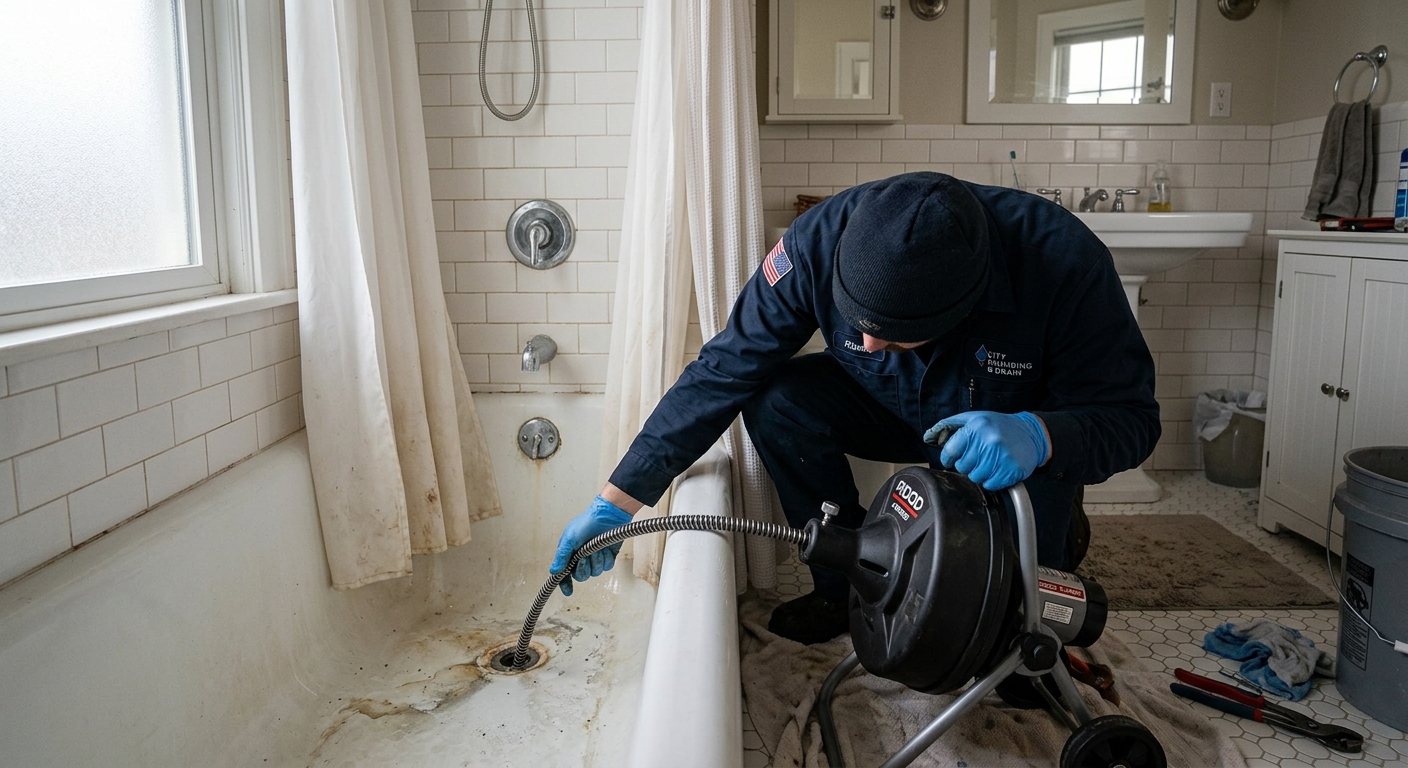
What plumbers charge in DuBois
In DuBois, the age and construction of your house have more to do with what you'll pay for plumbing work than just about anything else. Most single-family homes here—nearly 70% (U.S. Census Bureau, ACS 2024)—were built during the post-1945 wood-frame boom around DuBois and Clearfield. This era saw copper used widely for supply lines and galvanized steel for drains. Copper lasts, but pinholes and leaks get more common as those fittings hit their fifth and sixth decade. Galvanized pipe is even trickier, since it rusts internally and clogs the older it gets. As a result, plumbing jobs here swing between “quick fix” and full-blown replacement, depending largely on what you uncover when opening a wall.
Rates for plumbing in DuBois follow a clear fork: emergencies (anytime water is where it shouldn’t be, or you’re without service) cost more—sometimes double. The premium comes not just from after-hours labor, but the fact that plumbers shift scheduled jobs aside to make an urgent call. In a region with only about 2,000 owner-occupied homes (U.S. Census Bureau, ACS 2024) and a rural contractor base, travel surcharges are common.
| Service |
Scope |
Emergency rate |
Standard rate |
| Emergency repair — burst pipe |
locate, open, repair section, restore service |
$550–$1,100 |
$325–$1,100 |
| Water heater replacement (gas, 40–50 gal) |
remove old, install, test, haul away |
$1,750–$2,600 |
$1,100–$2,600 |
| Drain cleaning — main line |
augering or hydro-jet, camera if needed |
$350–$800 |
$200–$500 |
| Sewer line spot repair |
excavate or reline a failed section |
$1,850–$11,000 |
$1,850–$11,000 |
| Whole-house repipe |
replace supply lines throughout, patch and finish |
|
$3,200–$7,800 |
| Water service line replacement |
street to house, excavation and restoration |
|
$5,000–$11,000 |
Estimates for a typical DuBois home. Access difficulty and pipe material move these figures more than anything else.
Emergency rates versus scheduled work in DuBois
Plumbing prices in DuBois split sharply between work you schedule and work that’s truly urgent. The “emergency premium” has several causes: the plumber reroutes their day to help you first, pays overtime if it’s after hours, and often solves a problem on the spot without knowing exactly what’s hiding behind old wood and plaster. That makes emergencies unpredictable both for you and the person doing the work. For example, stopping a burst copper line at 11pm will run you $550–$1,100 instead of the usual $325–$1,100 if it could wait till daylight.
What actually counts as an emergency here? You should pick up the phone right away if:
- There’s active flooding from a burst pipe, a failed water heater, or a drain backup.
- You have no water service anywhere in the house.
- Sewage is backing up into tubs, toilets, or the basement.
- You smell gas near a water heater—this is never a wait-and-see issue.
On the other hand, these problems can usually wait until regular business hours (and regular rates):
- A slow drip under a sink (shut off that fixture’s supply valve for now).
- One slow drain, as long as water is moving and there’s no sewage odor.
- A toilet that won’t stop running (close its supply valve behind the bowl).
Your best tool: shutoffs. At every fixture (sink, toilet, water heater), you’ll see small valves below the unit—turn them clockwise to shut off supply. At the main, usually in a basement or pit near where water comes into the foundation, turn the lever or wheel clockwise to stop all water. Taking this step can save you hundreds by making almost any leak a non-emergency job.
What's in the water here
If your house is in DuBois or Clearfield Borough, your tap water comes from the Clearfield Municipal Authority public system, which publishes an annual water quality report—just call and request it. That report will tell you about hardness (minerals in the water), treatment chemicals like chlorine, and whether any contaminants have been found. Most homes here see moderate hardness, which shortens the life of water heaters and makes scale ring up inside faucets and showerheads. Left unchecked, scale can kill a heater well before ten years are up, pushing you sooner toward the $1,100–$2,600 end for water heater replacement.
Some DuBois and Clearfield homes also struggle with ‘aggressive’ water—low pH eating away at copper from the inside, causing pinhole leaks. A softener helps with hardness but not with corrosion, and unless you’re dealing with stubborn white buildup and soap scum, the investment for a whole-house system is hard to justify financially. If your water tastes fine and leaves you with no residue, skip the fancy filters—simple carbon filters at the kitchen tap are enough for most families here unless the utility report recommends more. (Point-of-use filters are cheaper and targeted.)
On private wells—common in some outlying Clearfield County townships—you’re responsible for testing, and no public report exists. At a minimum, test yearly for coliforms, and every few years for metals and nitrates. Steer clear of door-to-door water treatment sales; reputable labs are used by banks for mortgage testing, and you don't need anything special unless your test comes back with a problem.
Licensing and permits for plumbing work in DuBois
Plumbing in Pennsylvania is not handled by a statewide license. Instead, it’s enforced at the municipal level. What does that mean for you? A plumber may be qualified in one city, but hold zero credential in the next township over—even a few miles away. In DuBois itself, licensure runs through the City of DuBois Code Enforcement Office. Always ask if the contractor is licensed to work specifically in your municipality, not just “licensed in Pennsylvania.”
For most jobs in DuBois, especially replacing any part of your water or sewer service line from the street or curb into the house, a plumbing permit is required from the city’s code office. For minor fixture repairs inside a single-family house (like a leaky faucet) in Clearfield Borough, you won’t usually need a permit—but larger work triggers oversight. After work is done, inspections ensure it’s up to the Pennsylvania Uniform Construction Code (UCC), which the city enforces based on the IRC.
Pennsylvania also requires Home Improvement Contractor (HIC) registration for jobs over $500, which you can verify directly at hic.attorneygeneral.gov. For workers’ compensation, check coverage through the WCAIS system (wcais.pa.gov) before signing a contract. State law demands a written contract for any plumbing work over $500—your protection under the Home Improvement Consumer Protection Act. Don’t skip these checks; they’re your basic filter for a reputable plumber in DuBois.
Camera inspection, relining and replacement
In DuBois and Clearfield, the homeowner owns the sewer lateral all the way from the house to the main—often including the part under the street. That means if something clogs, breaks, or collapses, it’s usually yours to repair. The first sign is usually subtle: one slow drain. It often spreads to gurgling or slow flushing at other fixtures. If more than one drain moves slowly, or you see sewage backing up at the basement floor drain or tub, suspect a mainline problem.
Modern repairs start with a sewer camera inspection. For under $200–$500 (often rolled into a drain cleaning call), you should see footage of what’s happening inside the pipe—roots, breaks, or sags (“bellies”) show up clearly. Older homes in DuBois often have clay tile lines, which let tree roots creep in at the joints. Cast iron and PVC have their own weak spots—but it’s impossible to know what you’re up against without the camera.
If a problem is localized, spot repairs may run $1,850–$11,000, depending on depth and whether excavation or trenchless relining is possible. Relining (pulling in a new pipe inside the old) can avoid digging up your whole yard. Don't let anyone sell you a replacement job without letting you view the inspection video—this is routine and a basic standard in the industry.
In townships outside DuBois, many homes use septic. There, slow drainage and backups might mean the tank itself needs pumping every 3–4 years, or that the drainfield is failing, which calls for a completely different sort of contractor and solution. Be sure you know what system you’re on before calling for quotes.
What a plumbing quote should contain
Plumbers in DuBois tend to use two billing models: flat rate and time-and-materials. Flat rate gives you a fixed price for a specific scope; you pay the same even if the job winds up more complex. With time-and-materials, you pay by the hour, plus the cost of parts—so it can be less for simple repairs but open-ended if surprises lurk behind the walls. Neither is wrong, but it pays to know exactly which one you’ve signed up for before the plumber starts work.
Good quotes also spell out whether the diagnostic fee (to find the problem) gets credited against the final bill, or is always paid regardless. The itemized quote should be clear on what’s included—like wall and floor repairs after the plumbing is finished. Does the bid include drywall repair? Is the permit fee covered? Are both labor and part warranties written out? You want everything spelled out before work starts, as after-hours premiums and exclusions caught later are an expensive surprise. Here's what that should look like:
| Line item |
What to look for |
Red flag if… |
| Billing model |
flat rate or hourly, stated up front |
unstated |
| Diagnostic fee |
amount, and whether it credits |
vague |
| Scope |
what is opened, repaired and restored |
price with no scope |
| Restoration |
drywall and finish explicitly in or out |
silent |
| Permit |
included and priced |
'not needed' |
| Parts |
brand and model for fixtures |
'standard fixture' |
| Warranty |
labour period stated separately |
parts only |
Lead service lines in DuBois
In DuBois and Clearfield Borough, water is provided by the Clearfield Municipal Authority, which actively tracks both known and suspected lead service lines. What matters for you as a homeowner is that the line running underground from the water main to your house—the “service line”—is your responsibility, not the utility’s once it leaves the main. Most replacement programs (if offered) only upgrade the utility-owned segment; the section on your property is up to you unless you’re told otherwise.
To identify whether you have a lead service line, inspect where the water pipe enters your house (typically in the basement). Scrape it gently with a coin—lead is dull and soft. A magnet won’t stick to lead, but it will to steel. Most houses built before 1980 (86.5% here per U.S. Census Bureau, ACS 2024) were piped with copper or galvanized steel, but some older properties may still have partial lead lines.
If a lead line shows up, call the Clearfield Municipal Authority and ask for their current service line inventory; they’ll tell you whether you’re on their suspected list and what, if any, cost-share or replacement program exists (this is actively updated—don’t rely on rumor). For full replacement with excavation, expect $5,000–$11,000, though a spot pipe replacement involving only your half may be as little as $1,850–$11,000. Beware partial replacement—cutting out only one section of a lead line stirs up lead flakes and can spike your exposure for weeks. When you replace, replace the full length from the street to the house in one shot.
Frequently asked questions — plumbing in DuBois
Do older DuBois homes have galvanized pipes?
Yes, many DuBois homes built in the post‑1945 era feature galvanized steel drain lines and copper supply pipes. The widespread use of these materials followed the wood-frame construction boom across DuBois and Clearfield. Galvanized pipes were common until the early 1960s; while durable, they corrode and gradually scale shut inside, leading to slow drains or complete blockages. Once a line is too constricted, it’s often more cost-effective to replace it than attempt repeated cleanings. Expect a whole-house repipe—replacing galvanized with PEX or copper—to cost between $3,200–$7,800 for a typical DuBois home. Knowing your construction era and checking exposed pipes in the basement will give you a clear answer about what’s in your walls.
Is a sewer line replacement covered by homeowner's insurance?
Standard homeowner’s insurance in DuBois and the rest of Pennsylvania almost never covers the cost of repairing or replacing a failed sewer lateral, especially if the problem is due to age, corrosion, or tree roots—all common locally. Some insurers offer a specific sewer backup or underground utility rider, but it’s optional and not included by default. Without this, the full cost of a sewer spot repair (ranging $1,850–$11,000) is paid by the homeowner. It’s best to call your insurer before there’s an issue and ask what, if any, coverage you actually have. The slow shift of responsibility from the city to the property line in DuBois means checks like this are essential.
How long should a water heater last in DuBois?
With DuBois’ moderately hard water, gas water heaters usually last around 8–12 years—sometimes shorter if scale accumulates or the tank isn’t flushed yearly. Most units fail by leaking from the base, not heating water efficiently, or rusting out the connection pipes. With more than 86% of local homes built before 1980, you’re often replacing a heater installed by a prior owner, sometimes long past its prime. A new 40–50 gallon gas heater, including haul away and installation, will run $1,100–$2,600. If your heater is ten years old or more, leaks, or can’t keep up with demand, it’s usually more economical to replace than repair.
What do I do if sewage is backing up?
If you have sewage backing up into your tub, floor drain, or basement in DuBois, stop using all water immediately—don’t flush, run sinks, or do laundry. First, check your home’s main sewer cleanout (usually a white plug in the basement or crawlspace). Call a local plumber and request an emergency mainline drain cleaning, which typically costs between $350–$800 under emergency rates. If multiple homes nearby are also backing up, call your municipal authority, as the main may be blocked. Most backups result from root infiltration or broken clay tile, both common in post-war construction here. Never let anyone dig until you’ve seen the camera footage—it’s the standard first diagnostic step.
Do I need to drain outdoor spigots in DuBois?
Yes, freezing temperatures in DuBois are a fact of life, with winter design lows at 2°F and frost reaching 36 inches deep. Failing to drain and shut off outdoor spigots almost guarantees a cracked pipe or burst fitting—one of the most common reasons for emergency calls in late fall. Before the first hard freeze, turn off the inside shutoff valve supplying the spigot (often in your basement), then open the outdoor valve to drain water fully. Skipping this step risks a costly emergency pipe repair of $550–$1,100, especially if a freeze causes a break behind finished walls.
What does drain cleaning cost in DuBois?
Mainline drain cleaning in DuBois varies based on urgency. If you schedule during business hours, expect to pay $200–$500; if it’s an emergency call (like sewage backing up or multiple fixtures clogged at once), that jumps to $350–$800. Most blockages are caused by tree root intrusion in older clay or cast iron pipes, which post‑1945 homes in DuBois still have. High-pressure hydro-jetting or camera inspection are additional costs but may be necessary for stubborn or repeat blockages. For single slow drains, some plumbers will offer a lower-tier rate.
Repair or replace a leaking water heater?
In DuBois, if your water heater is leaking from the tank itself—rather than a connection—you’re almost always better off replacing it. Hard water and scale make corroded tanks hard to salvage, especially in homes built before 1980. Basic repair (like swapping a valve or heating element) may be worth it if the unit is less than a decade old, but a full replacement, including install and haul away, will cost between $1,100–$2,600. If the heater is over ten years old or repeatedly loses efficiency, replacement is a better bet than pouring money into a failing unit.
Who inspects plumbing work in DuBois?
In the City of DuBois, plumbing inspections are handled by the DuBois Code Enforcement Office, which administers the Pennsylvania Uniform Construction Code (UCC) for residential work. For service line replacements or major piping changes, the inspector will check for code compliance after installation but before any walls are closed up. It's not uncommon to need two visits—one for rough-in, one for final. Contractor licensing isn’t statewide; make sure your plumber is permitted to work in DuBois. For major jobs costing over $500, confirm the contractor has a valid Pennsylvania Home Improvement Contractor (HIC) registration and current workers’ compensation coverage you can verify via WCAIS.
What does emergency plumbing cost in DuBois?
Emergency plumbing in DuBois brings a clear premium due to after-hours labor, travel surcharges, and the need to solve problems immediately, even in the middle of the night. Most burst pipe or active leak calls cost between $550–$1,100—double what you might pay if the same repair could wait for a scheduled appointment. Travel costs are higher outside DuBois or Clearfield, as the local contractor base is thin. Always shut off water at the main to limit damage and, if safe, wait for business hours; it can save several hundred dollars per repair.