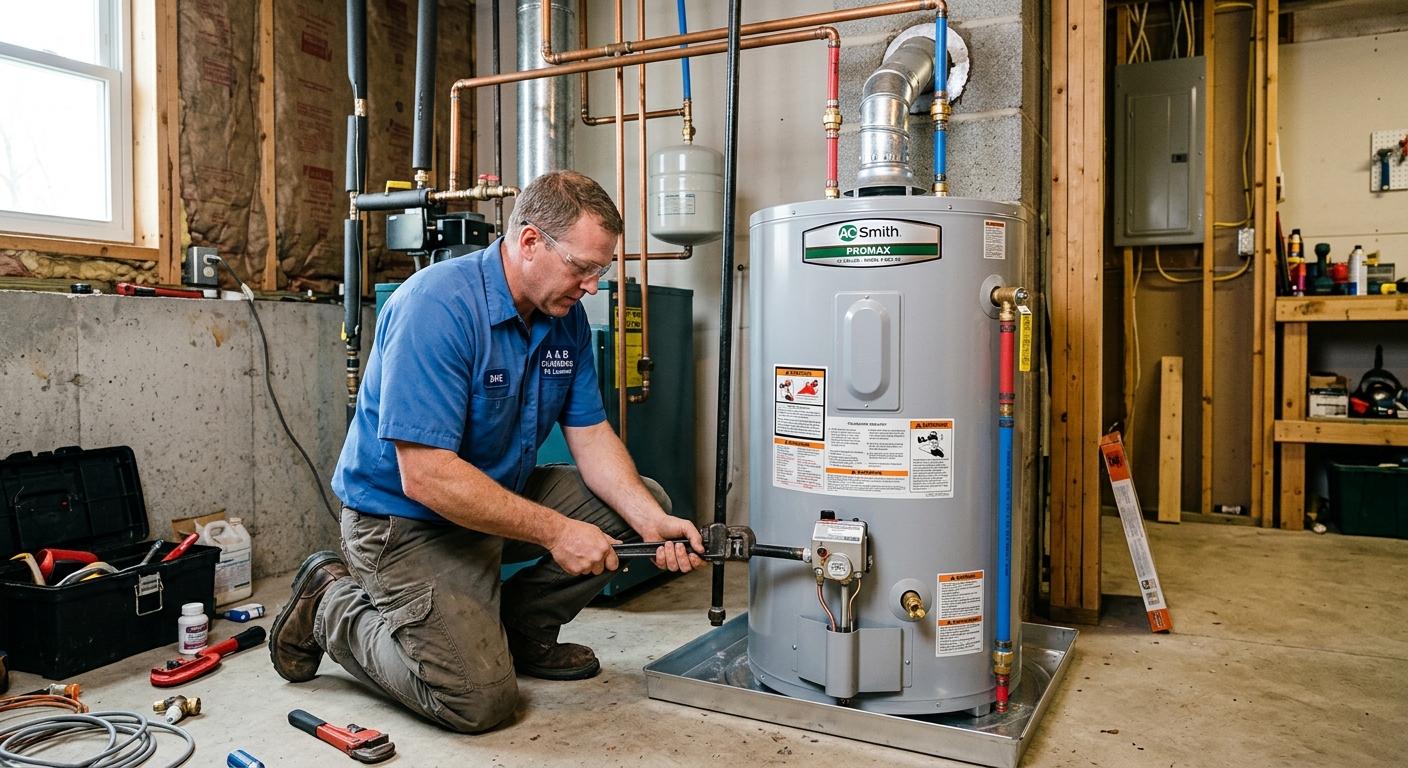
What plumbers charge in Dallas
Dallas, in Luzerne County, sees plumbing costs shaped by two things: the age of the housing stock and whether you need a repair right now, or can schedule work. Over half of homes here went up before 1980, and many are much older (U.S. Census Bureau, ACS 2024). That’s key, because older properties in Wilkes-Barre and Hazleton often still have galvanized supply pipes, cramped access for repairs, and original drains. Construction era tells you what you’ll pay: replacing failed legacy pipes is never as cheap as a quick fix on newer copper or PEX.
Emergency calls carry a premium in Dallas. The same pipe repair that’s $350–$1,200 when you book ahead becomes $600–$1,200 when you’re dealing with a 2 a.m. leak pouring into the basement. This price swing impacts every major plumbing job, from water heaters to sewer line spot repairs. Homeownership here is high at 76.6% (U.S. Census Bureau, ACS 2024), so many residents will face these choices as systems age.
Below is what you can realistically expect to pay for common plumbing jobs in Dallas. All work is impacted by how easy it is to reach pipes and what material you’re dealing with—older multifamily homes frequently add hours to even basic jobs.
| Service |
Scope |
Emergency rate |
Standard rate |
| Emergency repair — burst pipe |
locate, open, repair section, restore service |
$600–$1,200 |
$350–$1,200 |
| Water heater replacement (gas, 40–50 gal) |
remove old, install, test, haul away |
$1,950–$2,900 |
$1,200–$2,900 |
| Drain cleaning — main line |
augering or hydro-jet, camera if needed |
$350–$800 |
$200–$500 |
| Sewer line spot repair |
excavate or reline a failed section |
$2,000–$12,000 |
$2,000–$12,000 |
| Whole-house repipe |
replace supply lines throughout, patch and finish |
|
$3,600–$8,700 |
| Water service line replacement |
street to house, excavation and restoration |
|
$5,600–$12,000 |
Estimates for a typical Dallas home. Access difficulty and pipe material move these figures more than anything else.
Licensing and permits for plumbing work in Dallas
Plumbing licensing in Pennsylvania is handled at the local level, not statewide. This means that a plumber’s credentials are only valid in the municipality where they’re issued. In Dallas and throughout Luzerne County, always ask “Are you licensed here?” not just “Are you licensed?” For Wilkes-Barre, for instance, the Wilkes-Barre City Code Enforcement Office manages both contractor licensing and building code inspections. If a plumber is licensed in Wilkes-Barre, it does not automatically mean they’re authorized in Dallas or surrounding townships, where a separate local requirement may exist.
Projects involving new supply lines, drain work, or major fixtures frequently trigger permit requirements, particularly in Wilkes-Barre and similar boroughs. Always confirm up front if your job requires municipal inspection. Any significant work—especially anything that opens walls or disturbs existing supply—should come with a permit number, and the plumber should coordinate with the inspector.
Contractors doing jobs totaling more than $500 are required to hold Pennsylvania Home Improvement Contractor (HIC) registration through the Office of Attorney General. You can verify an HIC number at hic.attorneygeneral.gov. Insurance and workers’ compensation are similarly required for all employers and can be checked via the state WCAIS site (wcais.pa.gov). These steps ensure the plumber is not only allowed to work here, but is covered if anything goes wrong on site.
Choosing a water heater in Dallas
If your water heater in Dallas is due for replacement, your choices are tank (gas or electric), tankless gas, or heat pump. Each has real tradeoffs, and expensive changes don’t always pay off in this climate.
A basic gas tank heater is the cheapest upfront. It costs $1,200–$2,900 installed, lasts 8–12 years, but wastes energy keeping water hot and will eventually rust through the tank. Electric tanks are slightly more expensive to run, but have a longer service life.
Tankless gas (on-demand) models deliver endless hot water and more lifespan—up to 25 years—but installation is much higher: $1,950–$2,900. Many older Dallas homes are not set up for these: you’ll often need a larger gas line and a special vent, which can add hundreds to the job. If your home is older stock in Wilkes-Barre or Hazleton, be aware this can turn into a surprise budget item.
Heat pump water heaters are cheapest to operate and are becoming more popular as fuel prices rise. They run off electricity, but need plenty of space and pull heat from the surrounding air—so they cool the room they sit in, and are noticeably noisy in a finished basement. In a small or unheated utility room, that can be a dealbreaker.
No matter what, sizing by first-hour rating is more important than gallons—make sure recovery rate fits your morning or evening rush. For local code, expansion tanks and pans draining to a floor drain are standard. Replacements usually fail at the tank wall due to corrosion—controls rarely kill the heater first.
| Type |
Installed cost |
Service life |
Operating cost |
Best when |
| Gas tank, 40–50 gal |
$1,200–$2,900 |
8–12 yrs |
moderate |
Existing gas line, easy tank swap, moderate use |
| Electric tank, 40–50 gal |
$1,200–$1,950 |
10–15 yrs |
high |
No gas service, or low upfront budget |
| Gas tankless |
$1,950–$2,900 |
18–25 yrs |
low-moderate |
High hot water demand, able to upgrade gas/vent |
| Heat pump water heater |
$1,950–$2,900 |
13–15 yrs |
lowest |
Heated space, electric only, want energy savings |
Camera inspection, relining and replacement
Most homeowners in Dallas own their full sewer lateral—the pipe from your foundation to where it meets the city main or your septic tank. This holds you responsible for problems under your yard, driveway, or even beneath the street. It’s why early symptoms matter: a single slow drain might be a branch line, but multiple slow fixtures, gurgling when using another drain, or a backup at your basement tub almost always point to a problem somewhere in the main lateral.
If you’re seeing these signs, a camera inspection is step one. Never accept a quote for excavation without watching the camera footage yourself. A quality plumber will show you the actual problem: common issues include root intrusion (especially in older clay tile lines common to pre-1940 Wilkes-Barre homes), joint offsets from settling, and “bellies” where the pipe sags and holds waste.
Repairs fall into two broad types—dig and replace (open-cut) or trenchless (relining with an epoxy sleeve). Relining avoids tearing up drives and landscaping but isn’t always possible if the pipe is still collapsing.
In Dallas and much of Luzerne County, Wilkes-Barre homes are usually tied to separated public sanitary sewers. Outlying townships often still have single-home septic systems, where problems can be different—drainfield failure or an overfull tank. Those systems should be pumped out every 3–5 years to avoid backups, and repairs are rarely the same as a city sewer issue.
How to find a good plumber in Dallas
When hiring a plumber in Dallas, go beyond a business card. Licensing here is local, not statewide—so you must confirm your plumber is registered in your municipality, not just somewhere in Pennsylvania. Start by verifying their Pennsylvania Home Improvement Contractor registration using the Attorney General’s HIC search. For jobs in Wilkes-Barre, double-check that their municipal license is current via the Wilkes-Barre City Code Enforcement Office.
Look for a certificate of insurance that lists your Dallas property as “certificate holder.” Verify workers’ compensation coverage through the WCAIS portal. Ask if the company uses its own licensed crews or subs work out to whoever’s available. Get clear documentation and up-front pricing for emergency dispatch—this is where costs balloon, especially after-hours.
- Confirm HIC registration at hic.attorneygeneral.gov
- For Wilkes-Barre jobs, verify city license through Code Enforcement
- Request an insurance certificate naming your home address
- Check workers’ comp via wcais.pa.gov
- Clarify whether sub-contractors will be on site
- Ask for written estimates—required on jobs over $500
- Get a clear disclosure of emergency and after-hours rates
- Demand to see camera footage before a sewer repair is quoted
- Require a pressure test for any major supply repipe bid
- Make sure any permit is in the company’s name, not a “runner’s”
- Ask what materials are proposed (PEX, copper, etc.)
- Insist on start and completion dates in your contract
Red flags in Dallas: any contractor who wants cash, hands you a “business license” that isn’t municipal or HIC, won’t show live insurance, or quotes a sewer/proposed repipe without evidence. In Luzerne County’s crowded small-city market, aggressive upselling is common—don’t buy a big job unless you see the camera or pressure test proof yourself.
The point where patching stops making sense
In Dallas, two or more leaks in three years on the same piping isn’t just bad luck—it’s time to consider a repipe. You’re likely living with legacy galvanized supply or aging cast iron drain lines, especially in Wilkes-Barre’s pre-1940 multifamily housing. The repairs start to add up, and low water pressure across every fixture, rust tinge when you turn on the tap, or visible crusted joints signal a deteriorating system that patch jobs won’t solve.
A single leak on modern copper or PEX usually makes sense to spot repair. But repeated pinholes, especially on old galvanized, point to pipe walls thinning throughout the system. For supply lines, you’ll need to weigh copper (durable, familiar to older homes, but pricier and trickier to install behind plaster) versus PEX (less expensive and more flexible, but may not be code-approved everywhere depending on the inspector).
Don’t forget—the final dollar figure isn’t just plumbing. On older homes with plaster or finished basements, the cost to patch, paint, or re-plaster often comes close to the piping labor itself.
| Situation |
Recommendation |
Cost |
Reasoning |
| One leak, accessible, modern pipe |
Spot repair |
$350–$1,200 |
Cheapest fix, minimal disruption |
| Two or more leaks in 3 years |
Partial repipe |
$3,600–$5,800 |
Localized aging, upgrade critical runs |
| Galvanized supply, pressure loss |
Full repipe |
$3,600–$8,700 |
Galvanized is near end of life, poor pressure will not improve |
| Polybutylene anywhere in the house |
Full repipe |
$3,600–$8,700 |
Material known to fail, insurance risk |
| Cast iron drain with root intrusion |
Camera, then reline or replace |
$2,000–$12,000 |
Hidden condition determines the scope |
| Suspected lead service line |
Test, then replace the lateral |
$5,600–$12,000 |
Health risk mandates full replacement |
Winter pipe failures in northeastern Pennsylvania
Northeastern Pennsylvania winters are no joke. With a design temperature of 4°F and a frost depth reaching 36 inches, bursts from frozen pipes can hit any Dallas homeowner—especially in homes with uninsulated lines running through attics, exterior walls, or crawlspaces. Local conditions add risk: the high snow loads in the Poconos can press meltwater against foundation walls and lead to basement leaks if thaw cycles hit fast.
Freezing usually isn’t what actually breaks a pipe. The ice plug forms upstream, but the pipe ruptures between that plug and a closed faucet as pressure builds. That’s why the damage often appears away from where the pipe froze—sometimes only noticed when things thaw and water starts spraying inside a finished basement.
Most vulnerable spots are basement rim joists, garages, crawlspaces, hose bibs, and any plumbing left in unconditioned attic spaces. Top prevention steps (cheapest to most involved):
- Insulate any exposed pipes in unheated areas
- Install heat tape on especially at-risk lines
- On truly cold nights, let a trickle run at the furthest faucet
- Open under-sink cabinet doors to warmer room air
- Shut off and drain outdoor spigots before the first hard freeze
If pipes do freeze, use a hair dryer or heating pad—never an open flame. Most burst repairs cost $600–$1,200 in Dallas, and restoration from water damage can quickly double that. Spending an hour on prevention is far less expensive than a midnight call to dry out your basement.
Frequently asked questions — plumbing in Dallas
What does repiping a house cost in Dallas?
Whole-house repiping in Dallas generally costs between $3,600–$8,700. Your final number depends on your home’s size, the accessibility of the plumbing (which is a challenge in Wilkes-Barre’s older multifamily stock), and whether the replacement is with PEX or copper. Copper is more expensive, especially where finishes are hard to repair. With so many homes built before 1980, old galvanized pipe is common here, making repiping a frequent investment when leaks or rusty water start showing up. If you need lots of patching or have visible corrosion and falling pressure throughout the house, you’re better off putting that repair money into a full repipe, rather than chasing leaks every year.
Is a tankless water heater worth it in Dallas?
In Dallas, a gas tankless water heater is worth considering if your household runs through a lot of hot water daily and you’re willing to pay more up front—installation usually runs $1,950–$2,900, sometimes more if a new gas line or vent is required, which is common in older Wilkes-Barre or Hazleton homes. Tankless saves space, gives endless hot water, and can last 18–25 years. However, if your home isn’t already set up for it, the retrofit costs can wipe out any energy savings for years. For smaller households or when the budget is tight, staying with a tank may just make more sense. Heat pump water heaters are becoming popular as well for their low operating cost, but only make sense in heated spaces.
What causes low water pressure in Dallas homes?
Low water pressure across the whole house in Dallas is almost always traced to old galvanized or clogged main lines, which are common in pre-1940 housing throughout Wilkes-Barre and Hazleton. Sediment from aging supply or mineral build-up chokes off flow. If it’s just one fixture, look at the aerator or local shutoff. But whole-house drops, together with rusty or colored water, mean the pipes are nearing end-of-life. A repipe is typically needed at $3,600–$8,700. Also check your pressure reducing valve and main shutoff—both can fail, but in this market, pipes are almost always the culprit after 60+ years.
Are tree roots a common sewer problem in Dallas?
Yes, particularly in older sections of Dallas and Wilkes-Barre where clay tile sewer lines were standard for early 20th-century houses. Roots find their way into tiny gaps in pipe joints and expand, eventually blocking the lateral. Classic signs are slow drains on the lowest level, gurgling, or sewage backing up in your basement. Fixes start with a camera inspection, which typically costs $350–$800 bundled with drain cleaning. Major root jobs may require spot repairs or full relining at $2,000–$12,000. Don’t accept any replacement quote until you see the footage yourself.
How do I verify a plumber's licence and insurance?
The first step for any plumbing job in Dallas is to confirm the contractor’s Pennsylvania Home Improvement Contractor (HIC) registration at hic.attorneygeneral.gov. For work in Wilkes-Barre, cross-check their municipal license with the city’s Code Enforcement Office. Next, ask for an insurance certificate naming your property and check workers’ compensation coverage through wcais.pa.gov. Any job over $500 in Luzerne County requires a written contract under state law. Never work with a plumber who won’t show you proof or whose paperwork looks vague or mismatched. Always double-check before work begins, as local rules matter more than state credentials in this market.
What do I do if sewage is backing up?
If you’re experiencing a sewage backup in Dallas, the first move is to stop using water—don’t flush, don’t run the dishwasher—then call a plumber for an urgent camera inspection and cleaning. Backups are nearly always a blocked or collapsed lateral in homes tied to public sewer, or a failed tank or drainfield in rural areas with septic. Professional drain cleaning with video verification is typically $350–$800. If relining or excavation is required, expect $2,000–$12,000. Don’t let anyone quote excavation without proof on camera. After the line is clear and flow restored, sanitation and minor repairs may be needed, but rule out a recurring problem with proper diagnosis first.
What does drain cleaning cost in Dallas?
Main drain cleaning in Dallas typically costs $200–$500 for routine snaking, or $350–$800 if the job requires hydro-jetting or a camera inspection. Keep in mind that in pre-1940 houses found across Wilkes-Barre and Hazleton, older pipes mean heavier root infiltration and sometimes the need for specialized equipment. These jobs can run higher if tree roots or collapsed sections are found, but you should always be shown footage and given an estimate before agreeing to a more expensive repair. Annual root cleaning is common where mature trees are present near old clay lateral pipes.
Is a sewer line replacement covered by homeowner's insurance?
In most Dallas homes, homeowner’s insurance does not cover sewer line replacement for age, root intrusion, or normal wear and tear—which is how most failures occur in Luzerne County’s older housing stock. Sudden events, like collapse from a newly fallen tree, might qualify. Full replacements from house to street run $5,600–$12,000, making it a major out-of-pocket repair for most owners. You can check with your policy provider about optional sewer “backup” or “line protection” riders. Always clarify coverage before work: standard insurance rarely covers excavation or relining.
Do I need to drain outdoor spigots in Dallas?
Yes—northeastern Pennsylvania’s winters reliably drop below freezing, with a design temp of 4°F and frost line at 36 inches. Failing to drain outdoor faucets causes water in the pipe to freeze, expand, and burst the line inside your home (often behind the siding or in a basement ceiling). Always shut off the interior valve if present, open the outside spigot, and let it drain out before the first hard freeze. A burst hose line costs $350–$1,200 to repair, but can easily cause much more damage if in a finished room. Prevention is always cheaper than the mess left behind in spring.