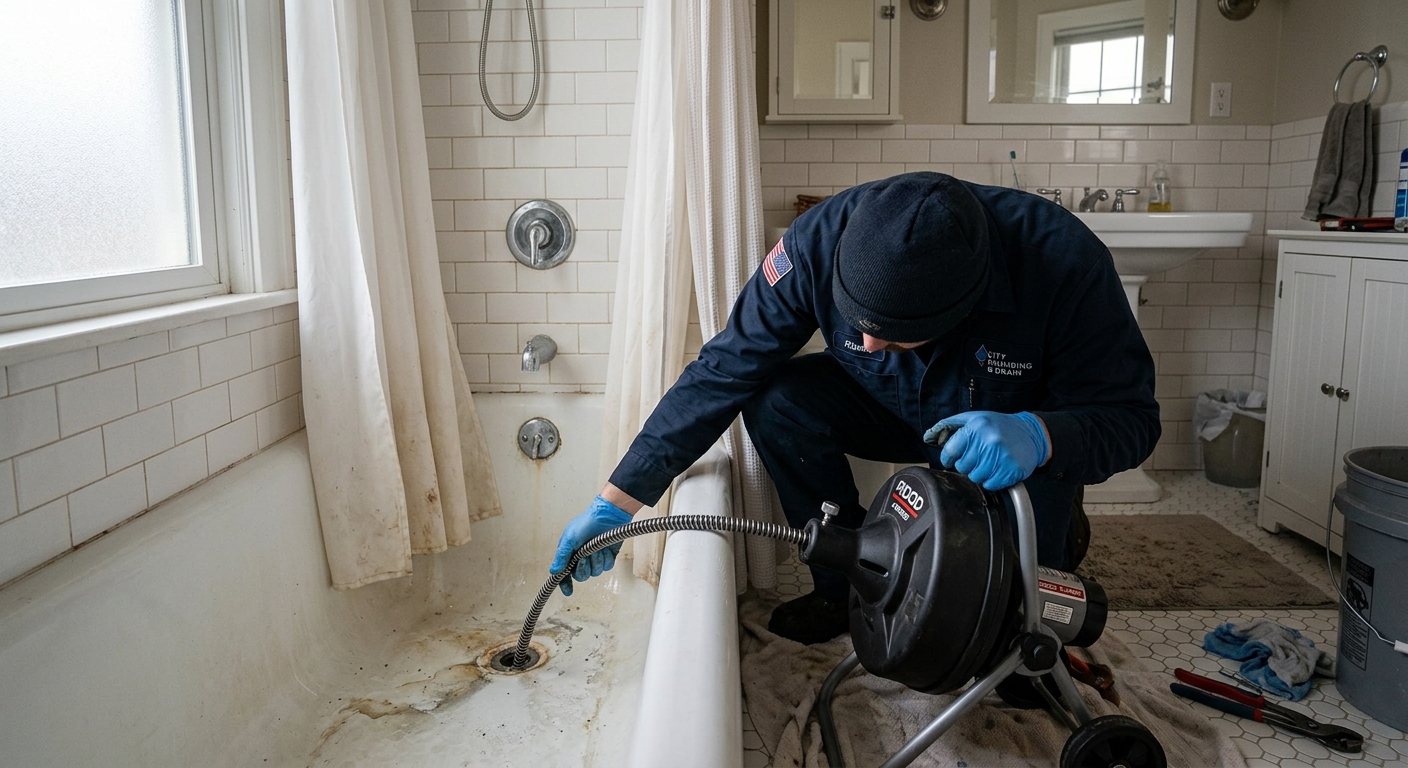
Plumbing costs in Aliquippa — 2026
In Aliquippa, the cost of plumbing work comes down to two factors: whether it is an emergency and the era your home was built. About 92.9% of homes here were built before 1980 (U.S. Census Bureau, ACS 2024), so Beaver County’s postwar boom left Aliquippa with single-family slab-on-grade homes and many galvanized supply lines. Construction era predicts material, and that material shapes the job — and its price. For example, older galvanized pipes are much slower to work on than newer PEX, so the same repair will cost more and take longer simply due to access and replacement difficulty.
Whether you call for an emergency or can schedule the work during regular hours sets the price from the top. Emergency repairs jump higher: burst pipes at night, no water service, or an active leak means paying the rapid-response rate. Standard work — like drain cleaning or a water heater swap when it’s not urgent — runs cheaper. Aliquippa’s moderate, suburban plumbing market means prices cluster near the region’s typical, but with local factors like slab floors and street-side shutoffs that can push costs up.
Here's what you can expect to pay for the most common jobs:
| Service |
Scope |
Emergency rate |
Standard rate |
| Emergency repair — burst pipe |
locate, open, repair section, restore service |
$550–$1,100 |
$325–$1,100 |
| Water heater replacement (gas, 40–50 gal) |
remove old, install, test, haul away |
$1,700–$2,500 |
$1,100–$2,500 |
| Drain cleaning — main line |
augering or hydro-jet, camera if needed |
$350–$800 |
$200–$500 |
| Sewer line spot repair |
excavate or reline a failed section |
$1,800–$11,000 |
$1,800–$11,000 |
| Whole-house repipe |
replace supply lines throughout, patch and finish |
|
$3,200–$7,700 |
| Water service line replacement |
street to house, excavation and restoration |
|
$5,000–$11,000 |
Estimates for a typical Aliquippa home. Access difficulty and pipe material move these figures more than anything else.
Hardness, treatment and fixture life in Aliquippa
Aliquippa’s public water is supplied by systems like the Beaver Falls Municipal Authority, which publishes an annual water quality report you can request directly. One thing to note in this area is that scale buildup from hard water is a routine cause of shortened water heater and fixture life. If you see white crust around your faucets or in your kettle, you’re seeing this mineral accumulation at work. Over a few years, your water heater can lose efficiency and need replacing at the lower end of its life span.
Copper pinhole leaks show up in places with aggressive or poorly balanced water, but they’re not as common as scale-related issues. A water softener takes care of hardness, but between its installation, salt refills, and waste water, payback isn’t automatic. If your fixtures are getting more than 8–10 years and your water heater is lasting a decade or more, a softener isn’t a necessity for most Aliquippa homes. Whole-house filters are overkill for most, unless you have a specific contaminant — something a water quality report will show. For drinking water, a single point-of-use carbon filter at the kitchen tap does 95% of the job at a fraction of the cost.
In Aliquippa’s rural fringe and townships, many homes use private wells. There’s no utility report for well water — it’s on you to test for contaminants yearly if you have a well, especially with older septic systems or clay and shale subsoils that move water quickly. Don’t take a sales pitch about $1,000s in filtration until you’ve had an independent water test.
Verifying a Aliquippa plumber's credentials
In Pennsylvania, plumbing is not regulated with a single statewide licence—licensing is done on the municipal level only. This means there’s no such thing as a “Pennsylvania licensed plumber.” Each city or township sets its own rules. In Aliquippa, the City of Aliquippa Code Enforcement Office oversees local plumbing permitting. A plumber licensed in one municipality might hold no credential at all just one town over. So, you don’t need to ask, “Are you licensed?” You need to ask, “Are you licensed to work in Aliquippa?”
For most jobs over $500, Pennsylvania law requires contractors to have Home Improvement Contractor registration (HIC), issued by the Pennsylvania Office of Attorney General. You can check HIC registration at hic.attorneygeneral.gov. On top of that, every employer must have workers’ compensation — this protects you if a worker is injured on the job. Homeowners can verify a company’s active workers’ comp policy through the WCAIS system at wcais.pa.gov.
Any new or replacement water or sewer service line connection in Aliquippa needs a plumbing permit. These are pulled from the City of Aliquippa Code Enforcement Office, and the city inspects the work. Before hiring, always ask to see the permit, HIC registration, and proof of insurance. If a contractor hesitates, keep looking — it’s a legal and safety requirement. For lead-related work in homes built before 1978, the federal EPA Lead RRP Rule also applies and you can verify certification at certifiedrenovatorsearch.epa.gov.
Galvanized, copper, PEX, cast iron
Beaver County’s housing boom after World War II left Aliquippa with thousands of slab-on-grade homes built between 1945 and 1970. Most of these still have galvanized steel supply lines unless the plumbing has been replaced. Galvanized pipes look dull gray; they attract a magnet and have threaded joints. Copper pipe is reddish and soldered, not threaded; a magnet won’t stick. PEX is colored (usually red, blue, or white plastic), flexible, and has crimped fittings. Cast iron drain piping is heavy, black, and clangs if you tap it. Clay tile sewer pipes outside are brownish and feel rough to the touch, with mortar joints.
Galvanized steel’s main failure is internal corrosion leaving the pipe constricted and pressure low well before you get pinhole leaks. Copper lasts long, but aggressive water chemistry can trigger pinhole leaks. Polybutylene (gray plastic, labeled “PB2110”) isn’t common, but it fails at fittings and insurers dislike it. PEX is now the standard and reliable if protected from UV light. Cast iron drains corrode with age and crack after 50–75 years; clay tiles let roots in at joints by 50–60 years.
For Aliquippa homes, if you rub an exposed pipe with a coin and gray metal shines (and a magnet sticks), it’s galvanized — plan for replacement soon. Most homes built before 1960 are running out the clock on these pipes, and the house era tells you what’s inside even if you can’t see all the plumbing.
| Material |
Typical era |
Failure mode |
Service life |
| Galvanized steel supply |
pre-1960 |
internal corrosion, pressure loss |
40–60 yrs |
| Copper supply |
1950s–present |
pinhole leaks, joint failure |
50–70 yrs |
| Polybutylene supply |
late 1970s–1995 |
fitting failure, sudden bursts |
unreliable |
| PEX supply |
2000s–present |
fitting or UV degradation |
40–50 yrs |
| Cast iron drain |
pre-1975 |
corrosion, cracking, scale |
50–75 yrs |
| Clay tile sewer lateral |
pre-1980 |
root intrusion at joints, offset |
50–60 yrs |
| PVC / ABS drain |
1970s–present |
joint separation, crushing |
50+ yrs |
Tank, tankless or heat pump water heater?
When it comes time to replace your water heater in Aliquippa, you’ll choose between three main types: gas or electric tanks, tankless (on-demand), and heat pump water heaters. The standard tanked unit is the cheapest to buy and install — install costs run from $1,100–$2,500 for a 40–50 gallon gas model — but you’ll get 8–12 years before the tank rusts through. Tankless models cost more to install ($1,700–$2,500), often need a gas line upgrade, new venting, and sometimes permits. They last nearly twice as long, but upgrades can surprise your wallet.
Heat pump water heaters are efficient and cheap to run but need space and a temperate location. They cool the room they sit in and are noisy enough that a finished basement or utility closet may not be ideal. They’re usually best in large, unfinished basements where heat loss isn’t a downside. In Aliquippa’s older homes, space can be tight and basements damp, so consider your layout before committing. Use the first-hour rating (how much hot water it can deliver at once) as your sizing guide, not just the gallon size. Expansion tanks and drain pans matter if you want the warranty to count and don’t want water damage on the slab.
Most water heater failures come down to the tank itself rusting out, not the controls. Spending the premium for tankless only pays back if your hot water use is high and you plan to stay in your house long enough to enjoy the savings.
| Type |
Installed cost |
Service life |
Operating cost |
Best when |
| Gas tank, 40–50 gal |
$1,100–$2,500 |
8–12 yrs |
moderate |
gas available, lowest upfront, replacement |
| Electric tank, 40–50 gal |
$1,100–$1,700 |
10–15 yrs |
high |
no gas or venting, smaller homes |
| Gas tankless |
$1,700–$2,500 |
18–25 yrs |
low-moderate |
high use, can upgrade gas/vent |
| Heat pump water heater |
$1,700–$2,500 |
13–15 yrs |
lowest |
ample space, warm basement |
The leak you can hear but can't see
If you suspect a hidden leak in your Aliquippa home, start by doing a simple meter test: shut off every faucet and appliance, then check the water meter. If the dial is moving, you have a supply-side leak somewhere. This is free, and it proves whether water is escaping even if nothing is visible yet.
Professional leak detection comes next. Common methods include acoustic listening (listening for water movement in pipes in walls or under slabs), thermal imaging (infrared cameras can spot chill from water seepage), and tracer gas testing for the trickiest cases. Finding a slab leak (common in Aliquippa’s postwar slab-on-grade houses) or pinning down a leak in a wall cavity is a focused skill — the average service runs from $325–$1,100 depending on the time and technology needed. Expect higher rates for late-night calls and when the leak is especially inaccessible.
The right plumber will find the leak’s location before anyone opens a wall or jackhammers a slab. Scanning first saves time and keeps your home intact. If someone wants to start cutting without solid evidence, that’s backwards. Once a leak is confirmed, repair costs can stack, so accurate detection is your best way to save money from the start.
Lead service lines in Aliquippa
Aliquippa has an active lead service line replacement program, with the published inventory showing more than 1,000 lead laterals in the city. The split is: the water utility typically owns the pipe from the street main to your curb stop, but as a homeowner, you own the lateral from the curb into your house. Replacement programs usually cover just the utility side — sometimes both, but not always — and partial replacement can be worse for lead levels in the short term because it disturbs the old pipe’s protective scale.
To check your own line, look for an exposed service line inside your basement. Rub it with a coin: lead is soft, silvery, and will not attract a magnet. Copper is reddish, galvanized is a dull gray but magnetic. If it’s lead, it’s worth checking with the water utility about their replacement map or cost-share options — but don’t assume; details change and sometimes only the public right-of-way is covered.
Check the utility’s published inventory for your address and contact them directly about their current replacement policy. If you need to replace your own side, the typical out-of-pocket for a water service line replacement in Aliquippa will fall in the $5,000–$11,000 range, depending mostly on the difficulty of excavation. If you need a full repipe inside, that adds another $3,200–$7,700, but most homeowners can stage the work as budget allows.
Frequently asked questions — plumbing in Aliquippa
How do I verify a plumber's licence and insurance?
In Aliquippa and the rest of Beaver County, there is no statewide plumbing licence. Each municipality manages its own licensing, so always ask directly if your plumber is licensed to work in Aliquippa itself. For jobs over $500, anyone doing the work must be registered as a Home Improvement Contractor (HIC) with the Pennsylvania Office of Attorney General — you can check this at hic.attorneygeneral.gov. For workers’ compensation insurance, verify coverage with the WCAIS system at wcais.pa.gov, which shows active policies in Pennsylvania. The plumber must also be able to show you a copy of their local permit when required (such as for water and sewer service line connections). If you’re not shown valid credentials, keep looking. Emergency repairs here typically cost $325–$1,100, so making sure the company is legit is worth your time.
What do I do if sewage is backing up?
A sewage backup in Aliquippa is a health risk and needs fast action. First, stop using all water immediately — don’t flush, shower, or run laundry. Call a plumber familiar with both sewer and septic systems in Beaver County, as older Aliquippa neighborhoods are on combined sewers while the outskirts rely on septic. If you’re in the city, let the Aliquippa Code Enforcement Office know if the backup is in the main, as the problem may be shared. A main line drain cleaning or snaking typically runs $200–$500, but if it turns out to be a collapsed sewer line, repairs get much more expensive. Don’t wait hoping it will clear — backups never fix themselves, and prompt action minimizes damage and expense.
What does drain cleaning cost in Aliquippa?
For a typical home in Aliquippa, a main line drain cleaning job (using a cable machine or sometimes hydro-jetting) is generally $200–$500 if scheduled during normal hours. If it’s an emergency, late-night, or holiday job, the charge may rise to $350–$800. This includes clearing common root clogs in old clay tile laterals, which are still common under postwar homes in the city. Camera inspections are sometimes included, sometimes a surcharge — ask to confirm up front. Many backups are caused by roots or scale, thanks to our aging infrastructure, particularly in homes built before 1980, which is almost all of Aliquippa.
How do I find a hidden water leak?
If you think you have a leak you can’t locate in your Aliquippa home, start with the simple meter test: turn off all taps, appliances, and check your water meter. If it moves, you have a leak on the supply side. If you don’t find anything obvious, a professional plumber can use acoustic sensors, thermal cameras, or even gas tracing to find leaks in walls or under concrete slabs, which are common here because so many homes were built slab-on-grade. Expect these diagnostic services to start around $325 and run up to $1,100 for a complex job. Never let anyone start opening walls or floors without first pinpointing the leak with these non-invasive tools.
Is a sewer line replacement covered by homeowner's insurance?
In Aliquippa, the short answer is: rarely. Most homeowner’s insurance policies specifically exclude the cost of repairing or replacing buried sewer laterals unless you’ve added special coverage. Old clay or cast iron lines, common here, tend to fail from wear and tear, root intrusion, or ground movement, not a sudden covered peril. Some insurers offer limited “service line coverage” that might pay a portion — check your policy or call your agent. Out-of-pocket sewer line spot repair can run $1,800–$11,000 depending on how much pipe needs replaced and how difficult the excavation is. Reviewing your coverage before trouble strikes is a smart move.
Are tree roots a common sewer problem in Aliquippa?
Yes, tree roots invading old clay tile sewer lines are a very common problem in Aliquippa, especially in neighborhoods with mature trees and pre-1980 homes. Most of the older homes here use clay laterals, which develop loose joints over time, letting roots in. If your drains are gurgling, slow, or backing up, there’s a good chance roots are involved. Clearing these blockages is often handled with a main line cleaning, costing $200–$500 for a routine call. Persistent problems may mean the line itself is cracked or offset, requiring a camera inspection and possibly excavation or lining, which gets into the $1,800–$11,000 range. The key is to address roots early, before they fill the line and cause a full backup.
What does emergency plumbing cost in Aliquippa?
Emergency plumbing work in Aliquippa, such as fixing a burst pipe or stopping an active leak late at night, usually costs between $550–$1,100. If you can wait until regular hours, the bill drops, but after-hours response has a higher base rate and the price can rise quickly if the repair is hard to access — for example, in a slab foundation (common here) or when old pipe materials are involved. Always ask for the rate structure when you call — some companies bundle the first hour of labor, others charge as soon as they roll the truck. If your situation isn’t flooding or causing imminent damage, it’s worth asking if a same-day standard appointment can save you some money.
Is trenchless sewer repair reliable?
Trenchless sewer repair has become a standard option in Aliquippa for spot repairs or full line replacement, especially with clay tile or cast iron pipes. Methods like pipe lining or pipe bursting avoid open trench excavation, which is a big deal for slab-on-grade homes and those with mature landscaping. When done right, a quality liner or new pipe section should last 40–50 years, comparable to a full replacement. The price is still significant — expect $5,000–$11,000 for a full replacement depending on length and access. The key is making sure a proper camera inspection is done before and after, and that the contractor stands behind their warranty. For most Aliquippa homeowners, trenchless is a worthwhile upgrade if you plan to stay put.
How deep do water lines need to be buried in Aliquippa?
In Aliquippa and the rest of southwestern Pennsylvania, the frost depth is 36 inches. That means water service lines need to be buried below that depth — at least 36 inches from grade to the top of the pipe — to prevent freezing during our hard winters. Most replacement jobs involve digging a trench at least that deep, sometimes deeper if the landscape is sloped or to clear driveways and other obstacles (the area is known for hilly terrain and clay/shale soils). If a plumber quotes you a water line replacement less than $5,000, check that they’re actually meeting frost depth and local permitting requirements — cutting corners means freeze-ups and broken pipes next winter, which costs more in the end.