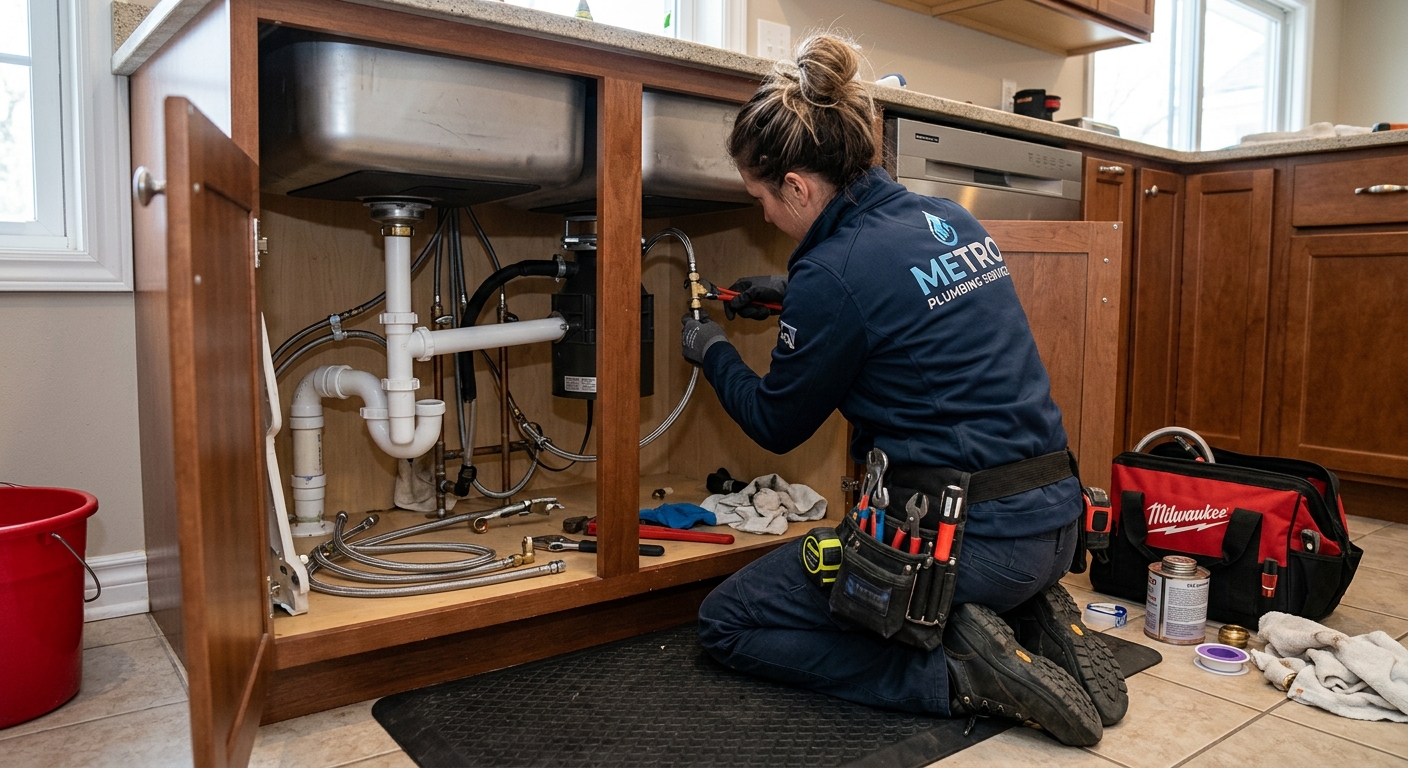
Cheltenham plumbing prices by job type — 2026
Cheltenham’s plumbing costs are closely tied to two factors: whether the call is an emergency and the era of the home. With 84.3% of homes here built before 1980 (U.S. Census Bureau, ACS 2024), most plumbing systems use older pipe materials, and many original water heaters and supply lines are reaching end-of-life. Combine that with 63.6% homeownership, and it’s not surprising that repipe, fixture, and water-heater jobs are frequent here.
A plumbing job in Cheltenham comes in two price bands: one for emergencies like burst pipes, and another for standard repairs or planned upgrades. Emergency service, especially after hours or when active water damage is involved, always comes at a premium. Restoring a burst pipe at 11 PM is a different animal from swapping a water heater on a Tuesday afternoon. This local price difference is real and worth factoring into your budget, because no one expects the leak that soaks the kitchen ceiling.
Your home’s construction era predicts its original pipe and fixture types: for most Cheltenham homes, that means galvanized steel, copper, or early plastics like polybutylene. These choices drive what goes wrong and what you’ll pay to fix it—especially when access is tight or pipes run behind finished walls and plaster.
| Service |
Scope |
Emergency rate |
Standard rate |
| Emergency repair — burst pipe |
locate, open, repair section, restore service |
$650–$1,300 |
$375–$1,300 |
| Water heater replacement (gas, 40–50 gal) |
remove old, install, test, haul away |
$2,100–$3,000 |
$1,300–$3,000 |
| Drain cleaning — main line |
augering or hydro-jet, camera if needed |
$350–$800 |
$200–$500 |
| Sewer line spot repair |
excavate or reline a failed section |
$2,200–$13,000 |
$2,200–$13,000 |
| Whole-house repipe |
replace supply lines throughout, patch and finish |
$3,800–$9,200 |
$3,800–$9,200 |
| Water service line replacement |
street to house, excavation and restoration |
$6,000–$13,000 |
$6,000–$13,000 |
Estimates for a typical Cheltenham home. Access difficulty and pipe material move these figures more than anything else.
Choosing a water heater in Cheltenham
For Cheltenham homeowners replacing a water heater, cost and fit both matter. Tank-type heaters are cheapest upfront—typically $1,300–$3,000 installed for gas, slightly less for electric—but offer the shortest service life. They waste energy through standby losses, and replacement is usually driven by a leaking tank rather than the controls. For houses with finished basements or older drain setups, remember: local code calls for installation of a pan and floor drain (or a leak sensor shutoff) to prevent damage when heaters fail.
Tankless gas heaters cost more upfront (commonly $2,100–$3,000), sometimes need a bigger gas line, and may require a new vent. In Cheltenham’s older homes, line sizing surprises people—modifications can run up the bill fast. On the plus side, tankless units mean endless hot water, but they need yearly service and aren’t “instant”—if the kitchen is far, wait times remain.
Heat pump water heaters offer the lowest operating cost and decent lifespans. They typically need an unconditioned space (not tight cabinets), cool the area they sit in, and can be loud. For Cheltenham’s many finished basements, noise and cooling could be a dealbreaker. If you don’t already have natural gas, a heat pump almost always pays back over electric resistance.
Sizing comes down to the first-hour rating—can your heater deliver enough for shower + laundry? For most families in Cheltenham’s single-family homes, 40–50 gallons suffices, but check the first-hour draw. Always install a code-required thermal expansion tank on closed systems, as backflow devices are common here.
| Type |
Installed cost |
Service life |
Operating cost |
Best when |
| Gas tank, 40–50 gal |
$1,300–$3,000 |
8–12 yrs |
moderate |
Most homes with gas, moderate hot water needs |
| Electric tank, 40–50 gal |
$1,300–$2,100 |
10–15 yrs |
high |
No gas line, smaller household |
| Gas tankless |
$2,100–$3,000 |
18–25 yrs |
low-moderate |
Endless hot water, can justify higher upfront cost |
| Heat pump water heater |
$2,100–$3,000 |
13–15 yrs |
lowest |
No gas service, high electric rates, unconditioned basement |
Licensing and permits for plumbing work in Cheltenham
Plumbing in Pennsylvania is licensed at the local municipal level—not statewide. What this means for Cheltenham is that a plumber may have credentials in Norristown or Philadelphia, but unless they’re approved to work specifically in your township, that license holds no authority here. The right question to ask is, “Are you licensed to work in Cheltenham?”—not just “Are you licensed?”
For any plumbing alteration in Cheltenham—replacing water heaters, running new lines, changing drains, or repiping—a permit is mandatory. Inspection is handled by the municipality, not the county or state, and this ensures that work meets the Pennsylvania Uniform Construction Code (UCC) as locally enforced. Minor jobs like swapping a faucet or replacing a toilet (with no piping changes) usually don’t require a permit, but ask before any major work.
All contractors doing work over $500 must be registered as Home Improvement Contractors (HIC) with the Pennsylvania Office of Attorney General. You can verify this at hic.attorneygeneral.gov. Workers’ comp for any employer is mandatory and can be checked at wcais.pa.gov. For homes built before 1978, the federal EPA Lead Renovation, Repair and Painting (RRP) rule applies. Always ask to see proof of insurance and local registration before any contract is signed.
Water quality and what it does to your pipes
Cheltenham homes are supplied by Aqua Pennsylvania—a public utility that provides routine water quality testing and publishes an annual report. If you’re curious about water hardness or specific minerals, you can request this report directly from the utility. In practice, three things matter most for local plumbing: scale accumulation, overall water aggressiveness, and the age/material of your pipes. Hard water causes scaling, which can shorten the life of water heaters and clog aerators; aggressive water (more common here than very hard water) can pit copper and cause pinhole leaks over time.
Softeners get pitched for every house, but for much of Cheltenham, a water softener rarely pays for itself unless you see obvious scale buildup in kettles, on the shower glass, or frequent heater element replacement. Whole-house filters are sometimes worth it for aesthetic reasons, but point-of-use filters (for drinking water) are usually a better bet and much cheaper to maintain.
If you’re on a private well (rare but possible in outer Cheltenham), annual testing is essential because no outside company is publishing your water’s quality. For most homeowners on the public supply, check the utility’s report before investing in expensive treatment equipment. Local water quality doesn’t require drastic or unusual measures.
Finding a hidden leak in Cheltenham
Before you call anyone, every Cheltenham homeowner can do one useful test: after shutting off all taps and appliances, check your water meter. If the dial is still moving, you have a leak on the supply side somewhere between the meter and your fixtures. This simple check is free and can save hours of unnecessary searching.
For tougher hidden leaks, professional plumbers use acoustic listening devices (to pinpoint leaks inside walls or under floors), thermal imaging to spot damp areas, and sometimes tracer gas for very stubborn slabs or underground runs. Each method has a price: acoustic or thermal imaging leak detection in Cheltenham usually runs $375–$1,300 depending on access and complexity.
Typical leak scenarios here include slab leaks in homes with radiant floor heat, leaks in wall cavities behind tubs or showers, and hidden irrigation line breaks. The right approach always involves confirming the leak location without opening up finished walls or ceilings until it’s absolutely necessary. Any plumber who suggests immediate demolition “just to look” is doing it backwards—Cheltenham homes often have plaster or specialty finishes that are expensive to restore, so non-invasive leak location is worth every penny.
Winter pipe failures in southeastern Pennsylvania
Cheltenham’s winters bring freeze risks you can’t ignore—our local frost depth is 30 inches, and the winter design temperature drops to 14 °F. Add in moderate freeze–thaw cycles and the region’s share of older homes with pipes in exterior walls or crawlspaces, and you get why burst pipes are a winter staple here.
The science: When water freezes in a pipe, it expands outward until a plug forms. But the burst almost never happens right at the ice—it blows between the ice plug and the nearest closed faucet, as pressure builds. That’s why you’ll find a geyser in the ceiling below, not necessarily at the frozen spot itself.
Problem spots are predictable: uninsulated pipes in exterior walls, garages, unheated basements, crawlspaces, attics, and, in mid-century Cheltenham homes, neglected hose bibs and laundry lines. Prevention means insulation (cheap and usually effective), heat tape for known trouble spots, letting a faucet run at a slow trickle during the coldest nights, and opening cabinet doors under kitchen or bath sinks. Always shut off and drain outdoor spigots before the first hard freeze.
If a line does freeze, thaw safely with a hair dryer or space heater—never an open flame. The cost to fix the aftermath can run $375–$1,300 or more for a burst pipe, plus drywall and flooring. For Cheltenham homes, spending the $10–$30 for pipe insulation beats a night waiting for emergency service.
Spot repairs or whole-house repipe?
In Cheltenham’s postwar neighborhoods, repiping is a mainstay. The real threshold is easy: if you’ve had two or more leaks in three years from the same type of pipe (especially copper pinholes, galvanized rust, or polybutylene splits), you’re looking at system failure—not just bad luck. Other signs include water pressure dropping at every fixture, rusty water on first draw, visible corrosion at exposed joints, or repeated leaks in hidden runs.
Spot repairs make sense for a single leak in accessible, modern pipe. But as leaks multiply or when pipes are old galvanized or polybutylene, it’s time for a partial or full repipe. Cheltenham’s typical 1950s–1970s homes usually still have at least some sections of original material, and full repipes are frequent. In these older homes, don’t forget the expense—sometimes rivaling the plumbing—for plaster and drywall patching after new lines are run. Copper is still the premium, code-compliant choice, but PEX has the flexibility, speed, and price edge for many jobs.
| Situation |
Recommendation |
Cost |
Reasoning |
| One leak, accessible, modern pipe |
Spot repair |
$375–$1,300 |
Still likely isolated, minimal opening/patching |
| Two or more leaks in 3 years |
Partial repipe |
$3,800–$6,200 |
Repeated failures indicate system age or material issue |
| Galvanized supply, pressure loss |
Full repipe |
$3,800–$9,200 |
Material failure, reduced flow, future leaks |
| Polybutylene anywhere in the house |
Full repipe |
$3,800–$9,200 |
Polybutylene is failure-prone, insurance risk |
| Cast iron drain with root intrusion |
Camera, then reline or replace |
$2,200–$13,000 |
Roots signal sectional failure, relining may save cost |
| Suspected lead service line |
Test, then replace the lateral |
$6,000–$13,000 |
Lead is a health hazard, full replacement required |
Frequently asked questions — plumbing in Cheltenham
How much does a water heater replacement cost in Cheltenham?
Water heater replacement costs in Cheltenham reflect both the local labor market and the type of heater. For a typical gas tank model (40–50 gallons), you should expect to pay $1,300–$3,000 installed, which includes removal of the old unit and all code-required hookups. This range covers both basic and more complex swaps—if your setup requires a new expansion tank, extra venting, or changes to the gas line, costs run toward the higher end. Local permit requirements also add a modest fee. Heat pump and tankless models usually land at the high end of this band because of equipment and added installation steps. Given most Cheltenham homes' vintage, it’s not uncommon for a replacement to reveal related issues—like old shutoffs or deteriorated connections—that can add a bit more. Always get a line-item quote so you know exactly what is (and isn’t) covered in your price.
Am I responsible for the water line under the street?
In Cheltenham, and throughout most of Montgomery County, you as the homeowner are responsible for the water service line from your home up to the curb or meter pit—sometimes all the way to the main, depending on local utility rules. If your service line fails, a full replacement typically runs $6,000–$13,000, including excavation and restoration of lawn or pavement. Most issues occur near the curb or where the pipe first enters the house, often tied to older materials used in homes built before 1980. Repair or replacement on the public side (beyond the curb) generally falls to the utility, but always verify this with Aqua Pennsylvania before authorizing any work that runs under a sidewalk or street. Homeowners’ insurance may cover some losses for sudden failures but rarely pays for full line replacement.
How hard is the water in Cheltenham?
Most water in Cheltenham is moderately hard, supplied by Aqua Pennsylvania, but aggressive water chemistry also affects older homes with copper lines. Scale buildup can shorten water heater lifespans and clog up showerheads or aerators, but it’s usually not severe enough to require a costly whole-house softener—unless you see rapid scaling or have to replace elements or fixtures much more often than normal. In any event, a new water heater (at $1,300–$3,000 installed) should last its full rated life if regularly flushed. For drinking water taste or minor odor, a point-of-use filter at the faucet is usually a better investment than an expensive whole-house setup. If you're thinking about extra treatment equipment, ask to see a recent water quality report from Aqua before writing any checks.
Why do plumbers charge a diagnostic fee?
Diagnostic fees are common in Cheltenham and across Montgomery County, especially for leak detection and troubleshooting jobs that require specialized tools or extra time. This fee covers a plumber’s time and expertise in identifying the root problem—often using acoustic or thermal equipment—without opening up unnecessary walls or floors. For example, finding a hidden leak or troubleshooting a chronic drainage issue might land between $375–$1,300, but sometimes this charge is credited toward the final repair if you hire the same contractor. Local trade saturation means you might find slightly lower minimums than in rural Pennsylvania, but expertise is worth paying for, especially in older homes with plaster walls or vintage plumbing. Good plumbers will always explain their findings before proceeding with repairs.
Why do all my drains drain slowly at once?
In Cheltenham’s 1950s–1970s homes, when every drain slows down together, it usually means you have a mainline clog, not just a fixture problem. Common culprits are accumulated scale, grease, or tree roots infiltrating older clay or cast iron pipes. Clearing a main line with a power auger or hydro-jet generally runs $200–$500 (standard rate), and it’s often money well spent since this prevents backups and potential sewage spills. If your home has mature trees nearby, annual mainline cleaning is worth considering. If slow drainage recurs or is accompanied by gurgling or floor drain backups, a camera inspection can rule out structural issues like a collapsed pipe, which, if left, can escalate to a repair costing $2,200–$13,000.
Should I leave a faucet dripping in cold weather?
Yes, if temperatures are predicted to dip below 20 °F (Cheltenham’s design temp is 14 °F), leaving a faucet trickling overnight can prevent pipe freezes in suspect areas—especially on exterior walls, basements, and unheated spaces. Even a pencil-thin stream keeps pressure from building if ice forms deeper in the line, dramatically lowering burst risk. The cost for this preventive step is pennies a night; compare that to an emergency repair at $650–$1,300 plus drywall and flooring, and it’s easy to see why it’s recommended for many older Cheltenham homes. Combine this with opening cabinet doors and insulating known trouble spots. But remember, don’t forget to also shut off and drain outdoor spigots—a dripping hose bib can still freeze and burst behind the wall.
Do I need a permit for plumbing work in Cheltenham?
Permits are required for most plumbing work in Cheltenham and surrounding Montgomery County townships whenever you’re altering water lines, replacing a water heater, doing a repipe, or changing any drain or vent system. Minor like-for-like fixture swaps—such as changing a faucet or toilet—don’t require a permit, but once a pipe is moved or replaced, municipal inspection is mandatory to meet Pennsylvania’s Uniform Construction Code (UCC). Permit fees are usually modest but save time and money in the long run by ensuring the work passes inspection and meets insurance requirements. Unpermitted work can complicate resale, refinancing, or claims. A repipe, for example, will always require a permit and typically runs $3,800–$9,200 including patching. Never skip the permit—it adds real value and helps protect you as a homeowner.
Is a tankless water heater worth it in Cheltenham?
Tankless water heaters (especially gas models) are getting more common in Cheltenham, but consider both pros and cons. Installed costs usually run $2,100–$3,000—often higher than a standard tank—and many of the area’s older homes need gas line or venting upgrades to comply with present code. You do get endless hot water and lower standby losses, but wait times at the tap stay the same if your bathrooms are far from the basement. Yearly flushing is essential to avoid local mineral buildup. For small families or moderate use, the payback period is long enough that a regular gas or even heat pump unit might make better sense. However, if you have large, steady hot water needs (showers, laundry, kitchen all at once), tankless can be a smart fit—just make sure to budget the full installed price and check what extra upgrades will be needed for your home’s piping and venting.
Should I wait until business hours to call?
If you have an active leak or flooding, call immediately—waiting will only increase water damage, and the emergency repair cost (typically $650–$1,300 in Cheltenham) is usually far less than the bill for ruined floors or ceilings. For no-hot-water, slow drains, or suspected small leaks that aren't causing visible damage, you can often safely wait for business hours and pay the standard rate ($375–$1,300 for most service calls). Keep in mind that Cheltenham's market is busy, with short travel times and quick local turnarounds—so even next-morning scheduling is realistic for many non-emergencies. Turn off the main shutoff to control any active leak, and when in doubt, give a plumber a quick call for advice—even after hours, many will tell you honestly if your issue can wait until morning.