What plumbers charge in Franklin
Franklin’s plumbing costs aren’t outliers for a rural Pennsylvania county, but construction era and pipe material matter more here than in newer markets. With 81.3% of homes built before 1980 and a homeownership rate of just 55.3% (U.S. Census Bureau, ACS 2024), most plumbing problems are playing out in late-1800s and early-1900s framing—with galvanized and cast-iron still present behind walls or under floors. These older materials mean that small repairs often reveal a deeper, building-wide issue, and jobs that run long typically do so because of access or rotten piping.
Emergency rates are the other major price divider in Franklin. The same repair—say, fixing a burst pipe—carries a much different price after hours or on weekends than it does as a scheduled visit. You’re paying extra for immediate dispatch, overtime labor, and the trip charge, not just the work itself.
| Service |
Scope |
Emergency rate |
Standard rate |
| Emergency repair — burst pipe |
locate, open, repair section, restore service |
$550–$1,100 |
$325–$1,100 |
| Water heater replacement (gas, 40–50 gal) |
remove old, install, test, haul away |
$1,750–$2,500 |
$1,100–$2,500 |
| Drain cleaning — main line |
augering or hydro-jet, camera if needed |
$350–$800 |
$200–$500 |
| Sewer line spot repair |
excavate or reline a failed section |
$1,800–$11,000 |
$1,800–$11,000 |
| Whole-house repipe |
replace supply lines throughout, patch and finish |
— |
$3,200–$7,700 |
| Water service line replacement |
street to house, excavation and restoration |
— |
$5,000–$11,000 |
Estimates for a typical Franklin home. Access difficulty and pipe material move these figures more than anything else.
When to repipe a Franklin home
In Franklin’s older homes, two or more leaks in the same plumbing material within three years is no longer bad luck—it’s a clear sign your pipes have reached the end of their useful life. Given the age of local housing, with galvanized and cast-iron common in walls and floors, patterns matter. If you’re seeing falling water pressure throughout the house (not just one fixture), rusty or discolored water on first draw, visible rust on exposed pipe joints, or multiple pinhole leaks, chances are the entire system is deteriorating at once.
The smart call isn’t always a full repipe. If you have a single leak in accessible modern copper or PEX, a spot repair for $325–$1,100 can be justified. But with galvanized supply lines or polybutylene anywhere in the house, full or partial repiping is simply safer and more cost-effective over time. Expect repiping to cost $3,200–$7,700 depending on scope and material. Don’t forget the “hidden” expense: in a home with plaster or hard-finished walls, restoring surfaces after plumbing can rival the plumbing labor itself—always ask whether patching is included.
Choosing copper costs more but lasts longer, while PEX is more flexible and faster to install, often with less invasive wall openings. With older Franklin homes, the final price tag depends as much on the walls as the piping.
| Situation |
Recommendation |
Cost |
Reasoning |
| One leak, accessible, modern pipe |
Spot repair |
$325–$1,100 |
No systemic problem, quick fix |
| Two or more leaks in 3 years |
Partial repipe |
$3,200–$5,200 |
Pattern means broader failure |
| Galvanized supply, pressure loss |
Full repipe |
$3,200–$7,700 |
Clogged pipes, more leaks coming |
| Polybutylene anywhere in the house |
Full repipe |
$3,200–$7,700 |
Risk of sudden failure, insurance issue |
| Cast iron drain with root intrusion |
Camera, then reline or replace |
$1,800–$11,000 |
Roots indicate exterior failure |
| Suspected lead service line |
Test, then replace the lateral |
$5,000–$11,000 |
Health and code requires replacement |
Emergency rates versus scheduled work in Franklin
Plumbing in Franklin costs more the minute urgency enters the picture. An emergency premium covers after-hours dispatch, mileage out to rural townships, overtime labor, and rushed diagnostics. The surcharge exists partly because a slow leak at 2 a.m. can turn into a ceiling collapse, but also to guarantee a truck is rolling your way, no matter what.
Real emergencies—think active flooding, no water throughout the house, sewage backing up at the basement floor, or a gas smell—justify these rates. Everything else? You can usually wait for business hours and pay a much lower “standard” rate. For example, repairing a burst pipe on a Saturday night could run $550–$1,100; the same repair scheduled on a weekday is more like $325–$1,100.
Here’s the truth: the single best way to avoid emergency charges is to know where, and how, to shut off your home’s main water. If just one fixture is leaking, each supply line typically has its own shutoff below the sink or toilet—twist clockwise to close. For a major leak, look for the main valve near where the service line enters the basement or crawlspace. In most Franklin homes, that will be close to the street side of the house, often with a round wheel or lever. Turn clockwise until it stops, and you’ve likely converted an emergency into a scheduled appointment.
Pipe materials in Franklin homes and how they fail
Walking into a Franklin basement tells the story of when the house was built and what era of plumbing it represents. Late-1800s and early-1900s homes are full of galvanized steel and cast iron, typically swapped in piecemeal with whatever was on hand. Galvanized, common until the ‘60s, builds up deposits inside until pressure drops, then leaks as it rusts through. Copper, the standard since the postwar years, pinholes if your water eats at the inside walls or joints crack with old flux. Polybutylene—a gray plastic—shows up in some late ‘70s to mid-’90s remodels, but it can burst without warning, especially at the joints. PEX is today’s standard: flexible, quick to install, and immune to the worst Franklin winter freezes if protected from sunlight.
To tell what you have, run a magnet along any exposed pipe. Magnetic? That’s galvanized steel or cast iron. Scratch the surface: steel will show silver-grey, copper orange, and lead (rare but dangerous) a dull grey and stays shiny. Threaded joints mean steel; soldered joints mean copper; plastic crimp rings mean PEX or polybutylene. Know the age of your home and the last big plumbing update—if you’re in an early 20th-century house without a full repipe, the risk clock is ticking.
| Material |
Typical era |
Failure mode |
Service life |
| Galvanized steel supply |
pre-1960 |
internal corrosion, pressure loss |
40–60 yrs |
| Copper supply |
1950s–present |
pinhole leaks, joint failure |
50–70 yrs |
| Polybutylene supply |
late 1970s–1995 |
fitting failure, sudden bursts |
unreliable |
| PEX supply |
2000s–present |
fitting or UV degradation |
40–50 yrs |
| Cast iron drain |
pre-1975 |
corrosion, cracking, scale |
50–75 yrs |
| Clay tile sewer lateral |
pre-1980 |
root intrusion at joints, offset |
50–60 yrs |
| PVC / ABS drain |
1970s–present |
joint separation, crushing |
50+ yrs |
Camera inspection, relining and replacement
In Franklin and Venango County, you as the homeowner usually own the entire sewer lateral from your foundation to the city main—even out into the street. This fact surprises many, but it matters: any break, root intrusion, or offset is yours to diagnose and repair.
The warning signs—slow drain at one fixture (local clog), then multiple slow fixtures, gurgling, and finally a backup at the lowest drain—usually track the worsening of a main sewer problem. In Franklin’s older neighborhoods, clay tile laterals are the norm, and these allow roots in at the joints. Cast iron runs crack or scale up with age. The first step should always be a camera inspection before you accept any quote for excavation or even a spot repair. Only the camera tells you where the problem is and whether trenchless relining or open trench replacement makes more sense—since digging up a sidewalk or street in Franklin isn’t cheap.
Township homeowners often have septic systems instead of sewers. A slow drain here can come from a full tank or a failing drainfield, not necessarily a pipe issue. Septic tanks should be pumped every 3–5 years, and a true backup inside the home may require more than just plumbing.
Never accept a sewer repair estimate in Franklin unless you’ve seen (and kept a copy of) the camera footage showing exactly what the problem is and where it starts.
Verifying a Franklin plumber's credentials
In Pennsylvania, plumbing is not licensed at the state level—registration and actual licenses are handled by local municipalities. This means a plumber could be fully licensed in one city, with no legal credential in the neighboring township. In Franklin and Oil City, always ask: “Are you licensed to do plumbing in this municipality?” Don’t settle for “yes, I’m licensed”—ask where.
For most plumbing jobs over $500, Pennsylvania law requires plumbers to have Home Improvement Contractor (HIC) registration from the Office of Attorney General. You can verify this at hic.attorneygeneral.gov. Employers in Franklin must carry workers' compensation insurance, which you can check at WCAIS. A written contract is required over $500, and you have three business days to cancel any contract—never pay a deposit until you see that language.
Permit requirements vary: In Oil City, new installations, replacements, and alterations need a plumbing permit and code inspection, but simple fixture repairs or a basic drain clearing usually don’t. Always ask if your job needs a permit and who will pull it. If you’re in an outlying township, permit requirements may be less strict; check before starting work.
Choosing a water heater in Franklin
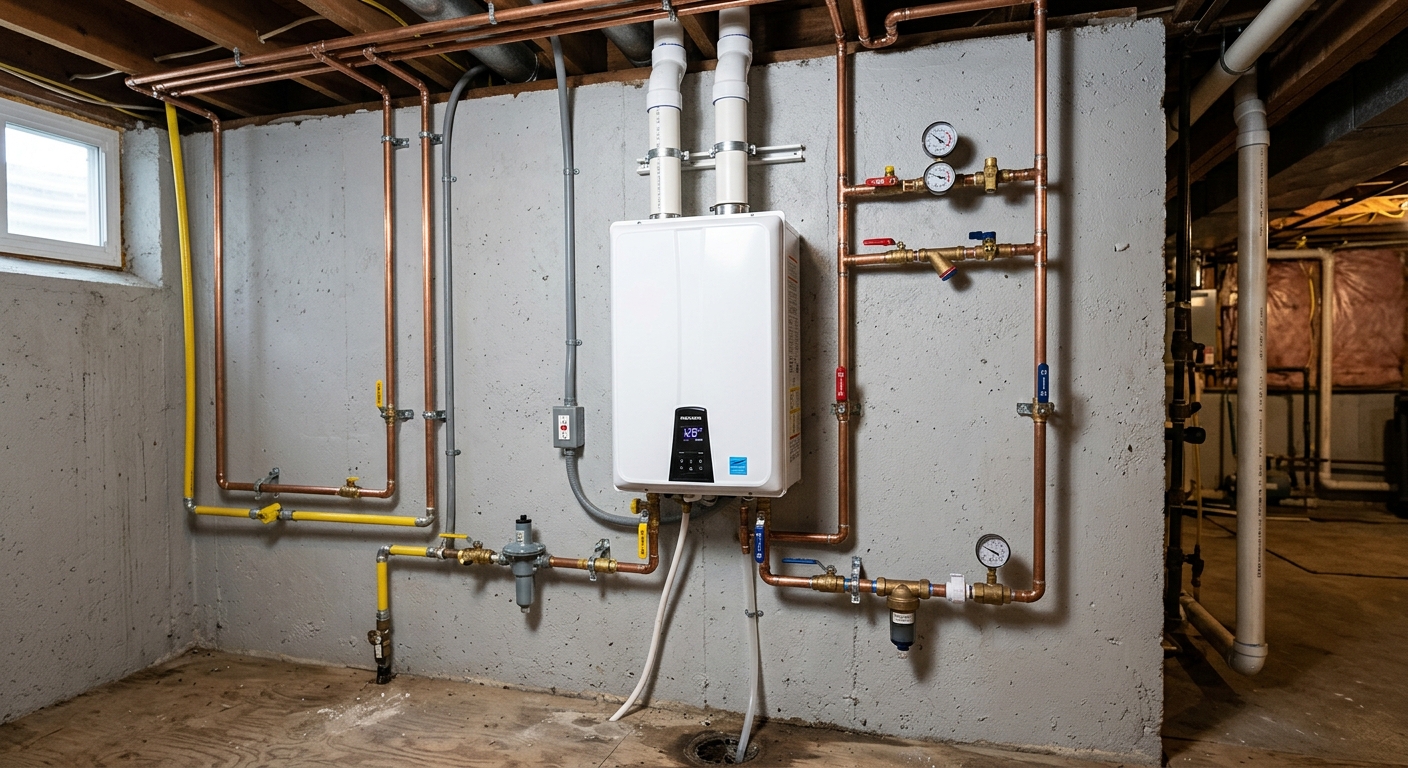
Franklin’s housing stock—largely built pre-1980—means basements may be tight and headroom limited. That matters when replacing a water heater. The right choice depends on your needs and what you already have. Standard gas tank models are cheapest to install—$1,100–$2,500—but have the shortest life and waste energy reheating stored water. Gas tankless delivers endless hot water, but installation can require a bigger gas line and a new vent; those upgrades can push you toward the top of the $1,750–$2,500 range.
Heat pump water heaters are efficient and have the lowest running costs, but they need a big, warm space—uncommon in colder Franklin basements. They also drop the room temperature and make enough noise to be unsuitable for finished basement rec rooms. Electric water heaters cost less upfront but run hotter and cost more on your electric bill.
No matter the style, size by the “first-hour rating” (how much hot water it delivers immediately), not just storage volume. In Franklin, it’s smart to have an expansion tank and always require a drain pan with a floor drain, since failures are nearly always from tank rust—not the controls.
| Type |
Installed cost |
Service life |
Operating cost |
Best when |
| Gas tank, 40–50 gal |
$1,100–$2,500 |
8–12 yrs |
moderate |
existing gas line, standard families |
| Electric tank, 40–50 gal |
$1,100–$1,750 |
10–15 yrs |
high |
no gas available, smaller homes |
| Gas tankless |
$1,750–$2,500 |
18–25 yrs |
low-moderate |
endless hot water needed |
| Heat pump water heater |
$1,750–$2,500 |
13–15 yrs |
lowest |
warm, open basement areas |
Frequently asked questions — plumbing in Franklin
How do I prevent frozen pipes in Franklin?
Freezing is an annual headache in Franklin, where single-digit temperatures and extreme snowfall are the rule. Start by insulating pipes in unheated spaces—think basements, crawlspaces, and attics. Letting faucets trickle during cold snaps helps, but make sure you know the location of your main shutoff in case a pipe does burst. Heat tape can be used on especially vulnerable runs, but only following all safety directions. Don’t rely on leaving cabinet doors open unless pipes are actually adjacent to an outside wall—that advice is sometimes quoted for newer builds, but in Franklin’s late-1800s and early-1900s homes, it pays to know exactly where your lines run. It’s much cheaper to invest in proper insulation than pay for emergency repairs, since fixing a burst pipe can easily run $325–$1,100 or more in our area.
Why do all my drains drain slowly at once?
In Franklin, if every drain slows down at once (showers, tubs, sinks, and toilets), it’s usually a main sewer line problem—not a clog in one branch. With the age of houses here and the prevalence of cast iron and clay tile laterals, the trouble is often a collapsed or root-obstructed line. That’s especially common in township homes with older trees nearby. A camera inspection is the way to get a clear answer and typically costs less than a mainline excavation. Drain cleaning in Franklin generally ranges from $200–$500 for scheduled work, but if roots or a broken pipe are found, you may be looking at thousands for a repair.
Should I repipe my Franklin home or keep repairing?
If your Franklin house still has galvanized steel or you’ve had two or more leaks in the same pipe material within three years, repiping is almost always a better long-term choice—especially with our rough winters and older framing. The main risk with repeated repairs isn’t just the cost ($325–$1,100 each), but the damage from hidden failures behind old plaster or in basements. Partial repipes are common if most lines have already been swapped over, but for whole-house supply, expect $3,200–$7,700—while also budgeting for any wall or floor repairs afterward. The peace of mind, especially in Franklin’s aging homes, is usually worth it.
What counts as a plumbing emergency?
In Franklin, a real emergency is anything causing active flooding, a complete loss of water, sewage backing up into your house, or the smell of gas (especially near water heaters or boilers). These conditions can cause fast damage—walls, floors, and personal property. Most other problems—a slow leak, a single slow drain, or a running toilet—can safely wait until business hours, costing you much less. For instance, a burst pipe fix during the night may be $550–$1,100, but scheduling it the next morning can cut that price easily in half. Until help arrives, locate and shut off your main water valve to prevent further issues.
Why do plumbers charge a diagnostic fee?
Diagnostic fees in Franklin are about paying for the time, knowledge, and sometimes mileage it takes to locate the source of a problem—especially with older pipe layouts common here. For example, finding a buried shutoff or tracing a hidden leak in a late-1800s house can take as long as fixing it. While this fee is often applied toward the final bill if you approve the work, it covers the plumber’s travel and expertise, both of which matter in a rural market where travel surcharges aren’t unusual. For typical emergency service, that initial fee may be rolled into the $325–$1,100 you pay for the repair.
What does drain cleaning cost in Franklin?
Drain cleaning costs in Franklin vary, but for a main sewer line, expect scheduled work to range from $200–$500. Emergency rates for nights or weekends can reach $800. The cost depends on access and what’s found—hydro-jetting or camera inspection may add to the bill. With the prevalence of clay and cast iron lines here, tree roots are a frequent culprit. Regular drain cleaning helps prevent the need for full excavation, which is considerably more expensive—spot sewer repairs can run up to $11,000 in tough cases.
Am I responsible for the water line under the street?
In Franklin and surrounding Venango County, you are responsible for the water service line from your home all the way to the city main, even if that line runs under sidewalks or the street. Repairs or replacements on this stretch are entirely your cost as a homeowner, and in older neighborhoods, those lines are often galvanized or even lead. If you suspect a break or leak, expect replacement to fall in the $5,000–$11,000 range, depending on how much digging is needed and how far the line runs under city property.
Are tree roots a common sewer problem in Franklin?
Tree root intrusion is especially common in Franklin, given our number of pre-1980 clay tile and cast iron sewer laterals and the mature trees in older lots. Roots enter at pipe joints or minor cracks, slowly blocking flow and eventually causing backups. Drain cleaning can temporarily clear a blockage for $200–$800, but the only long-term fix is a camera inspection and often relining or replacing the damaged section, which may cost up to $11,000 if excavation is extensive. If you have persistent slow drains and big old trees within 20 feet of your lateral, ask for a sewer camera check before you dig.
Who inspects plumbing work in Franklin?
In Franklin and Oil City, plumbing work—more than small repairs—usually requires a permit and inspection from the local codes department. For routine fixture repair or clearing a clog without pipe replacement, permits and inspections are rarely needed, but always ask your plumber to confirm based on your address. Inspections help ensure compliance with the Pennsylvania Uniform Construction Code (UCC), which relies on the IRC. Large jobs, especially repipes over $3,200, should always have a permit. In townships with less active enforcement, confirm the requirements yourself before allowing work to proceed.