What plumbers charge in Lehman
Lehman homes bring their own plumbing quirks, shaped by Pike County’s late-20th-century boom in vacation and second homes. This era predicts pipe materials—typically copper, CPVC, or older galvanized in places—which in turn predict what fails and what you’ll pay. Most houses here weren’t built for year-round use, so underused systems and abrupt temperature swings mean burst pipes and water heater trouble are extra common. With 91.0% of residences being single-family homes and an 88.2% homeownership rate (U.S. Census Bureau, ACS 2024), most call-outs are for private lines, not building-wide stacks.
In Lehman, plumbers charge distinctly different rates for the same job depending on urgency. Emergency calls—like a burst pipe while you’re away for a long weekend—command higher rates because contractors have to reprioritize their day, travel on short notice (with a rural market premium), and solve problems quickly to limit damage. If you can schedule work during standard hours, expect to pay less, especially for non-catastrophic fixes. Restoration after leaks (like drywall patching or subfloor repairs) frequently cost more than the pipework itself given the area’s typical finishes.
| Service |
Scope |
Emergency rate |
Standard rate |
| Emergency repair — burst pipe |
locate, open, repair section, restore service |
$550–$1,150 |
$325–$1,150 |
| Water heater replacement (gas, 40–50 gal) |
remove old, install, test, haul away |
$1,800–$2,700 |
$1,150–$2,700 |
| Drain cleaning — main line |
augering or hydro-jet, camera if needed |
$350–$800 |
$200–$500 |
| Sewer line spot repair |
excavate or reline a failed section |
$1,900–$11,500 |
$1,900–$11,500 |
| Whole-house repipe |
replace supply lines throughout, patch and finish |
$3,300–$8,100 |
$3,300–$8,100 |
| Water service line replacement |
street to house, excavation and restoration |
$5,200–$11,500 |
$5,200–$11,500 |
Estimates for a typical Lehman home. Access difficulty and pipe material move these figures more than anything else.
Hardness, treatment and fixture life in Lehman
If your Lehman home is served by Aqua Pennsylvania, you can request the system's annual water quality report to see hardness, iron content, and other specifics. In practice, tap water here is generally considered moderately hard: enough calcium and magnesium to coat fixtures and shorten water heater life, but rarely enough to foul pipes in just a few years. Scale build-up inside tank water heaters is the chief culprit behind early failure—think 8–12 years instead of the hoped-for 15. Replacement rates here back that up.
Some older Pike County homes on private wells may experience more pronounced hardness or acidic well water, which can lead to green stains (from copper pinholes) or rust staining. Remember, if you're on a private well, nobody is testing that water for you—consider an annual test for iron, coliform, and pH at minimum.
As for treatment equipment: water softeners do help with spotting and scale, but the savings on appliance and heater life rarely justify the upfront and ongoing salt expense unless your water is well above average for hardness. Whole-house filters make sense for removing sediment or chlorine taste; for most, point-of-use (sink) filters are more efficient for drinking water. Be suspicious if someone insists every Lehman home "needs" an expensive softener or filtration system without a test result in hand. For most homes, keep the solution proportional to the issue.
Choosing a water heater in Lehman
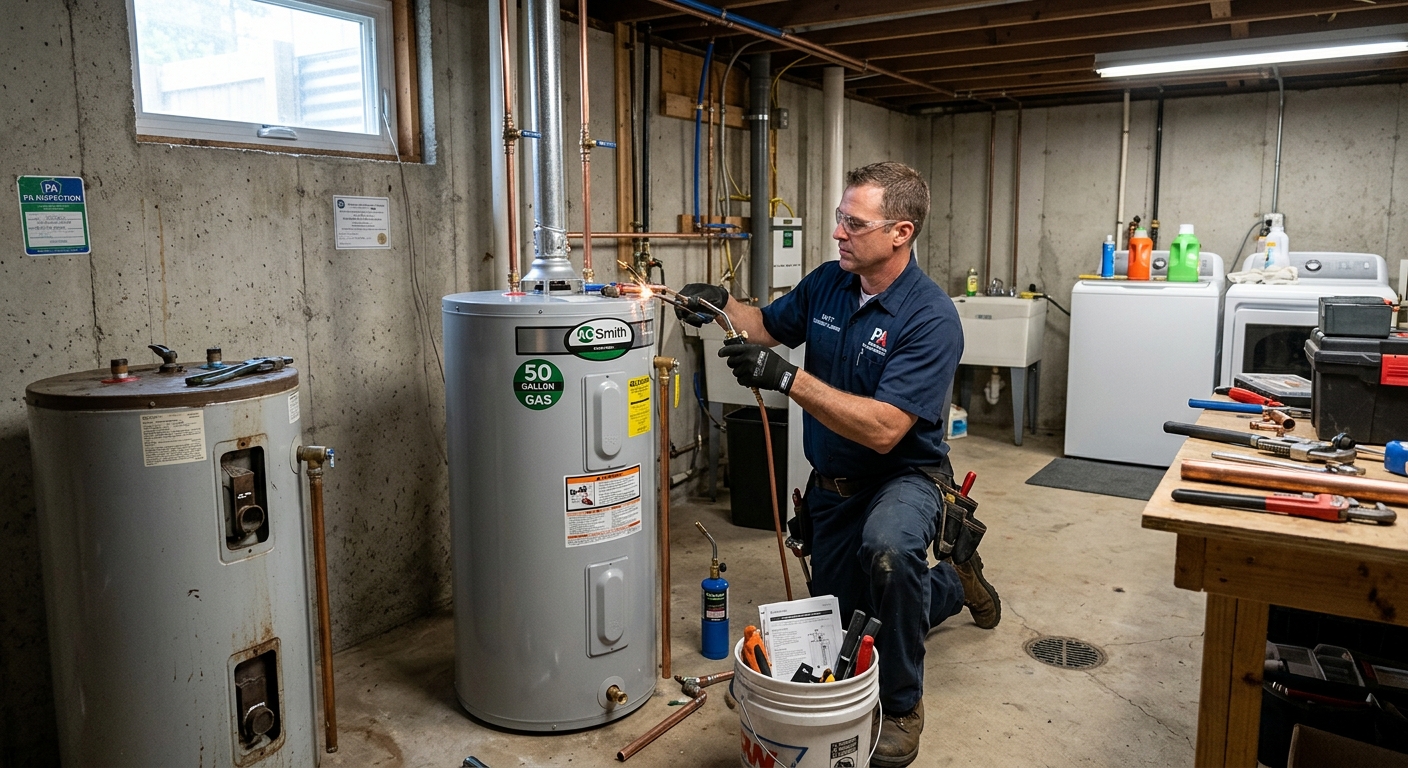
For most households in Lehman, a tank water heater remains the most affordable way to get reliable hot water. Install is straightforward—especially in the many homes built as vacation properties—and you’ll pay $1,150–$2,700 for gas or electric. Lifespan is usually 8–12 years, shorter if you have hard water and don’t flush the tank periodically. Failure is nearly always the tank—leaking or ruptured—rather than the thermostat or gas valve.
Tankless (on-demand) gas water heaters offer endless hot water but introduce higher upfront costs. Many homes here have gas available for heating, but not all have gas lines large enough for a tankless upgrade, and retrofitting venting in a finished basement can push the bill up fast. It is true tankless units can last 18–25 years and cost less to run, but you need to factor the install premium honestly.
Heat pump water heaters are the most efficient option, especially appealing if you’re all-electric or thinking long-term. They require a decent volume of air—don’t put one in a cramped closet or you’ll constantly cool the living space, which isn’t welcome in a finished basement in January. Noise is also a consideration if your family room or office is nearby.
Regardless of type, right-sizing comes from first-hour rating rather than gallons. In Lehman, expansion tanks and proper pans with drains are a must, especially with pier foundations or over finished spaces.
| Type |
Installed cost |
Service life |
Operating cost |
Best when |
| Gas tank, 40–50 gal |
$1,150–$2,700 |
8–12 yrs |
moderate |
Affordable, works with existing venting and gas |
| Electric tank, 40–50 gal |
$1,150–$1,800 |
10–15 yrs |
high |
No gas service, lower upfront cost |
| Gas tankless |
$1,800–$2,700 |
18–25 yrs |
low-moderate |
High hot water demand, upgrade-ready gas lines |
| Heat pump water heater |
$1,800–$2,700 |
13–15 yrs |
lowest |
Large space, seeking efficiency, all-electric |
Choosing a plumbing contractor
In Pike County and Lehman Township, plumbing licensing is municipal where it exists. This means a contractor working legally in one borough might not be authorized in the next township. Always confirm a plumber’s credentials apply to your address. Pennsylvania’s Home Improvement Contractor (HIC) registration is mandatory for contracts over $500 and can be verified at hic.attorneygeneral.gov. Ask for an insurance certificate that names your property directly, and confirm workers' compensation coverage through WCAIS (wcais.pa.gov)—even small companies must comply. A local company with their own crews tends to be more accountable than one that subs out regular work.
For emergency jobs, ask how after-hours rates are set and disclosed. In a rural, spread-out market like Pike County, travel surcharges and response times vary a lot—get clarity before work begins. Never hesitate to ask if a contractor carries a valid permit for your jurisdiction. And any major job—especially a sewer replacement or whole-house repipe—should be supported by camera footage or pressure test results, not just a one-page quote.
- Confirm HIC registration at hic.attorneygeneral.gov
- Verify insurance, with your address named on the certificate
- Check workers’ compensation via WCAIS (wcais.pa.gov)
- Ask if licensed for your township/Borough
- Confirm permit and inspection requirements
- Find out if service is self-performed or subcontracted
- Request written emergency rate policy up front
- Ask for recent references in Pike County, not just Pennsylvania
- For sewer or repipe jobs, insist on camera or pressure test proof
- Clarify restoration (drywall, finish) responsibilities
- Ask about manufacturer and labor warranties, stated apart
- Demand a written, itemized contract for any job over $500
In a thin rural contractor market, beware of one-size-fits-all quotes, especially for big jobs recommended without clear evidence. If someone recommends a costly sewer or water line replacement without a camera inspection or pressure test, stop and get a second opinion—this is the single most common way homeowners in Lehman overpay.
What a plumbing quote should contain
When Lehman homeowners get a plumbing quote, the most critical overview is how a contractor prices their work: flat rate or time-and-materials. Flat rate means the total cost is quoted upfront, regardless of how long the job takes, and places the risk on the contractor. This is common for standard installs and urgent calls. Time-and-materials tends to favor the homeowner if the problem is simple but can balloon if the job turns complex—like chasing a hidden leak. Nobody likes a surprise bill, but both models are legitimate; the problem is when you don’t know which you’ve agreed to.
Any good quote will state whether a diagnostic fee applies (and whether it’s subtracted from eventual work), and should describe not just a price, but exactly what will be opened, replaced, or restored. Permits matter: for major plumbing jobs, local code may require one, and restoration work (think drywall, paint, or patching an opening) should be listed as included or excluded. Finally, check for separate warranties for labor and for parts, as manufacturer coverage on parts is often longer than on workmanship.
| Line item |
What to look for |
Red flag if… |
| Billing model |
flat rate or hourly, stated up front |
unstated |
| Diagnostic fee |
amount, and whether it credits |
vague |
| Scope |
what is opened, repaired and restored |
price with no scope |
| Restoration |
drywall and finish explicitly in or out |
silent |
| Permit |
included and priced |
‘not needed’ |
| Parts |
brand and model for fixtures |
‘standard fixture’ |
| Warranty |
labour period stated separately |
parts only |
Lead service lines in Lehman
Neither Milford Borough nor Pike County has published a mapped inventory of lead service lines, according to current county data. This means homeowners in Lehman—served by Aqua Pennsylvania in some areas—cannot rely on public maps to know if their home has a lead line. The potential remains, especially for homes built before 1980, but definitive records simply don’t exist for most properties.
Every water service line in the county has two portions: the utility-owned section (typically from the main under the street to the curb stop or property line) and the homeowner-owned lateral from that point into the house. Utility replacement programs—the rare ones that may exist—usually cover only the public side unless stated otherwise, so the burden to replace the private segment lands on the homeowner.
If you want to check your own line, find where it enters your basement. Scratch the pipe gently with a coin—lead is soft, dull grey, and non-magnetic (a magnet will not stick). A partial replacement—where only one side is swapped—can actually spike short-term lead levels by disturbing protective scale, so comprehensive replacement is best. For cost, replacing a water service line in Lehman ranges from $5,200–$11,500, depending on access and restoration. Whole-house repiping for visible supply lines is $3,300–$8,100.
Because there’s no official county inventory or replacement program, contact Aqua Pennsylvania directly for the latest on any available cost-share or priority replacement aid. Never assume you’re covered by default. If in doubt, have a licensed plumber inspect your service entrance and document the material. Safety here is a matter of certainty, not assumption.
Verifying a Lehman plumber's credentials
Plumbing licensing in Pennsylvania is not statewide; it’s controlled at the municipal level. This is crucial in Pike County and specifically Lehman: a plumber licensed in a city like Philadelphia cannot legally claim plumbing credentials in Lehman Township unless the township or borough recognizes them. Always ask, “Are you licensed for plumbing work in this municipality?” rather than the generic “Are you licensed?”
For permits, practices differ: in Milford Borough, any new plumbing system installation or major alteration requires a borough building permit, and the work is inspected by the municipal code enforcement office. In Pike County’s rural townships—including Lehman—minor fixture swaps in single-family homes are routinely done without a plumbing permit. Confirm local requirements with your township office before starting, especially on larger projects. The Pennsylvania Uniform Construction Code (UCC), based on the IRC, governs residential code.
To protect yourself, verify the contractor’s Home Improvement Contractor (HIC) registration at hic.attorneygeneral.gov before signing any contract over $500. Demand a copy of their insurance certificate—your address must appear—and double-check their workers' compensation via WCAIS (wcais.pa.gov). Shortcuts here often leave homeowners uninsured if an accident or product failure occurs. Always insist on written contracts and keep permit receipts and inspection records on file.
Frequently asked questions — plumbing in Lehman
Who owns the sewer lateral, me or the city?
In Lehman and the surrounding Pike County townships, most homes use individual septic systems, but if your property is in Milford Borough and connected to its separated sanitary sewer system, responsibility for the sewer lateral (the pipe from your home's foundation to the municipal main) usually falls on the homeowner—not the borough—unless repair or replacement is needed within the street itself. If your sewer line fails under your yard or driveway, you’ll pay for that repair, which can run $1,900–$11,500 depending on excavation or relining. Any issue near the public main may involve both parties and often requires a permit and municipal inspection. Always verify with your borough or township office for specifics before digging or hiring a contractor.
What does drain cleaning cost in Lehman?
Drain cleaning in Lehman is mostly called for on main lines backing up due to roots or seasonal use (a common headache in Pike County vacation homes). Expect to pay $200–$500 for a standard scheduling, and $350–$800 if you need after-hours or true emergency service. These figures usually cover augering and basic snaking. Hydro-jetting and camera inspection (smart for older lines) can add to the bill. If a quote is much higher, or suggests full sewer replacement before showing you a video of the problem, it’s time to get a second opinion—especially in a rural market where travel surcharges can inflate simple jobs.
Why do all my drains drain slowly at once?
If every drain in your Lehman home is sluggish, you likely have a main sewer line blockage—or a failing septic system if you’re not on municipal sewer. Root build-up, years of soap scum, or scale in older pipes from seasonal shutdowns are all common in Pike County’s late-20th-century houses. A main line augering or hydro-jet cleaning in Lehman will typically cost $200–$500 for standard scheduling. Don’t let anyone upsell you on a full sewer replacement unless they show you camera footage of a collapsed or broken line. Multiple slow drains almost never means you need to replace the pipes from every fixture—target the main first.
What do I do about a burst pipe right now?
If you discover a burst pipe in your Lehman home—especially one that’s been underused or shut down during a cold snap—first, shut off the main water supply to your house. Next, open a faucet to relieve pressure. If you’re on a well, cut power to the well pump. The next call should be to a local plumber, who’ll typically charge $550–$1,150 for emergency leak repairs, depending on access, wall opening, and after-hours rates. In Pike County’s rural market, travel time can delay help, so act quickly to limit damage. Don’t bother trying “miracle” tape or temporary wraps on a split copper or CPVC line—it’s best to cut and fix it properly.
Do I need a permit for plumbing work in Lehman?
That depends on where your Lehman home is located. In Milford Borough, any new plumbing installation or significant alteration to existing piping requires a permit from the borough code enforcement office. In most rural Pike County townships, routine fixture replacements inside single-family homes often proceed without permits. Still, for bigger jobs—like repiping, water heater replacement requiring venting, or sewer work—always call your township first. Doing work without required permits risks fines and insurance denials. For reference, any job over $500 in Pennsylvania requires a written contract under the Home Improvement Consumer Protection Act.
Which utility supplies water to Lehman?
Aqua Pennsylvania supplies public water to parts of Lehman and nearby developed areas, according to Pike County data. Not all homes are on public water; many in rural Pike County rely on private wells. If you’re on Aqua’s system, you have a right to request their annual water quality report to review hardness and contaminant levels. If you’re on a well, no one is monitoring your water but you—testing for bacteria and minerals at least once a year is a good routine. Water heater replacements on public water lines in Lehman commonly cost $1,150–$2,700, due mostly to access and code requirements, not water source.
Should I leave a faucet dripping in cold weather?
In Lehman, winter lows can hit 4°F, and even more critical, some seasonal houses have plumbing runs through crawlspaces or outer walls. Leaving a trickle of water running overnight during a deep freeze can prevent a full pipe burst—saving you $550–$1,150 in emergency repair cost and potentially thousands in water damage. Focus especially on pipes running through unheated spaces. Insulate where you can, but a slow drip is a simple, effective backup in cold spells, especially when you’re away from the property for extended periods as many Pike County owners are.
What does emergency plumbing cost in Lehman?
For most plumbing emergencies in Lehman—like an active burst pipe or sewer backup—expect to pay between $550–$1,150 for rapid-response repairs. This reflects both the need for immediate service and the real travel surcharges present in Pike County’s rural market. Emergency rates include premium labor, faster dispatch, and typically a minimal amount of urgent restoration (cutting drywall, limited patchwork). For leaks that flood finished basements, further restoration may cost extra. Always ask your contractor how their after-hours or emergency pricing is structured, and get confirmation in writing before work starts.
Is a tankless water heater worth it in Lehman?
Tankless gas water heaters promise endless hot water, but in Lehman’s real-world context, they only pencil out if your home is already configured for gas (with a large enough line) and you need the space savings or continuous supply for large families. Upfront cost is higher—typically $1,800–$2,700 installed—and, depending on your basement or utility room layout, you may need upgraded venting or gas line work. Tankless units do last longer (18–25 years), but savings on utility bills are modest over a traditional tank. In Pike County homes with infrequent use or modest hot water needs, a standard tank—often cheaper—may be a more practical fit.