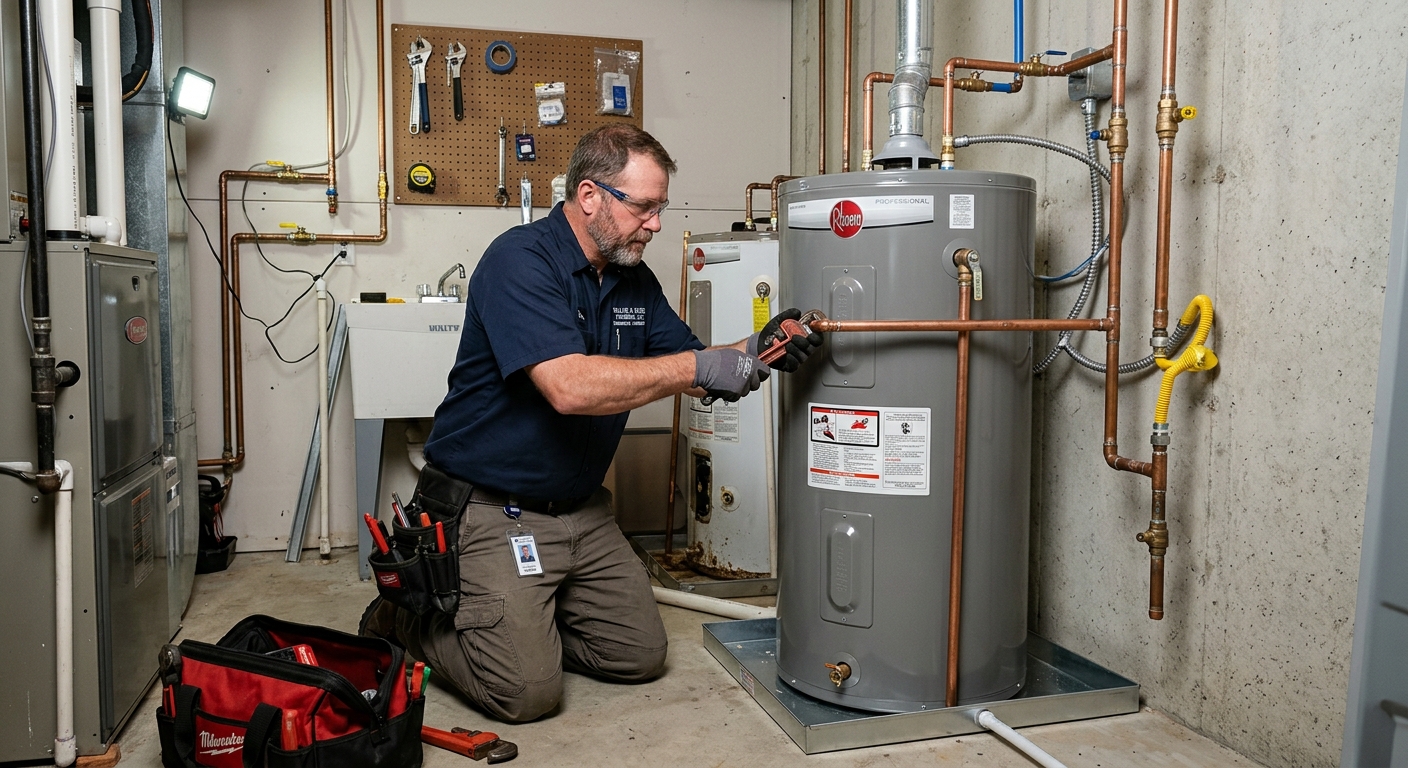
Upper Dublin plumbing prices by job type — 2026
In Upper Dublin, where 64.2% of homes were built before 1980 and the homeownership rate stands at 84.7% (U.S. Census Bureau, ACS 2024), plumbing costs are shaped by the demands of aging infrastructure. Most homes here date to the 1950s-1970s suburban boom, meaning galvanized, copper, and cast iron pipes are common. With these older materials, pipes fail more often and can be expensive to repair or replace.
The type of call—emergency or planned—strongly affects pricing. If you have an active leak or flooding, expect to pay an emergency premium for immediate response, after-hours dispatch, and urgent restoration. The same fix is typically cheaper if scheduled during regular hours because prep and troubleshooting aren’t rushed and pricing is less reactive. Pipe access and material—not house size—are the biggest cost factors.
| Service |
Scope |
Emergency rate |
Standard rate |
| Emergency repair — burst pipe |
locate, open, repair section, restore service |
$750–$1,450 |
$425–$1,450 |
| Water heater replacement (gas, 40–50 gal) |
remove old, install, test, haul away |
$2,300–$3,400 |
$1,450–$3,400 |
| Drain cleaning — main line |
augering or hydro-jet, camera if needed |
$350–$800 |
$200–$500 |
| Sewer line spot repair |
excavate or reline a failed section |
$2,400–$14,500 |
$2,400–$14,500 |
| Whole-house repipe |
replace supply lines throughout, patch and finish |
|
$4,300–$10,500 |
| Water service line replacement |
street to house, excavation and restoration |
|
$6,700–$14,500 |
Estimates for a typical Upper Dublin home. Access difficulty and pipe material move these figures more than anything else.
Choosing a plumbing contractor
To protect yourself in Upper Dublin, take the extra step of verifying a plumber’s credentials. Plumbing is municipally licensed in Pennsylvania—being “licensed” in one township means nothing in another—so always check your contractor’s paperwork is valid in your municipality.
Make sure registration for jobs over $500 is current by searching hic.attorneygeneral.gov. For any crew on site, look for a certificate of insurance that names your property, and verify workers’ compensation via WCAIS (wcais.pa.gov). If your project needs a plumbing permit (like a water heater, repipe, or major alteration), request a copy, and ask if restoration work (patching walls, etc.) is included. For emergency dispatches, ask upfront how pricing changes after hours and if diagnostic fees apply. Finally, find out if the company uses its own technicians or subs out the work.
- Confirm HIC registration over $500 at hic.attorneygeneral.gov
- Check municipal license—ask directly, “Are you licensed here?”
- Get insurance certificate with your address listed
- Verify workers’ comp coverage through WCAIS
- Ask if all staff are employees or if jobs are subcontracted
- Request job’s written scope and permit copies
- Ask about after-hours/emergency rates in writing
- Request a labor warranty along with parts warranty
- See camera footage and pressure test before a repipe/sewer replacement
- Don’t accept a contract without a three-day right to cancel
- Insurance deductible waiving is not legal here
- Lead-safe certs are required in pre-1978 homes—ask to see them
Red flags in this crowded contractor market: one-call big-ticket quotes (like a full repipe or sewer job) with no camera footage or pressure test, vague pricing terms, or a company pushing for emergency work with scare tactics. Avoid anyone vague about their credentials or insurance.
What's in the water here
Upper Dublin’s water is supplied and tested by Aqua Pennsylvania. Every public system publishes an annual water quality report; if you’re concerned, you can request a copy directly from the utility. Hardness is moderate, and scale buildup is a common reason for shorter water heater and faucet life in these older homes. Over several decades, scale can clog pipes internally, especially in homes built during the 1950s-1970s boom.
Copper pipes sometimes suffer pinhole leaks due to chemistry (“aggressive water”), but it’s less common here than in other regions. Most people don’t need a water softener—unless you’re seeing very fast scale buildup on fixtures, the savings rarely cover the initial cost and salt. Whole-house filtration makes sense only for specific contaminants (like chlorine taste or sediment). If you just want cleaner drinking water, a point-of-use filter is far simpler and less expensive.
Treatment equipment is often oversold in this area. For municipal water, most setups beyond a simple softener or point filter add maintenance without real benefit. If you have a private well (rare here), test your water yourself every year—no one monitors a well except the owner.
Flat rate versus time and materials
Homeowners in Upper Dublin will see both flat-rate and time-and-materials (T&M) quotes. Flat rate means the contractor’s price is fixed before work begins—good for peace of mind, especially in older houses where a small leak can turn into a big repair. Time-and-materials billing tracks labor hours and material use, which can be fair for simple repairs but open-ended if the problem grows.
Neither system is automatically better or a scam. The real trouble is not knowing what you’ve agreed to. Always ask if a diagnostic fee applies, and if it’s credited toward the actual job. Read the contract: it should spell out the job scope, restoration, permit responsibility, and what is/wasn’t included—like specific fixtures or brand names, not just “standard.” Restoration of any cut drywall or finished surfaces should be clearly stated. Confirm labor and parts warranties separately, and ask if after-hours work means a higher hourly rate or a flat emergency premium.
| Line item |
What to look for |
Red flag if… |
| Billing model |
flat rate or hourly, stated up front |
unstated |
| Diagnostic fee |
amount, and whether it credits |
vague |
| Scope |
what is opened, repaired and restored |
price with no scope |
| Restoration |
drywall and finish explicitly in or out |
silent |
| Permit |
included and priced |
'not needed' |
| Parts |
brand and model for fixtures |
'standard fixture' |
| Warranty |
labour period stated separately |
parts only |
What urgency costs you
When you call a plumber out to Upper Dublin in an emergency—middle of the night, a weekend, or during active flooding—you’re not just paying for repair labor. You’re paying for rapid dispatch, overtime rates, and the extra risk of working under pressure. Diagnosis is hasty, so more is rebuilt “just to be sure.” That’s why emergency repair for something like a burst pipe costs $750–$1,450 versus $425–$1,450 if scheduled when crews are available.
Here’s how to decide if you must act now:
- True emergencies: Active flooding, a burst or pouring leak, no water at all, raw sewage backing up, or any gas smell—these demand immediate response.
- Can wait: Drips under a sink, a single slow drain, a running toilet, or a small leak you can contain with a bucket—these typically can wait until business hours, often shaving hundreds off the bill.
If you know how, turn your water off at the main (usually near the water meter in the basement or garage; turn the valve clockwise). You can also shut water off at individual fixture stops below sinks or behind toilets. Learning these basics is the difference between a $750–$1,450 emergency bill and a much cheaper scheduled repair.
Galvanized, copper, PEX, cast iron
Because much of Upper Dublin’s housing stock dates to the 1950s–1970s, you’re likely to find galvanized steel, copper, or cast iron plumbing behind the walls. These materials each have unique life spans and failure modes. Galvanized steel, used widely pre-1960, corrodes internally and first shows with low pressure before it leaks. Copper, the standard from the 1950s on, is long-lived but can develop pinholes with aggressive water. Polybutylene—common in the late ‘70s to mid-90s and virtually never covered by insurance now—fails unpredictably at joints. Modern PEX, used since the 2000s, is flexible with fewer joints but can degrade with UV exposure.
Drains are often cast iron in homes built before the mid-1970s, and these may last 50–75 years before corrosion or cracks cause trouble. Sewer laterals in older homes may be clay tile—prone to tree root intrusion and shifting joints.
Not sure what you have? Try the scratch test on exposed pipes: galvanized is silver-gray and magnetic; copper is reddish and non-magnetic; polybutylene is gray-blue and flexible; PEX is usually red, blue, or white plastic. Cast iron drains are heavy, black, and ring when tapped, while PVC or ABS is white/black plastic with glued joints.
| Material |
Typical era |
Failure mode |
Service life |
| Galvanized steel supply |
pre-1960 |
internal corrosion, pressure loss |
40–60 yrs |
| Copper supply |
1950s–present |
pinhole leaks, joint failure |
50–70 yrs |
| Polybutylene supply |
late 1970s–1995 |
fitting failure, sudden bursts |
unreliable |
| PEX supply |
2000s–present |
fitting or UV degradation |
40–50 yrs |
| Cast iron drain |
pre-1975 |
corrosion, cracking, scale |
50–75 yrs |
| Clay tile sewer lateral |
pre-1980 |
root intrusion at joints, offset |
50–60 yrs |
| PVC / ABS drain |
1970s–present |
joint separation, crushing |
50+ yrs |
Licensing and permits for plumbing work in Upper Dublin
In Pennsylvania, plumbing licensing is handled at the municipal level—not statewide. This means being “licensed” in Norristown or another township does not make a plumber eligible to work in Upper Dublin unless they hold a license here. Always ask, “Are you licensed in Upper Dublin?” and request documentation. The Pennsylvania Uniform Construction Code (UCC, based on the IRC) is the enforced standard, but every municipality handles its enforcement, inspections, and permit procedures.
For projects like repiping, water heater replacement, or major plumbing changes, a permit is required in Upper Dublin. Minor repairs or like-for-like fixture swaps that don’t change the system usually aren’t permitted. Inspections are done by the local municipal office.
You should check HIC registration at hic.attorneygeneral.gov for all jobs over $500. Demand an insurance certificate naming your property and verify workers' compensation at WCAIS (wcais.pa.gov). For pre-1978 homes, ask for proof that any crew is EPA Lead RRP certified. Permits, insurance verification, and the right local licensing will protect you in the event of a claim or inspection.
Frequently asked questions — plumbing in Upper Dublin
What does repiping a house cost in Upper Dublin?
Repiping a typical Upper Dublin home (usually with copper or PEX) comes in at $4,300–$10,500, with many falling near the middle of that range. Because so much local housing was built in the 1950s-1970s, old galvanized or aging copper pipes are common and frequently reach end-of-life at the same time. The cost is mostly driven by how accessible the pipes are—houses with finished basements, tight crawl spaces, or lots of wall finishes to patch after the job will cost more. If your home is in the typical 1,800–2,400 sq. ft. range and built before 1980, expect the upper half of the price band. In rare cases with easy access or full gut renovations, it can be a bit less.
What does emergency plumbing cost in Upper Dublin?
Emergency plumbing in Upper Dublin typically runs $750–$1,450 for a burst pipe or significant leak that can’t wait. (A planned, same repair might be as little as $425 if you can safely shut off water and wait for a regular business-hours call.) Urgent dispatch includes a trip charge and often overtime labor, especially after hours or on weekends. Given that the majority of homes are older construction, accessing pipes and restoring service after a leak can be more complex, which bumps up the price. Always ask the contractor for a detailed explanation of what counts as emergency versus standard rate, and see if the diagnostic fee is credited if you use them for repair.
Who pays to replace a lead service line in Upper Dublin?
In Upper Dublin, you as the homeowner typically pay to replace a lead service line running from your curb to your home. Most of the area's homes date to the 1950s-1970s, when copper replaced lead; true lead lines are rare but possible in older properties. Replacement costs run $6,700–$14,500, depending on length and how much restoration is needed after excavation. Aqua Pennsylvania owns the main in the street, but the “lateral” from curb to house is almost always your responsibility. Some utility and township programs may offer limited assistance or cost-sharing—check before you commit, but be prepared for the bulk of the bill to land on the homeowner.
Repair or replace a leaking water heater?
In Upper Dublin, replacement is usually the right call for a leaking tank water heater, especially if it’s over 10 years old. Modern heaters are more efficient, and repair rarely makes sense once rust-through or leaks at the base appear. A typical installed replacement runs $1,450–$3,400, depending on size, gas or electric, and access. If the leak is at a supply connection or the pressure relief valve, that’s a smaller repair (and worth a basic service call). If the tank itself is leaking, repair is almost never cost-effective—especially given local water hardness, which shortens heater life.
What do I do if sewage is backing up?
If raw sewage is backing up in your Upper Dublin home, shut off all water-using fixtures immediately and call a licensed plumber. This is an emergency, both for health reasons and because property damage can escalate quickly. Expect this to fall in the higher end of the emergency repair price band: $750–$1,450, with main sewer spot repairs from $2,400–$14,500 if excavation or relining is needed. If you’re on public sewer (as is most of Upper Dublin), call Aqua Pennsylvania or your local sewer authority as well, since blockages can sometimes be on their side of the line. Take photos for insurance and keep people and pets away from affected areas.
What does discoloured water on first draw mean?
In Upper Dublin, brown or rusty water when you first turn on the tap is almost always caused by sediment or oxidation in aging pipes, especially galvanized steel. It can also show up after hydrant flushing or water main work. As the local housing stock ages, scale and rust inside pipes become more common. Let the tap run for a minute—if it clears up, it’s typically from sitting water in your own pipes rather than a system-wide issue. If the problem persists, it may be time to budget for repiping ($4,300–$10,500), particularly if your home predates the 1960s.
How do I prevent frozen pipes in Upper Dublin?
With winter lows dipping to 14°F in Upper Dublin, frozen pipes are a seasonal risk—especially in homes built before 1980, often with pipes in exterior walls, garages, or crawl spaces. Insulate any pipes in unheated areas, seal cracks, and disconnect garden hoses before deep freezes. On nights below 20°F, keep cabinet doors open under sinks against outside walls and let a trickle of water run. If a pipe does freeze, shut off your main water supply to reduce damage and call a pro. Emergency repairs for burst pipes run $750–$1,450 if immediate action is needed.
How do I verify a plumber's licence and insurance?
In Upper Dublin, always ask the contractor directly if they hold a plumbing license in your specific municipality—it’s not a statewide credential. For projects exceeding $500, verify their HIC registration at hic.attorneygeneral.gov, and ask to see a certificate of insurance listing your address as an “additional insured.” Confirm workers’ compensation coverage for all employees on wcais.pa.gov. For pre-1978 homes, check for EPA Lead RRP certification. If you don’t get straight answers and proper paperwork, keep looking. Serious contractors in this market expect to prove their credentials—don’t hire anyone without full documentation. For whole-house repiping jobs ($4,300–$10,500), do not proceed without these checks.
How hard is the water in Upper Dublin?
Upper Dublin’s water is moderate for hardness, so while it will leave some mineral deposits, it’s not among the worst in Pennsylvania. Hard water shortens water heater and fixture life, and you’ll see some scale on faucets or spots on dishes, but most homeowners never need a softener here. The rare exception is if you notice heavy buildup even after cleaning, or new appliances scaling up within a year. If you are thinking about a softener, expect the cost to pay back slowly—often it’s cheaper just to replace hot water parts when they clog. If you’re seeing heater problems every few years, a replacement runs $1,450–$3,400; installation of extra treatment gear is rarely worth it for typical homes here.