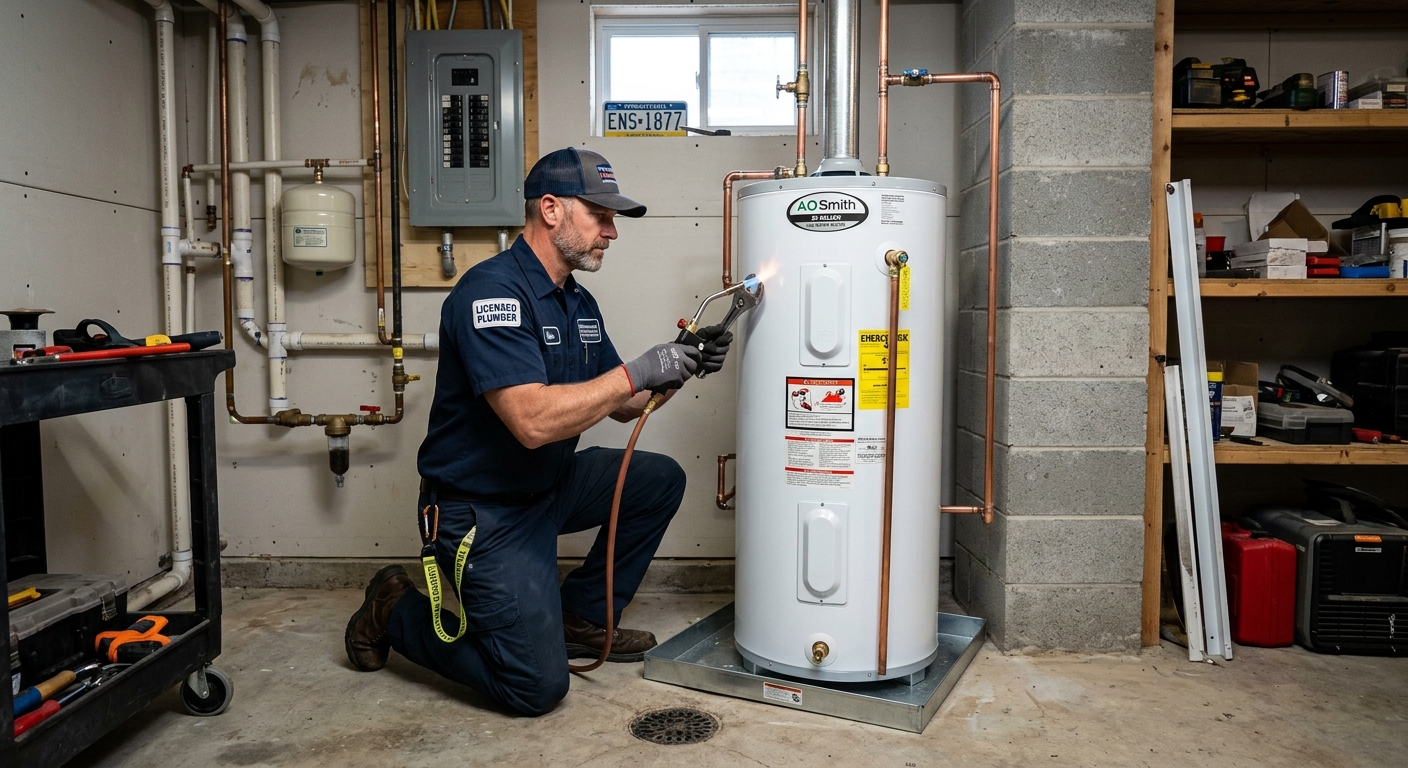
Coraopolis plumbing prices by job type — 2026
Coraopolis’s older homes bring unique plumbing realities, both in what fails and what it costs to fix. With 89.9% of local homes built before 1980 and a homeownership rate at just over half (U.S. Census Bureau, ACS 2024), much of the town’s piping is original or long outdated. Nearby Pittsburgh’s wave of 1900–1950 construction means you often find aging galvanized supply and cast-iron drains—materials that drive up both emergency service rates and planned replacement costs.
The costs of plumbing jobs in Coraopolis swing dramatically depending on whether it’s an urgent call or a scheduled repair. Emergencies—like a burst pipe at midnight—run higher because of labor rates, immediate response, and access conditions. Even the same task, such as a water heater swap, costs more after hours and when shutting off water to old lines brings surprises. You’ll find that access (such as in a finished basement), pipe material, and unexpected complications lead costs up fast. Here’s what to expect for 2026:
| Service |
Scope |
Emergency rate |
Standard rate |
| Emergency repair — burst pipe |
locate, open, repair section, restore service |
$550–$1,150 |
$325–$1,150 |
| Water heater replacement (gas, 40–50 gal) |
remove old, install, test, haul away |
$1,800–$2,600 |
$1,150–$2,600 |
| Drain cleaning — main line |
augering or hydro-jet, camera if needed |
$350–$800 |
$200–$500 |
| Sewer line spot repair |
excavate or reline a failed section |
$1,900–$11,500 |
$1,900–$11,500 |
| Whole-house repipe |
replace supply lines throughout, patch and finish |
|
$3,300–$8,000 |
| Water service line replacement |
street to house, excavation and restoration |
|
$5,200–$11,500 |
Estimates for a typical Coraopolis home. Access difficulty and pipe material move these figures more than anything else.
Verifying a Coraopolis plumber's credentials
Plumbing licensing in Pennsylvania is handled at the municipal level, not by the state. Unlike other trades, there’s no statewide plumbing license. In Allegheny County, a plumber licensed in Pittsburgh may not be automatically permitted to work in Coraopolis or the next township over, since each municipality can set its own requirements. The key question to ask isn’t just “are you licensed,” but “are you licensed for work in this municipality?”
In Pittsburgh and surrounding municipalities, plumbing permits and licenses fall under the Allegheny County Health Department (ACHD) Plumbing Program. While Coraopolis’s exact enforcement may vary by project, major alterations and new plumbing systems require an ACHD permit and inspection. Most minor fixture swaps such as replacing a faucet do not mandate a permit per county practice.
For any plumbing job in Coraopolis over $500, a written contract is required by Pennsylvania’s Home Improvement Consumer Protection Act (HICPA), and the contractor must be registered with the Pennsylvania Office of Attorney General as a Home Improvement Contractor (HIC). You can check a plumber’s HIC registration at hic.attorneygeneral.gov.
Always request proof of workers’ compensation insurance and verify it through the state’s WCAIS platform (wcais.pa.gov)—this protects you if anyone is hurt on the job. If your house was built before 1978, confirm the contractor is EPA Lead RRP certified (find certified firms) for any work that might disturb old paint or piping.
Hardness, treatment and fixture life in Coraopolis
The Pittsburgh Water and Sewer Authority supplies water to Coraopolis and publishes an annual water quality report, which every homeowner can request. Water in this region is typically moderately hard—meaning it has enough calcium and magnesium to form scale, but not at levels you see out west. Scale shortens water heater life and can reduce faucet flow, but it’s rarely so severe that most folks need a softener.
Coraopolis does not have a widespread problem with “aggressive water” that eats through copper pipes, but pre-1980 homes may see pinhole leaks where the pipe wall has slowly thinned. Repeated leaks in old copper usually mean it’s time to think about replacement over patching.
Most homeowners wonder if a water softener or “whole house” filter pays for itself. Unless you see major mineral buildup in showers or kettles, a softener usually isn’t needed here. The cost of installation and salt rarely justifies it. If taste or odor is a concern, a point-of-use filter (like for the kitchen tap) solves most issues for a fraction of the cost of a whole-house system.
If your water comes from a private well, you’ll need to do your own annual testing—public systems don’t publish data for wells, and issues like iron, sulfur, and bacteria are much more common.
Vetting a plumber in Allegheny County
Because Allegheny County’s plumbing licensing is municipal, always confirm your plumber’s credentials are valid specifically in your community—not just in Pittsburgh or a neighboring township. For projects costing over $500, Pennsylvania requires Home Improvement Contractor (HIC) registration, which is verified through the Attorney General’s HIC portal. Your chosen contractor must also provide you a written contract and cannot waive your deductible under the Home Improvement Consumer Protection Act.
Ask for proof of liability insurance that names your property and check workers’ compensation status through the state’s WCAIS system, especially on larger projects. Make sure to find out if the plumber uses his or her own crew or subs out to another company, which is common in the saturated Pittsburgh metro market.
Before hiring anyone, insist on clear emergency pricing—in this market, after-hours rates and travel fees can be all over the map.
- Is your license valid in Coraopolis or must you work through the ACHD program?
- Are you registered as a Home Improvement Contractor? (Check at hic.attorneygeneral.gov.)
- Do you carry current liability insurance naming my address?
- Is your workers’ comp verified at wcais.pa.gov?
- Will your own crew handle the work or will it be subcontracted?
- How do you quote emergency response pricing—flat or hourly?
- Will you pull all necessary permits from the ACHD?
- Do you offer camera footage or pressure test results to justify major pipe or sewer work?
- If my home is pre-1978, are you EPA Lead RRP certified?
- Do you have recent references from work in older Allegheny County homes?
- How are drywall and finish repairs handled after plumbing is complete?
- Will all guarantees and scope be put in writing?
Red flags in this market include high-pressure sales for full sewer or repipe work with no camera inspection or test results. If a plumber quotes a major replacement without documentation, walk away—too many operators chase volume in this crowded market.
Coraopolis's housing stock and its plumbing
With nearly 90% of homes built before 1980, Coraopolis sees the same plumbing legacy as Pittsburgh: original galvanized supply lines, cast-iron or clay drains, and a good chance of old lead or copper on the water service. Many homes have already had water heaters swapped once or twice, but it’s common to see decades-old units limping along. The older the plumbing, the more likely you are to face low pressure, rusty water at the tap, and leaks at joints where pipes have corroded from the inside out.
Galvanized pipes in Coraopolis have often lasted far past their intended life—expect mineral buildup restricting flow, especially on upper floors. Cast iron and clay laterals (underground sewer lines) show their age with cracks, tree root intrusion, or outright collapse, especially in soils like local clay and shale. Water heater longevity drops in homes where scale buildup is heavy, and fixtures often outlast their mounting hardware by years.
If you live in a small segment with newer construction, builder-grade fixtures or polybutylene (if installed late enough) present a different risk: sudden splits, leaking fittings, and water heaters hitting the 15–20 year mark all at once. Original doesn’t always mean “best”—it just means different problems come due.
The point where patching stops making sense
For Coraopolis homeowners, the line between spot repairs and a full repipe is clearer than some plumbers let on. If you’ve had two or more leaks on the same type of pipe (like garage-level galvanized) in three years, that’s a failing system—not bad luck. The warning signs: whole-house pressure drop (not just at one faucet), brownish water on first draw, visible corrosion where pipes meet, and repeated pinhole leaks, especially in old copper. In these cases, chasing repairs costs more in the long run.
Much of Pittsburgh’s 1900–1950 era housing, found right in Coraopolis, is now seeing galvanized and cast-iron pipes at the end of their lifespan. If you’re considering a repipe, know that finish repairs (to walls and ceilings) can rival plumbing labor—especially in homes with original plaster. Copper remains the gold standard for durability, but PEX is less intrusive on installation and can keep drywall cuts to a minimum. In older homes, whole-house repipe prices run from $3,300–$8,000; partial repipes can save money up front, but don’t solve the underlying age problem.
| Situation |
Recommendation |
Cost |
Reasoning |
| One leak, accessible, modern pipe |
Spot repair |
$325–$1,150 |
Cost-effective if all nearby piping tests sound |
| Two or more leaks in 3 years |
Partial repipe |
$3,300–$5,400 |
Recurring failures indicate widespread wear |
| Galvanized supply, pressure loss |
Full repipe |
$3,300–$8,000 |
Systemwide obstruction and internal corrosion |
| Polybutylene anywhere in the house |
Full repipe |
$3,300–$8,000 |
Material failure risk—insurance may not cover leaks |
| Cast iron drain with root intrusion |
Camera, then reline or replace |
$1,900–$11,500 |
Roots or cracks warrant video confirmation and structural fix |
| Suspected lead service line |
Test, then replace the lateral |
$5,200–$11,500 |
Water quality and saleability both suffer until replaced |
Service line material and drinking water in Coraopolis
Coraopolis, like much of Allegheny County, is supplied by the Pittsburgh Water and Sewer Authority, which has identified and is actively replacing thousands of lead water service lines in the area. For any home, the water service line has two parts: the “utility side” from the water main to the curb, which PWSA may be replacing under their programme, and the “homeowner side” from the curb into your basement, which is most often your responsibility. Replacement programs often only cover one portion—call the authority to confirm exactly what’s on offer for your address.
To check the material of your home’s service line, locate where the water pipe enters your basement wall (often near the meter). Lead is soft and dull gray: scratch it with a key and it will reveal a shiny face, and a magnet will not stick. Copper is reddish and hard, with a magnet still not sticking. Galvanized steel is silver-gray, and a magnet will hold firmly. If you have any suspicion or mix of materials, ask your utility directly—you can often check their online inventory or request an inspection.
Partial replacement can actually make short-term lead exposure worse by disturbing protective scale. Full-lateral replacement (from street to house) fixes the problem and runs $5,200–$11,500, depending on pipe length and restoration, but immediately makes your water both safer and your home much more saleable.
If you’re not sure about your service line material or if you want to know if there’s assistance in your specific case, always contact Pittsburgh Water and Sewer Authority directly—they’ll have current information which no contractor can guarantee on your behalf.
Frequently asked questions — plumbing in Coraopolis
How deep do water lines need to be buried in Coraopolis?
The frost depth in southwestern Pennsylvania, including Coraopolis, is 36 inches. For any new water line, piping should be buried at or deeper than this to prevent freezing in the winter. Burying water lines too shallow often results in freezing and rupture during a severe cold spell. Digging to this depth can add to excavation and restoration costs—installing a new water service line, including digging to proper depth and patching, generally falls in the range of $5,200–$11,500 for a typical Coraopolis property. Be sure your contractor is familiar with local code requirements and inspects for good drainage and backfill material, since Coraopolis’s heavy clay and shale subgrade can complicate the job.
How hard is the water in Coraopolis?
Coraopolis gets its water from the Pittsburgh Water and Sewer Authority, which supplies moderately hard water. This means you might notice some minor scale buildup on faucets and inside your water heater over time, but not enough to justify the expense of a whole-house softener in most cases. A standard tank water heater may last a bit less than the manufacturer’s rated life—from 10 to 12 years is typical before scale and sediment reduce efficiency. When it’s time for a water heater replacement, typical Coraopolis homeowner costs run from $1,150–$2,600. For most people, a simple point-of-use filter for taste is all that’s required, saving unnecessary softener installation and maintenance costs.
Am I responsible for the water line under the street?
In Coraopolis and across Allegheny County, homeowners are generally responsible for the portion of the water service line that runs from the curb into your house. The part under the street—up to the curb box or shutoff—is usually owned and maintained by the water utility (Pittsburgh Water and Sewer Authority for most of the area). If your “customer side” line is galvanized, lead, or leaking, you’re likely on the hook for full costs of replacement, which is typically between $5,200–$11,500. Some utilities offer assistance or partnership programs, so it’s smart to contact them directly before hiring a contractor or digging.
Who inspects plumbing work in Coraopolis?
In Coraopolis and most of Allegheny County, major plumbing work is permitted and inspected by the Allegheny County Health Department (ACHD) Plumbing Program. For jobs like new water heaters or whole-house repipes, your plumber should pull an ACHD permit and arrange for a post-installation inspection. Minor fixture replacements—like changing a faucet—typically don’t require a permit or inspection. This verification protects you as a homeowner because it confirms the work meets the Pennsylvania Uniform Construction Code. Permit and inspection fees are included in most quotes for permitted work, which for whole-house repipes may total $3,300–$8,000 including all required documentation.
How much does a plumber cost in Coraopolis?
Plumbing rates in Coraopolis swing depending on urgency, complexity, and access. Basic jobs like clearing a drain or fixing a single burst pipe cost between $200–$1,150 depending on if you call during business hours or overnight. Water heater replacements (gas, 40–50 gallons) typically fall in the $1,150–$2,600 range. Full sewer or water line replacements are the most expensive services and can exceed $11,500 if excavation is complex. Always ask for detailed quotes and clarification on whether after-hours rates apply before agreeing to any work.
Should I reline or replace my sewer line?
For Coraopolis homes, the choice to reline or replace your sewer line depends on the pipe’s age, the material, and the nature of the problem. For old clay or cast-iron laterals with a single area of root intrusion or minor cracks, trenchless relining can preserve landscaping and cost less than a full excavation. For major collapses or offsets, full replacement is safer and more permanent. Both methods fall in the $1,900–$11,500 range, with spot repairs on the low end and full replacements (especially deep or under driveways) at the top. Insist on a camera inspection before authorizing any work so you’re only paying for what’s necessary in your yard.
Why do all my drains drain slowly at once?
When every drain in a Coraopolis home begins to back up or run slow at the same time, the likely culprit isn’t a single trap or sink, but a blockage or restriction in the main sewer line. In older homes with original cast-iron or clay sewer pipes—which are common here—tree roots or years of buildup can choke off the main line. Before allowing anyone to dig, have the main line inspected by camera; cleaning by auger or hydro-jetting usually restores flow and costs between $200–$800 depending on the severity and time needed. If more extensive repairs are needed, you’ll have clear video evidence to justify next steps.
How do I shut off the water to my house?
In most Coraopolis homes, the main water shutoff is a round or lever-style handle on the pipe where water enters your basement—often near the water meter. In emergencies, turning this valve clockwise will stop water flow to all fixtures, limiting leak damage until repairs can be arranged. If your shutoff valve is original (decades old), it may be difficult to turn or prone to leaking itself—replacement is a quick job and usually fits in the $325–$1,150 emergency repair band. Test your valve at least annually. If you cannot locate or operate the shutdown, your utility can assist, or a plumber can install a new, accessible valve.
What does drain cleaning cost in Coraopolis?
Clearing a main line or household drain in Coraopolis typically costs between $200–$800. Standard business-hours cleanouts of sinks or showers are on the lower end ($200–$500), while main sewer line augering or hydro-jet work—especially if performed after hours—can approach $800. Some older homes require a camera inspection as part of the process, especially if symptoms suggest a collapsed or root-intruded line. That combined camera and cleaning service provides peace of mind on the true cause and helps you avoid scams for unnecessary replacements.