Plumbing costs in Franklin — 2026
Franklin sits amid the York–Hanover metro, with its housing split between newer suburban and older urban stock. Most homes here are owner-occupied (81.7%) and over a third were built before 1980 (U.S. Census Bureau, ACS 2024). In Franklin, the age of your home directly affects plumbing cost: homes built before 1960 in York City often still had galvanized steel, which clogs or leaks over time and usually needs total replacement—often with copper or PEX. In newer construction, common repairs involve modern materials and tend to be less invasive and less costly.
One thing that will always swing your bill is whether your issue is an emergency—nights, weekends, active leaks, or shutoff required. Emergency calls for a burst pipe or major leak command higher rates than planned projects. The same job can be hundreds more when you can't wait.
| Service |
Scope |
Emergency rate |
Standard rate |
| Emergency repair — burst pipe |
locate, open, repair section, restore service |
$600–$1,150 |
$350–$1,150 |
| Water heater replacement (gas, 40–50 gal) |
remove old, install, test, haul away |
$1,850–$2,700 |
$1,150–$2,700 |
| Drain cleaning — main line |
augering or hydro-jet, camera if needed |
$350–$800 |
$200–$500 |
| Sewer line spot repair |
excavate or reline a failed section |
$1,950–$11,500 |
$1,950–$11,500 |
| Whole-house repipe |
replace supply lines throughout, patch and finish |
|
$3,400–$8,300 |
| Water service line replacement |
street to house, excavation and restoration |
|
$5,400–$11,500 |
Estimates for a typical Franklin home. Access difficulty and pipe material move these figures more than anything else.
Is your water line lead? How to find out
Franklin and much of York County get their water from York Water Company, which has fully replaced all known lead service lines within York City after inventorying historic lines. This addresses one of the biggest plumbing health concerns, but it doesn’t mean every homeowner is out of the woods: service lines typically have two parts—the utility-owned portion (usually from the street to the shutoff at your curb) and the homeowner-owned lateral (from the curb stop into your foundation wall).
Replacement programs often focus only on the utility side. To check your own line, find where the pipe enters your basement. Use a house key or coin to scratch the pipe. Lead is soft, dull gray, and non-magnetic—a magnet won’t stick. Copper is orange-brown, while galvanized steel is dull gray and attracts a magnet. If your pipe is lead, partial replacements can be risky—disturbing pipes often sheds lead particles, raising short-term exposure risk.
York Water Company publishes its inventory online or will answer customer questions about service line materials. They do not currently advertise a program for cost-sharing or private-side replacement, so it’s up to the homeowner to ask and confirm before assuming coverage is available.
If you do need to replace your private water service line, expect to pay $5,400–$11,500 depending on distance and yard restoration. If your home needs a full repipe to replace original supply pipes throughout, the cost runs $3,400–$8,300 for copper or PEX, driven by accessibility and wall/floor repair afterward.
Detection methods and what they cost
Every Franklin homeowner can do a basic leak check for free: turn off every faucet and appliance, then watch your water meter. If the meter dial still moves, you’ve got a supply-side leak—possibly under a slab, in a wall, or even out to the curb.
Professional detection starts around the $350–$1,150 mark, depending on how deep the sleuthing needs to go. Acoustic listening devices “hear” leaks inside walls or under slabs by picking up the sound of escaping water. Thermal imaging can spot hidden warm pipes and wet patches in cold months. Tracer gas (an odorless gas pressurized into your plumbing) excels where water is tough to find but the infrastructure can be temporarily emptied. In slab homes, non-invasive location avoids unnecessary concrete cutting.
A competent plumber should pinpoint the leak before opening walls or floors, unless there’s imminent property damage. If someone wants to start tearing open, ask for another opinion—most Franklin homes don’t warrant demolition first. More specialized surveys are used for irrigation lines or concealed radiant loops, but most leaks in York County’s single-family homes are found by a combination of listening and metered isolation.
Dating your plumbing by what it's made of
Franklin’s plumbing landscape reflects the nearby York City trend: homes built 1900–1950 often started with galvanized steel supply and cast iron drains. After 1960, copper supply dominated, eventually yielding to PEX in the 2000s. Drain lines shifted from cast iron or clay to PVC/ABS in newer work.
You can learn a lot about your plumbing with simple tools. Exposed pipes: scratch with a coin. Copper is brownish and shines; galvanized is gray and takes a magnet; lead is soft, dull, and non-magnetic. Threads point to steel; solder to copper; gray or blue flexible tubing is often PEX or polybutylene.
Material tells you what to expect next. Galvanized steel clogs decades before it leaks—if your pressure is low and pipes date pre-1960, a whole-house repipe is on the horizon. Copper can pinhole with aggressive water but otherwise lasts. Polybutylene, common in the late 1970s to early 1990s, is notorious for sudden fitting failures and lost insurability in some carriers. PEX is today’s material. Cast iron drains usually last 50–75 years before corroding or cracking, while clay tile sewers admit roots at the joints, typically failing base-first.
| Material |
Typical era |
Failure mode |
Service life |
| Galvanized steel supply |
pre-1960 |
internal corrosion, pressure loss |
40–60 yrs |
| Copper supply |
1950s–present |
pinhole leaks, joint failure |
50–70 yrs |
| Polybutylene supply |
late 1970s–1995 |
fitting failure, sudden bursts |
unreliable |
| PEX supply |
2000s–present |
fitting or UV degradation |
40–50 yrs |
| Cast iron drain |
pre-1975 |
corrosion, cracking, scale |
50–75 yrs |
| Clay tile sewer lateral |
pre-1980 |
root intrusion at joints, offset |
50–60 yrs |
| PVC / ABS drain |
1970s–present |
joint separation, crushing |
50+ yrs |
Verifying a Franklin plumber's credentials
Pennsylvania regulates plumbing licensing on a municipal level—there is no statewide plumbing license. This catches many homeowners off guard; a plumber registered or licensed in York City or Spring Garden Township may not be recognized in a neighboring township. If you live in Franklin or anywhere in York County, do not just ask “are you licensed?” Instead, ask your plumber, “are you licensed or registered for plumbing in my municipality?” In Spring Garden Township, for example, local registration is separate from other York County areas.
Most contracts over $500 must be handled by a Home Improvement Contractor (HIC) registered with the Pennsylvania Office of Attorney General, and the HIC number is easy to check at hic.attorneygeneral.gov. For jobs requiring a crew or additional labor, all employers must carry workers’ compensation, which can be verified through WCAIS (wcais.pa.gov).
In York City, you need a permit for any plumbing system change beyond fixture swap-outs—so relocating a sink or opening a wall to access supply or drain lines should be permitted and inspected by the City of York Bureau of Permits and Inspections. In rural York County, township offices handle permits locally. Always get a copy of the written contract and keep your three-business-day right to cancel under Pennsylvania’s Home Improvement Consumer Protection Act.
Winter pipe failures in south-central Pennsylvania
South-central Pennsylvania winters bring pronounced freeze-thaw cycles, with average frost depth reaching 30 inches and winter design lows sinking to 12 °F. Most pipe bursts happen when a frozen portion blocks a pipe, and the section between the ice plug and the nearest closed faucet is pressurized by expanding ice. Eventually, this stress splits the pipe—not always where the freeze happened, but somewhere downstream.
In Franklin, the most vulnerable spots are pipes routed against exterior walls, above unheated basements or crawlspaces, in uninsulated garages, or feeding hose bibs and outdoor spigots. Once winter sets in, those thin-walled copper lines don’t stand a chance without basic preventive steps.
Prevention is straightforward and cheap: insulate exposed pipes in crawlspaces and garages, install heat tape where insulation alone won’t cut it, and in the deepest cold, let a trickle flow from vulnerable faucets. Open under-sink cabinets overnight to admit warm air. Before the first hard freeze, drain and shut off outdoor spigots at their indoor valves.
If you do have a burst, repairs typically cost $600–$1,150 on an emergency basis, far more than insulation and basic precautions. If you need to thaw a frozen line, use a hairdryer, heat gun (with care), or a special pipe-thawing machine from a hardware store. Never use an open flame—fires from thawing pipes are more common than most people think.
Tank, tankless or heat pump water heater?
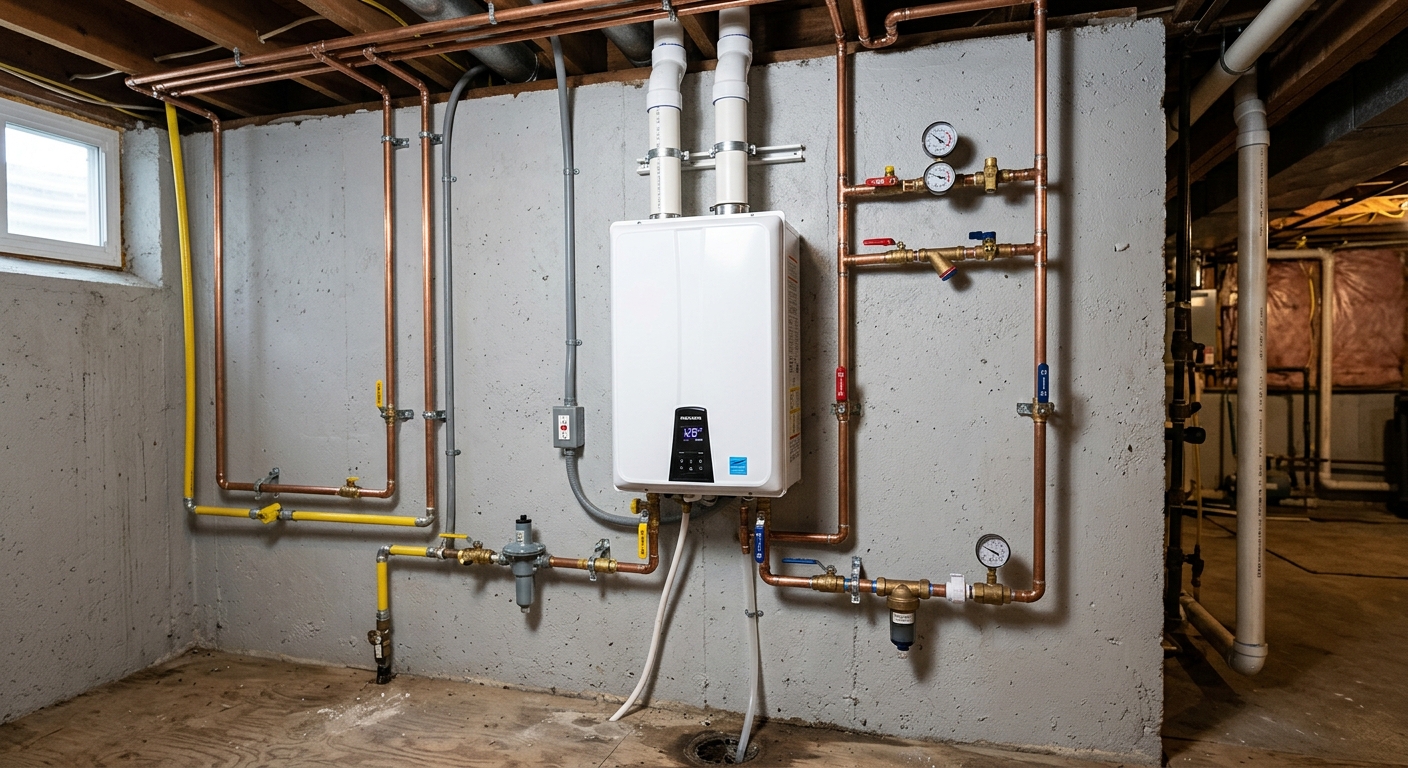
Franklin homeowners typically choose among three water heater types. Traditional storage tanks—gas or electric—are the lowest upfront cost, but they’re not the most efficient. They slowly lose heat all day (standby loss) and average 8–15 year lifespans. Tankless models cost more up front but deliver endless hot water and can last 18–25 years with routine descaling. The catch: most gas tankless installs in this area require upgrading the gas piping or vent, so actual cost may be higher than replacing a tank.
Heat pump water heaters boast the lowest running costs, but they need lots of air volume and a space that stays above 50 °F. They pull heat from the surrounding air, which cools and dehumidifies the basement—a plus or minus depending on your setup. They are also louder than most tanks, so installation in a finished basement should be thought through.
Tank sizing should be all about first-hour rating, not just gallons, to meet typical family peak demand. Pennsylvania’s code usually requires a pan and drain with installation, and in Franklin, expansion tanks are often mandated, especially on homes with a pressure regulator.
| Type |
Installed cost |
Service life |
Operating cost |
Best when |
| Gas tank, 40–50 gal |
$1,150–$2,700 |
8–12 yrs |
moderate |
existing gas, basement or utility room |
| Electric tank, 40–50 gal |
$1,150–$1,850 |
10–15 yrs |
high |
no gas available |
| Gas tankless |
$1,850–$2,700 |
18–25 yrs |
low-moderate |
higher initial budget, desire for endless hot water |
| Heat pump water heater |
$1,850–$2,700 |
13–15 yrs |
lowest |
unconditioned basement, attention to noise |
Frequently asked questions — plumbing in Franklin
Who inspects plumbing work in Franklin?
The authority inspecting plumbing work in Franklin depends on whether you’re in city limits or elsewhere. In York City, plumbing and permit inspections are handled by the City of York Bureau of Permits and Inspections. In Franklin itself and other parts of York County, inspections go through the municipal permit office—usually the township or borough’s building department. These inspectors check the work for compliance with the Pennsylvania Uniform Construction Code, which is based on the IRC. You should always require your plumber to pull the right permit and confirm inspection, especially for jobs exceeding $500. If in doubt about coverage or who the actual inspector is, call your municipal offices directly before work starts.
Which utility supplies water to Franklin?
For most Franklin homes, water is supplied by York Water Company, the primary public water supplier for York City and many surrounding municipalities in York County. If you use city water, you can confirm your utility by checking your most recent bill or your property paper trail. If your address is not within York Water Company’s service area, you may be on an individual well—common in some rural parts of northern York County. Either way, if you ever need a water service line replacement, expect a cost between $5,400–$11,500 depending on distance and yard restoration.
Should I wait until business hours to call?
Only wait if the issue can safely be delayed. If you have a burst pipe, a spraying leak, or a main stoppage putting water at risk of backing up, call right away—emergency rates apply, but the property damage from waiting could cost many times more than a prompt repair. Typical emergency plumbing repair runs $600–$1,150 in Franklin. For slow drains, running toilets, or updating fixtures, it’s fine to schedule during business hours and save on the service fee. When in doubt, ask the plumber if the wait could worsen your damage or health risk.
What does emergency plumbing cost in Franklin?
Emergency plumbing in Franklin—meaning late night, weekends, or active leaks needing immediate attention—typically runs $600–$1,150 for a burst pipe, and $1,850–$2,700 for urgent water heater replacement. Simple main line drain clearing ranges $350–$800. Prices skew high outside normal business hours for labor and materials on short notice. If you can safely wait and shut off the water, you’ll pay less by scheduling for standard hours. No reputable plumber minds quoting this up front.
Why do plumbers charge a diagnostic fee?
Diagnostic fees—usually in the range of $200–$500 for drain or leak location—cover the time and tools needed to properly identify the real cause of your plumbing problem. In Franklin and most of York County, shops invest in specialized equipment for acoustic listening, camera inspection, and meter testing. The fee ensures the plumber’s visit isn’t a loss when the homeowner declines further work, and it encourages honest, careful diagnosis. Many companies credit the diagnostic fee toward any major repair, so ask about this before booking. For complex issues or when walls need opening, a careful inspection up front prevents unnecessary demolition or repeated callbacks.
What do I do if a pipe is frozen but not burst?
In Franklin’s climate, frozen pipes are common but not always disasters—yet. If you have no flow at a fixture and suspect a freeze, open the faucet just a little and gently warm the affected part of the pipe with a hair dryer or heat gun. Start closest to the tap and move toward the cold zone. Never use an open flame; it’s a fire risk. If you reach the point of thaw and still see no leaks, you may have dodged a bullet, but watch closely over the coming hours. If a pipe does burst, you’re looking at a typical repair cost of $600–$1,150 on an emergency visit. Prevention is cheaper: insulation, heat tape, and letting a trickle run on nights that drop into the teens.
What causes low water pressure in Franklin homes?
In Franklin—especially in older homes built before 1950—low water pressure is most often caused by internal corrosion and buildup in galvanized steel supply pipes. Over time, rust and scale block flow so much that fixtures barely dribble, even though pressure at the curb is fine. In modern homes, pressure issues usually trace to a broken pressure regulator or a hidden leak. If you have consistently weak flow and old steel lines, it may be time for a repipe, which in Franklin runs $3,400–$8,300 depending on house size and finishes. Sometimes, a plumber can confirm the source with a quick inspection and targeted replacement rather than a whole-house overhaul.
Is a tankless water heater worth it in Franklin?
Tankless water heaters are popular in Franklin for compactness and their ability to supply endless hot water. The catch: initial install costs run higher ($1,850–$2,700), and you may need to upgrade gas lines or venting. For families with high hot water use, the lifetime savings on gas bills and the longer service life (often 18–25 years) can justify the price, but for moderate users or those with low-use patterns, a more basic tank can deliver years of service without the extra cost. Always have a plumber check your gas capacity and venting before making the switch, as these can swing the ROI substantially.
Is a sewer line replacement covered by homeowner's insurance?
In Franklin, as in much of Pennsylvania, most basic homeowner’s policies do not cover normal wear and tear or damage caused by root intrusion in sewer laterals. Coverage for sudden and accidental breaks inside the home may be part of a standard policy, but outside—the typical clay or cast iron line running to the street—it usually isn’t unless you’ve added a specific endorsement. Since repairs here run from $1,950–$11,500 depending on the damage and how much line needs replacement, check with your insurer now, not after trouble starts. Some utilities offer “line protection” policies for a few dollars monthly, but always read the fine print before relying on them.