Plumbing costs in Altoona — 2026
Altoona homeowners, especially those whose houses date to Blair County’s major building surge from 1900 to 1950, should be aware that aging galvanized piping drives both the kind of plumbing trouble you’ll see and the price of getting it fixed. In this market, 91.8% of homes were built before 1980 (U.S. Census Bureau, ACS 2024). That means most job costs reflect extra time and care to work around brittle pipes, tight cavities, and sometimes concealed, corroded lines. If you own one of Altoona’s 12,057 owner-occupied homes, the right solution weighs the age of your plumbing and your tolerance for risk and disruption.
The key cost driver is whether the call is for an emergency: a burst pipe or active leak always comes at a premium. The same job—for instance, stopping a supply line break—can add hundreds if it’s after hours, on a holiday, or if water is actively damaging the property. Altoona repair costs are also shaped by access, and here, construction era matters: finished basements and tight crawlspaces bring up both labor and restoration.
Below are price ranges typical for a standard Altoona home. All figures reflect the two-tiered reality of “emergency” versus planned work, and assume the most common local scenarios—aging supply lines, long pipe runs, and buried service lines below frost.
| Service |
Scope |
Emergency rate |
Standard rate |
| Emergency repair — burst pipe |
locate, open, repair section, restore service |
$550–$1,050 |
$325–$1,050 |
| Water heater replacement (gas, 40–50 gal) |
remove old, install, test, haul away |
$1,700–$2,500 |
$1,050–$2,500 |
| Drain cleaning — main line |
augering or hydro-jet, camera if needed |
$350–$800 |
$200–$500 |
| Sewer line spot repair |
excavate or reline a failed section |
$1,800–$10,500 |
$1,800–$10,500 |
| Whole-house repipe |
replace supply lines throughout, patch and finish |
– |
$3,100–$7,600 |
| Water service line replacement |
street to house, excavation and restoration |
– |
$4,900–$10,500 |
Estimates for a typical Altoona home. Access difficulty and pipe material move these figures more than anything else.
Detection methods and what they cost
If you think you have a hidden leak in Altoona, the quickest check is the meter test—shut off all fixtures and appliances, then watch your water meter. If the dial moves, there’s a leak somewhere on the supply side and you need to act quickly. This test is free, and nearly always available on municipal water systems like what’s served by Altoona Water Authority.
For leaks you can’t see or hear, a plumber will use several targeted tools. Acoustic listening devices amplify the sound of water escaping under pressure, useful for pinpointing leaks inside walls, under slabs, or in finished rooms. This kind of pinpoint leak detection usually runs between $200–$500. Thermal imaging can pick out cold spots or water trails behind drywall, though it’s most useful when there’s enough temperature difference; this can also fall in the $200–$500 range. When water supply lines are buried below a basement slab (common in older Altoona houses), tracer gas testing or electronic detection can narrow it down without needing to jackhammer blindly—often starting around $350.
Slab leaks, wall cavity leaks, and even hidden irrigation or outdoor lines should all be confirmed by one of these non-destructive methods before anyone opens a wall or floor. If a plumber suggests cutting without first locating, find someone who’s willing to do the proper diagnostics. The right tool means less mess, faster repairs, and lower restoration costs.
Frozen pipes in Altoona: prevention and thaw
In Altoona, frozen pipes are a real risk—frost lines run to 36 inches and winter design temps are down to 2 °F, with long cold snaps and high snow loads through the season. Most of the time, pipe bursts don’t happen at the ice blockage itself. Instead, as ice forms between a closed valve (like a faucet) and the plug, pressure builds up until weak pipe—often around joints or corroded elbows—gives way somewhere else.
Watch the usual suspects in these old Altoona homes: pipes run along exterior walls, lines through unheated crawlspaces or garages, hose bibs, and occasionally supply runs through uncapped attics. Here’s what prevents a freeze (cheapest first): insulate any exposed section, run heat tape along the length where accessible, let the cold-side trickle at farthest-run faucets during a deep freeze, open cabinet doors to circulate warm air, and—every fall—shut off and drain your exterior spigots before the first night below freezing.
If a pipe does freeze, thaw it slowly with a hair dryer, space heater, or heat tape—never with a torch or open flame, which is how houses go up every winter. If you’re unlucky and it bursts, the typical emergency fix in Altoona runs $550–$1,050 for a burst pipe, not counting wall or ceiling repairs later. A little prevention—sometimes a half-hour’s effort—can save a major bill.
Choosing a water heater in Altoona
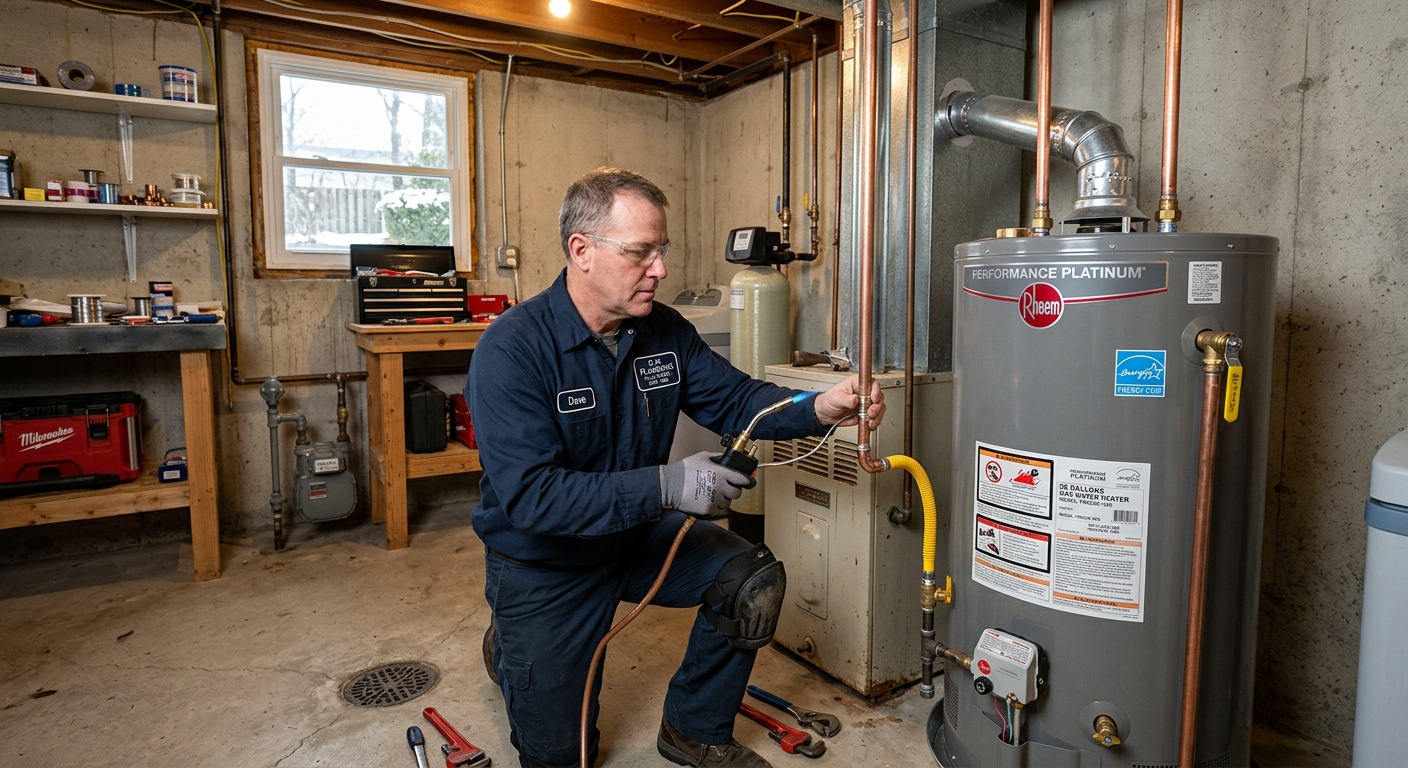
Altoona homeowners have the classic three choices: tank, tankless, and heat pump water heaters. Here’s how they stack up in Blair County. A conventional tank is cheapest to install and does the job, but comes with standby heat losses and a shorter life—usually 8–12 years. Tankless gas models offer endless hot water and a small wall footprint, but most Altoona homes from the surge era don’t have the right-sized gas lines or venting; that upgrade surprises a lot of budgets. Heat pump water heaters are the most efficient, though they need enough room and warmth to run well—putting them in a cold Altoona basement (especially unfinished) means loud operation and slower recovery in deep winter.
Sizing is about first-hour rating—the amount of hot water the unit can deliver in 60 minutes—not just the physical tank size. Codes and modern water heaters also require an expansion tank (since municipal supply lines have backflow prevention); a drain pan and floor drain are smart upgrades. In these older Altoona homes, failures are almost always the tank rusting out, not the electronics.
| Type |
Installed cost |
Service life |
Operating cost |
Best when |
| Gas tank, 40–50 gal |
$1,050–$2,500 |
8–12 yrs |
moderate |
gas is present, fastest recovery, lowest upfront |
| Electric tank, 40–50 gal |
$1,050–$1,700 |
10–15 yrs |
high |
no gas service, lowest upfront install |
| Gas tankless |
$1,700–$2,500 |
18–25 yrs |
low-moderate |
newer home, vent/gas line upgrades possible |
| Heat pump water heater |
$1,700–$2,500 |
13–15 yrs |
lowest |
warm, large unfinished area, electric only |
How to find a good plumber in Altoona
In Altoona and the rest of Blair County, plumbing contractors are registered at the state level for home improvement jobs over $500, not licensed statewide for plumbing itself. Always verify HIC registration at the state site (hic.attorneygeneral.gov) for any substantial job. Know the difference between state registration and local requirements: for city work, confirm if your job (especially commercial) needs an Altoona-issued contractor license.
Once you’ve shortlisted plumbers, ask for a certificate of insurance naming your property, and check that workers' compensation is current—verify this at wcais.pa.gov. If a company uses subcontractors, ask who exactly will be on your job. Emergency dispatch is common here due to rural travel; good companies are clear up front about after-hours pricing.
- Check HIC registration number at hic.attorneygeneral.gov
- Ask for city of Altoona contractor license for commercial projects
- Request certificate of insurance showing your property
- Verify workers’ compensation through WCAIS
- Confirm crew (employee or subcontractor) doing the work
- Ask about after-hours/emergency rates before scheduling
- Get camera footage for any quoted sewer or main drain repair
- Ask for before/after pressure test documentation for repipes
- See written breakdown on water heater replacements (new vent/gas runs)
- Review contract for 3-day cancellation wording (required by law)
- Ask for written warranty policy for parts and labor
- Be wary of plans that offer to “waive” an insurance deductible (not legal)
Red flag here: Anyone selling you a repipe or sewer dig without offering camera evidence (or at least a pressure test) is skipping the basics. Blair County’s moderate market means you do have real choices—don’t pay for major work without documentation.
Licensing and permits for plumbing work in Altoona
Plumbing in Altoona is not licensed by the state of Pennsylvania; rather, it is a municipal credential. Pennsylvania has no statewide plumbing license (outside of Philadelphia and Pittsburgh’s muni-run registries). That means your plumber’s resume in Harrisburg or Johnstown doesn’t help you—the key question is, “Are you approved to work in Altoona?”
The City of Altoona issues its own commercial contractor licenses for plumbing work, separate from other municipalities in Blair County. For homeowners, most small fixture swaps (like replacing a toilet or faucet in the same spot) are commonly done without pulling permits, but anything that alters piping or adds fixtures in a residence starts to require proper city oversight. Commercial plumbing upgrades or installations always need both a permit and a locally recognized contractor.
Permits are enforced locally through the City of Altoona Codes & Inspections Office. Always verify not just that your contractor is HIC-registered (statewide home improvement) but that their insurance and workers’ compensation are current—WCAIS is the system for this. For jobs in Altoona, this dual layer (state registration plus city credential) is the reality.
What construction era means for your pipes
Blair County’s housing boom from 1900–1950 shows up in almost every Altoona plumbing job today. Over 90% of homes here were built before 1980, so you’re likely dealing with galvanized steel supply lines—now prone to internal corrosion and reduced flow—or in some older runs, lead or early copper. Drains from that era are usually cast iron in buildings, but by the time you hit the yard heading for the street, expect vitrified clay or orangeburg—both are failure-prone after 60+ years. Sewer backups in town are often traced to these cracked or root-invaded lines.
On the supply side, many Altoona homes have had one or even two water heater replacements. If yours is still the original, it’s past the design life; third replacements are common. Water service lines in these areas may be copper, galvanized, or sometimes even remnants of lead, tying into the Altoona Water Authority’s ongoing inventory program.
For homeowners in newer subdivisions, the trouble shifts: you’ll see builder-grade fixtures, possibly thin-walled copper or early PEX, and water heaters approaching their first replacement. Newer construction doesn’t mean you’re safe from issues, just that the problems change—more with plastic fittings and less with corrosion.
Frequently asked questions — plumbing in Altoona
Is Altoona on combined sewers or septic?
Altoona itself is on separated sanitary and storm sewer lines, so stormwater and household waste flow in different systems. This reduces the urban risk of backups during heavy rainfall, compared to old cities with combined sewers. However, the farther you get into Blair County's outlying townships (especially rural and suburban areas), you’ll find a high reliance on individual septic systems instead of public sewers. If your home has a “main” clog or sewage backup inside Altoona city limits, it's almost never a case of stormwater overwhelming the sanitary system—it’s usually a localized blockage or a failed sewer lateral. A main line cleaning in this market usually costs $200–$500; if you're on septic and the problem’s not in the house, call your pumper.
What do I do if sewage is backing up?
If you’re in Altoona and you see sewage backing up in your tub or basement floor drain, stop running any water inside—shut off washing machines, dishwashers, and avoid flushing toilets. In most city homes, sewer backups mean a blockage in the main line, either on your property or at the lateral connection to the city’s separated sanitary sewer. Call a plumber equipped to do camera inspections; you'll want visual documentation before anyone quotes a dig or repair. Expect drain cleaning (with auger or hydro-jet plus camera) to run $200–$500 in standard situations. In rural Blair County, if you're on septic, backups could mean the tank needs pumping or that the field is saturated—call your septic pro, not a city plumber.
Does insurance cover a burst pipe in Altoona?
Most Altoona-area homeowner’s insurance policies will cover the sudden damage caused when a pipe bursts, including restoration of water-damaged walls and floors. However, they usually exclude the cost to repair the pipe itself. If your house is among the many built before 1980 and has a supply line burst, expect to pay $550–$1,050 for the repair alone. Make sure to document everything from the start—take photos before cleanup begins and keep all receipts. Notify your insurer immediately, as some policies have tight notification windows after an event. Also, many policies now exclude coverage for “slow leaks” or neglect, so prevention (like insulating pipes) isn’t just about saving on a plumber—it’s about keeping your coverage intact.
How much does sewer line repair cost in Altoona?
Sewer line repair is one of the most expensive plumbing jobs in Altoona, especially with the prevalence of clay tile or orangeburg pipe running from older houses to the street. A spot repair—where only a section is dug up or relined—typically starts at $1,800–$10,500. Full replacements (say, curb to house) can push to the higher end due to excavation, restoration, and if the line runs under a driveway or mature trees. Always ask for a camera inspection before you sign; a proper plan and documentation can save thousands or eliminate unnecessary work. City rules expect you to handle the lateral up to the tap, so it’s on you unless the problem’s in the main.
What does discoloured water on first draw mean?
Discoloured or rusty water on first draw in an Altoona home—especially after hours of no use—almost always points to aging galvanized or iron pipes inside the house or public supply lines. Given that most Altoona homes were built before 1980, it’s not rare for these pipes to shed rust scale after sitting still. Sometimes it’s harmless, but it can mean your supply lines are at or near end of life. If the water clears after running for a few moments, that’s usually consistent with interior pipe issues. A supply repipe can cost $3,100–$7,600, but a simple sediment flush or cleaning of aerators may solve it if you’re lucky.
How much does a plumber cost in Altoona?
In Altoona, the price for common plumbing repairs is shaped by the urgency of the call and the nature of the old housing stock here. For a standard repair—like a leaky valve, faucet swap, or non-emergency drain clearing—expect a plumber’s bill to run between $200–$500 depending on access and if you can schedule during regular hours. Emergency repairs (like a burst pipe) come in higher, often $550–$1,050, because they require fast response and can involve after-hours labor or materials. Always ask if there’s a dispatch or diagnostic fee before inviting anyone out.
Should I leave a faucet dripping in cold weather?
Yes, during extreme cold spells in Altoona—especially where pipes run through uninsulated crawlspaces or exterior walls—letting a farthest-run faucet trickle overnight is standard advice. Our local frost line (36 inches) and winter lows (2 °F) mean pipes freeze hard. The small water movement relieves pressure buildup behind an ice plug, dramatically reducing burst risk. Even one avoided freeze can save you the cost of a typical burst pipe repair: $550–$1,050. That little wasted water is worth it compared to a flooded basement in a Blair County winter.
Repair or replace a leaking water heater?
Most Altoona water heaters are tank-type and well past their expected life (8–12 years for gas, 10–15 for electric). If the leak is from the tank body, replacement is almost always the right call—the tank is corroding from within, and a patch will only buy you days at best. Replacing a 40–50 gallon gas heater typically costs $1,050–$2,500, depending on how much re-piping or venting is needed. If the leak is at a pipe, valve, or temperature-pressure relief fitting, that can often be repaired for less. In these older Altoona basements, however, watch out for secondary water damage if the leak goes unnoticed.
How do I verify a plumber's licence and insurance?
In Pennsylvania, plumbing trades are regulated at the municipal level—not by the state. For jobs in Altoona, you want a plumber who is Home Improvement Contractor (HIC) registered (check at hic.attorneygeneral.gov) for anything over $500, and if you’re doing commercial work, they must also have a City of Altoona contractor license. Always request a certificate of insurance with your name and address, and confirm they carry workers’ compensation (verify at wcais.pa.gov). For major work—a whole-house repipe or sewer line replacement ($3,100–$10,500)—never proceed without these verifications. Don't hesitate to call the city Codes & Inspections Office and confirm everything is on file before your project begins.