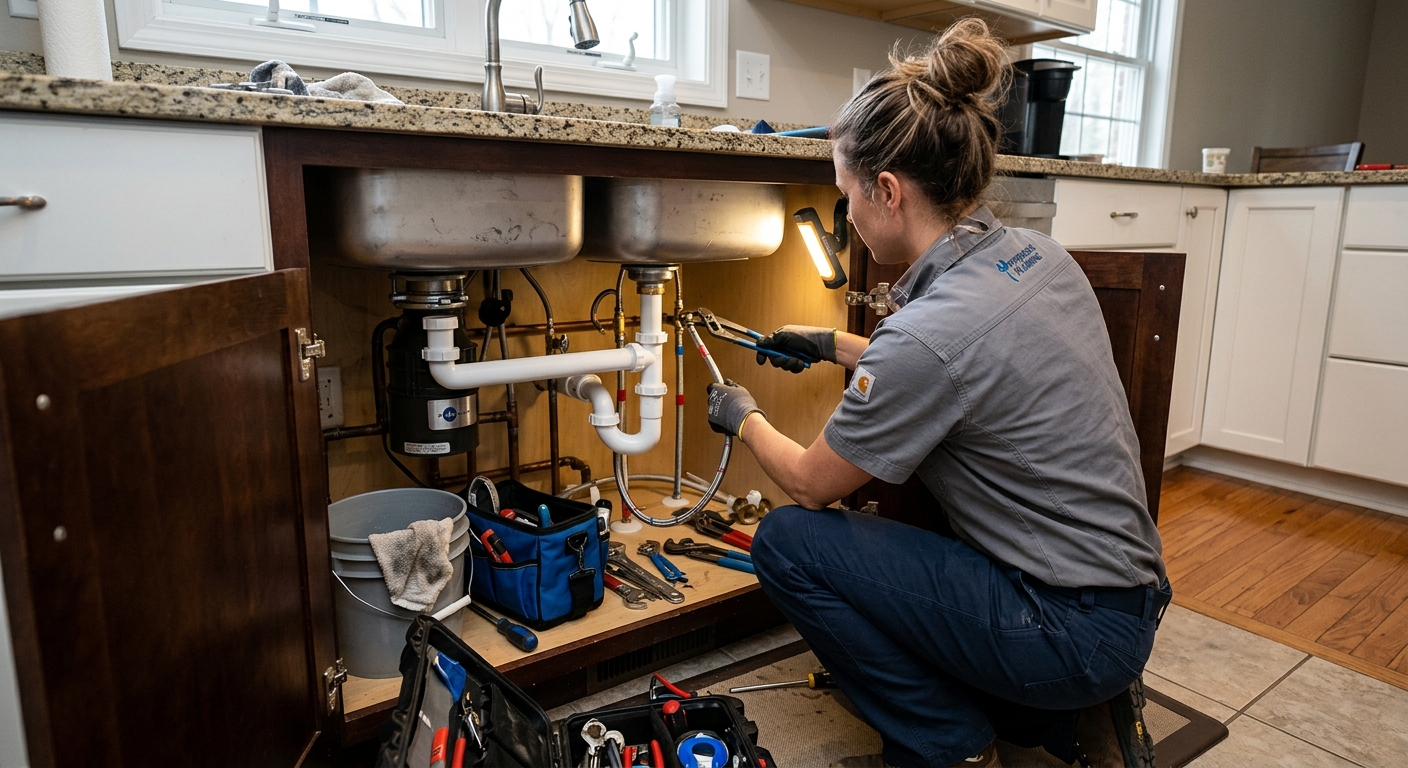
West York plumbing prices by job type — 2026
In West York, plumbing costs are determined by both the type of work and whether you’re facing an emergency. With 94.9% of homes built before 1980 and only 23.8% single-family housing (U.S. Census Bureau, ACS 2024), many local houses date back to the era when galvanized steel was a default, and now that material is reaching the end of its reliable life. This age and style of construction, especially in nearby York City homes built 1900–1950, nearly always means interior supply lines have needed or will need replacement with copper or PEX. The work involved in this shift affects both prices and how unexpected repairs unfold.
Be aware that emergency repairs—anything that stops water or threatens damage—almost always cost more due to dispatch and after-hours rates. Knowing whether your issue is urgent helps control spending, especially when the difference can be hundreds of dollars for the same repair done under less pressure.
| Service |
Scope |
Emergency rate |
Standard rate |
| Emergency repair — burst pipe |
locate, open, repair section, restore service |
$550–$1,150 |
$325–$1,150 |
| Water heater replacement (gas, 40–50 gal) |
remove old, install, test, haul away |
$1,800–$2,700 |
$1,150–$2,700 |
| Drain cleaning — main line |
augering or hydro-jet, camera if needed |
$350–$800 |
$200–$500 |
| Sewer line spot repair |
excavate or reline a failed section |
$1,900–$11,500 |
$1,900–$11,500 |
| Whole-house repipe |
replace supply lines throughout, patch and finish |
— |
$3,400–$8,100 |
| Water service line replacement |
street to house, excavation and restoration |
— |
$5,300–$11,500 |
Estimates for a typical West York home. Access difficulty and pipe material move these figures more than anything else.
Hardness, treatment and fixture life in West York
Most homes in West York get their supply from York Water Company, which means water is treated to safe standards and an annual water quality report is available (you can request the latest from the utility). Hardness—meaning dissolved minerals—affects water heaters and fixtures directly. Homes with harder water see more scale build-up, reducing water heater efficiency and cutting short valve and cartridge life.
Aggressive or slightly acidic water, though less common, can lead to pinhole leaks in copper over time, especially in older homes now converted from galvanized steel. Some installers push whole-house softeners, but in practice, the math rarely pencils out in West York unless you’re replacing expensive fixtures every few years. In most cases, scale and hardness are moderate; a softener can help, but if you’re not noticing crusty buildup or bitter-tasting water, you’re probably fine without one.
If you’re considering filtration, prioritize point-of-use filters at kitchen taps if you’re mainly concerned about taste and drinking water—these cost much less to maintain than a whole-house filter and tend to address actual complaints better. Unless you have a specific contaminant problem, avoid oversold “miracle” water treatment units. For well owners out in the more rural stretches of York County, remember: nobody checks or publishes your water quality—you need to test annually for bacteria, nitrates, and heavy metals.
Choosing a water heater in West York
Water heater replacement in West York usually comes down to tank (gas or electric), gas tankless, or heat pump units. Traditional tank models are the lowest in up-front cost and what you’ll find in most existing homes, but they have the shortest lifespan and lose energy to standby heat losses. Replacement costs range from $1,150–$2,700 installed for gas or electric tank units.
Tankless gas models promise endless hot water and lower fuel use—good for families with high peak demand—but installation costs hit $1,800–$2,700 because many West York homes need a new, larger gas line and a properly vented flue. If your gas piping or vent runs aren’t already up to code, budget toward the higher end. These units rarely pay back the extra cost unless you’re using a lot of hot water or finishing a basement where space-saving is crucial.
Heat pump water heaters have the lowest operating cost and are becoming popular where basement space and mild temperatures fit. They work best in a big, open, semi-heated area—if it goes in a cold or finished basement, they become loud and chill down the room. Expect similar installed prices to tankless units. No matter which you pick, size it by first-hour rating (not just by tank size) and don’t skip the expansion tank or a drain pan—West York basements have enough history with wet floors to prove why.
| Type |
Installed cost |
Service life |
Operating cost |
Best when |
| Gas tank, 40–50 gal |
$1,150–$2,700 |
8–12 yrs |
moderate |
For lowest up-front cost in existing gas homes |
| Electric tank, 40–50 gal |
$1,150–$1,800 |
10–15 yrs |
high |
No gas available; moderate use |
| Gas tankless |
$1,800–$2,700 |
18–25 yrs |
low-moderate |
High hot water demand, open basement, gas supply up to code |
| Heat pump water heater |
$1,800–$2,700 |
13–15 yrs |
lowest |
Plenty of space, want lowest operating cost, no existing gas |
Who is allowed to do plumbing work in Pennsylvania
In Pennsylvania, plumbing is not licensed at the state level—licensing is handed down to individual municipalities. That means a plumber working in Spring Garden Township (which has its own registration) or York City may hold credentials there, but those same credentials carry zero weight if they step over the township line into West York or another spot. So, the real question isn’t “are you licensed?” but “are you properly registered for this job, right here?”
In York City, any work that alters or adds plumbing beyond a fixture swap requires a municipal plumbing permit; replacing a toilet or faucet in the same location, with no re-piping, is commonly done with no permit needed. Inspections are usually handled by the city or township that issued the permit using their own code office. Make sure your contractor offers a written contract for any job over $500 (required by the Home Improvement Consumer Protection Act), and their insurance and workers’ compensation can be checked via the state’s WCAIS system (wcais.pa.gov). Always verify HIC registration at hic.attorneygeneral.gov before signing anything—West York and its neighbors are covered by this requirement.
Is your water line lead? How to find out
Service lines in West York are supplied by York Water Company, and, as of their latest public inventory, the utility reported all lead service lines in its York City system have been replaced. Still, responsibility for a water service line is split: from the street to the curb stop is typically the utility’s, but, from that point into the house, ownership is on the homeowner. Historically, replacement programs have often covered only the utility-owned section—so the replacement on your side isn’t automatic, and the price can reach $5,300–$11,500 if excavation or street crossing is needed.
To identify your supply line, locate where the pipe enters your basement. Gently scrape it with a coin: lead is soft and silvery, while copper shines reddish brown and galvanized steel is silver under the surface and magnetic. If the pipe is lead, or if you can’t tell, ask York Water Company to confirm their records or arrange a site check—their published inventory is a starting point but does not override what’s in your basement. Don’t rely on an old permit or neighbor’s word—lines are replaced piecemeal, and records can be incomplete.
If you think you might still have lead or a mix of old and new pipe (a “partial” replacement), know that disturbing the line can temporarily spike lead in your water. Ask the utility about cost sharing, but unless they offer a program, assume replacement on your side is yours to fund. For a full replacement, the cost will fall between $5,300–$11,500, essentially the same as a full-service line replacement in any York County home.
Winter pipe failures in south-central Pennsylvania
With a frost depth of 30 inches and a winter design temperature of 12 °F, West York gets the full brunt of freeze-thaw cycling typical for south-central Pennsylvania. Most burst pipes don’t give way right where they freeze. Instead, ice forms in a cold section and blockades the pipe; pressure builds up between the blockage and a closed faucet until a weaker spot splits downstream, flooding after the first thaw means you often find the break feet away from where it froze.
The riskiest pipes are in unheated crawlspaces, against drafty exterior walls, in garages, attics, and anywhere hose bibs protrude without proper shutoff. Insulating pipes is your best first defense, followed by adding heat tape for chronically cold stretches. On the worst nights, crack cabinet doors under sinks and let a faucet drip to keep water moving—cheaper than the cleanup from a burst. Outdoor hose bibs should always be shut off and drained before the first hard freeze.
If a pipe does freeze, use a hair dryer, heating pad, or a warm towel—never an open flame. Call a plumber if you can’t access or safely thaw the section. For local context, the cost of repairing a burst pipe often lands between $550–$1,150 when urgent, underscoring why prevention is cheaper than recovery.
What urgency costs you
Emergency plumbing in West York means paying for speed—night or weekend labor, rapid dispatch, and a premium because diagnosis and repair get compressed into one trip. Most local plumbers charge a trip fee, plus higher hourly rates for after-hours visits. Emergency calls force quick access and more disturbance because “making it work” trumps “making it pretty.” Overtime and special call-out rates are the rule, not the exception.
That makes urgency an expensive choice: a burst pipe repair that’s $325–$1,150 as scheduled work quickly becomes a $550–$1,150 bill at night or on the weekend. Severity is key—here’s what needs a true rush: active flooding, no running water at all, sewage backing up inside, or any gas odor. Less urgent: a drip under the sink (put a bucket under it), a single slow drain (don’t run more water), or a running toilet.
Here’s one place to save money: every homeowner should know how to shut off water at the main (usually a valve just inside where the water line enters your basement wall) and at fixture stops under sinks and behind toilets. That skill alone turns many “emergencies” into routine repairs in West York.
Frequently asked questions — plumbing in West York
How much does a plumber cost in West York?
In West York, plumber costs depend on whether your job is routine or urgent. For example, a burst pipe can range from $325–$1,150 when scheduled during regular hours to $550–$1,150 when it’s an emergency call. Even something simpler, like a main drain auger, is usually $200–$500 as planned work and goes up for after-hours calls. Because nearly all homes here were built before 1980, repairs sometimes mean working around old materials, so quotes can vary more than in newer housing. Always ask for a clear, written estimate before any work happens, especially for large repairs or replacements.
How do I prevent frozen pipes in West York?
To prevent frozen pipes, insulate any plumbing running through unheated areas—think basement rim joists, crawlspaces, garages, and exterior walls. In West York, frost can reach 30 inches deep, so pipes near the surface or against cold walls freeze first. On the coldest nights, open kitchen and bathroom cabinets to let warm air flow, use heat tape where needed (especially on older pipes), and allow a trickle of water to keep things moving. Don’t forget to shut off and drain outdoor hose bibs before winter. Prevention always beats the cost of a burst pipe—repairing even a short split can run $550–$1,150 as an emergency. Skip open flames for thawing and use safe, gradual heat like a hair dryer if a pipe does freeze.
Is a tankless water heater worth it in West York?
Tankless water heaters provide endless hot water and can save on gas use, but the up-front cost is steeper—usually $1,800–$2,700 installed in West York. Many local homes need upgrades to gas supply lines and new venting to meet code, bumping up the cost. If your hot water demand is high and you have a suitable basement, tankless can make sense, but if you stay within the typical usage and aren’t re-plumbing anyway, a regular tank heater (at $1,150–$2,700) is often the practical choice. The savings are gradual, not instant, so weigh needs against budget.
How do I tell what my pipes are made of?
In West York, you can usually check pipe material by locating a section near the main water shutoff or where exposed in the basement. Scratch the surface with a coin: lead is soft and gray, copper gleams reddish-brown, and galvanized steel is hard, metallic, and magnetic. Most pre-1980 homes started with galvanized pipes, with many updated to copper or PEX over the years. If you’re unsure, a licensed plumber can help identify pipe materials during any repair call. For service line replacement, costs typically run $5,300–$11,500 if excavation is required.
Are tree roots a common sewer problem in West York?
Tree roots are a major cause of sewer clogs in York County—especially in older neighborhoods with clay or cast iron lines and mature growth. Roots seek out tiny cracks, grow inside the line and eventually block flow. If your main drain is slow or you notice gurgling, a camera inspection is often the next step. Clearing a root blockage usually starts at $200–$500 for regular drain cleaning, but severe cases needing spot repairs or pipe replacement can be much more. Avoid flushing wipes or grease, which contribute to root and sewer backups.
How do I verify a plumber's licence and insurance?
In Pennsylvania, plumbing licences are not issued statewide; municipalities set their own requirements. In West York and all surrounding townships, you should confirm your plumber has Home Improvement Contractor (HIC) registration, which is required for contracts over $500. You can check this directly at hic.attorneygeneral.gov. Insurance and workers’ compensation are also mandatory for employers—look these up on WCAIS at wcais.pa.gov. Don’t accept “licensed and insured” without seeing proof. Verifying credentials before work starts protects you from liability if things go wrong, and is especially important for larger jobs like a whole-house repipe ($3,400–$8,100).
What does drain cleaning cost in West York?
For a typical main line in West York, professional drain cleaning runs $200–$500 for standard augering and camera inspection as scheduled work. Hydro-jetting or after-hours emergencies lift the cost to $350–$800. The biggest price variables are whether it’s just a soft clog or heavy root incursion, how far the clog is from the main cleanout, and whether a camera inspection finds anything more serious (like a broken pipe segment). Preventative cleaning is almost always less expensive than waiting for a backup, which can quickly become a disruptive emergency.
Who owns the sewer lateral, me or the city?
In West York and throughout York County, you as the homeowner own and maintain the sewer lateral—the pipe running from your house to where it meets the public main or street line. The city or township is only responsible for the main line in the street. If you need a spot repair due to roots or a collapse, budget $1,900–$11,500. It’s up to the property owner to keep the private line clear and functional; if a backup occurs, you pay for repairs right up to the tap at the public main.
How do I shut off the water to my house?
Every West York home has a main shutoff valve—usually a ball or gate valve—on the water supply line just after it enters the basement or crawlspace, often near the water meter. Turn this valve clockwise (right) to shut off all water to the house. For sink, toilet, and washing machine leaks, use the small oval valve (fixture stop) under or behind the unit, turning it right until tight. Learning to shut off water instantly can turn a true emergency (flooding, burst pipe) into a planned, non-emergency repair and save you the emergency premium of $550–$1,150. If you can’t locate your shutoff, or if the valve is stuck, ask your plumber to tag and test it the next time they’re out.