Scranton plumbing prices by job type — 2026
When you live in Scranton, what you pay for plumbing depends just as much on your house’s age as on what actually broke. With over half the homes here built before 1940 (U.S. Census Bureau, ACS 2024), most original plumbing was galvanized steel or cast iron, which means ongoing repair and repiping work is common—especially in older areas like much of Scranton and Old Forge. Pipe material predicts where failures show up and what’s involved in fixing them: steel pipes corrode from the inside and restrict flow long before they outright leak, while cast iron drains eventually crack or scale up. That construction era sets the table for cost.
The other big driver is timing. A sudden leak at midnight—an emergency call—costs a different amount than work scheduled during regular hours. Plumbers build the after-hours response into their price, and when pipes fail in a Scranton winter it’s almost always an emergency. For every common job, there’s a split: do you need it fixed today, or can you wait?
| Service |
Scope |
Emergency rate |
Standard rate |
| Emergency repair — burst pipe |
locate, open, repair section, restore service |
$550–$1,050 |
$300–$1,050 |
| Water heater replacement (gas, 40–50 gal) |
remove old, install, test, haul away |
$1,700–$2,500 |
$1,050–$2,500 |
| Drain cleaning — main line |
augering or hydro-jet, camera if needed |
$350–$800 |
$200–$500 |
| Sewer line spot repair |
excavate or reline a failed section |
$1,800–$10,500 |
$1,800–$10,500 |
| Whole-house repipe |
replace supply lines throughout, patch and finish |
— |
$3,100–$7,600 |
| Water service line replacement |
street to house, excavation and restoration |
— |
$4,900–$10,500 |
Estimates for a typical Scranton home. Access difficulty and pipe material move these figures more than anything else.
Is your water line lead? How to find out
Scranton and neighboring boroughs, served by Pennsylvania American Water and the Scranton Sewer Authority–related entities, have properties with both utility-owned and homeowner-owned sections to the water service line. The utility maintains a lead service line inventory for their part of the pipe, but the segment under your lawn—from the curb to your house—is usually your responsibility. Replacement programs reported in Scranton are ongoing, but do not include a promise to fully replace both utility and homeowner pipes. You should never assume both sides are covered; instead, directly ask your water utility what their published inventory status is for your address and what help, if any, covers your side.
You can identify your own service line at the main point of entry. Use a coin to scratch the pipe: if it scrapes to a bright silver and a magnet doesn't stick, that's usually lead. If it stays dull gray and the magnet grabs, it's galvanized steel. For homes built before 1940—common in Scranton—this check is worth doing, since lead and galvanized lines were both common then.
If you decide to replace your water service line from street to house in Scranton, expect to pay $4,900–$10,500, depending on yard access and length. Only replace your full line at once—partial replacements, where lead pipe remains on either side, can temporarily increase your lead exposure by disturbing the mineral scale inside old pipe.
If you’re unsure about your material—or the utility’s database isn’t clear—contact Pennsylvania American Water or the Scranton Sewer Authority for direct guidance. They can give you the current status for your home and any updates to replacement coverage.
Verifying a Scranton plumber's credentials
No statewide plumbing licence exists in Pennsylvania. In Scranton and every other Lackawanna County town, plumbing licensing and permit registration is handled municipality-by-municipality. This means a plumber valid in Scranton might hold no credential in Old Forge, or vice versa. The smart question for any plumbing contractor is not "Are you licensed?" but "Are you licensed here?"—because only Scranton’s own Department of Licensing, Inspections & Permits enforces codes and plumbing permits within city limits.
In Scranton, you’ll need a permit for water heater replacements, full repipes, and any substantive plumbing alterations—even if it’s not new construction. If you have a major repair or repipe, make sure your contractor is registered with the city and files permits on your job; inspection follows before walls close back up. Cosmetic remodeling (like painting or new flooring with no plumbing, electrical, or structural change) usually doesn’t require a permit.
For insurance and workers’ compensation, real companies should show a certificate with your address as named coverage, and you can confirm their workers’ comp through the WCAIS system. Don’t skip checking Home Improvement Contractor (HIC) registration at hic.attorneygeneral.gov—any plumbing job over $500 legally requires it.
Choosing a plumbing contractor
In Scranton and the surrounding Lackawanna County area, always check if a plumber is licensed and permitted to work where your home sits—not just "in Pennsylvania" but in your specific city or township. Start by asking for their local registration number and confirm with your city’s permit office if you have any doubt. Next, check their Home Improvement Contractor (HIC) registration for jobs above $500 at hic.attorneygeneral.gov; it’s required by state law. Insurance should list your property on the certificate. For workers’ compensation, use the state’s WCAIS system to verify coverage, especially if their crew isn’t family-only.
Ask if the company uses its own employees, not just subcontractors who might not meet local code. On emergency calls, a real Scranton pro will be clear about after-hours rates and how diagnostics work before quoting a fix.
- Confirm plumber holds a valid permit registration in your city or township
- Check Home Improvement Contractor (HIC) registration at hic.attorneygeneral.gov
- Ask for valid insurance certificate with your address named
- Verify workers' compensation at wcais.pa.gov
- Confirm if work is done by employees or subcontractors
- Request an itemized, written contract for any job over $500
- Ask about warranty on workmanship and materials
- Clarify emergency call-out fees in writing
- Require a permit and inspection for water heater, repipe, or major repair in Scranton
- Request before and after photos for underground or in-wall work
- Require pressure test or camera evidence for repipe or sewer quotes
- Check online reviews specifically for jobs in your neighborhood
With so many licensed and unlicensed outfits operating in a saturated Scranton–Wilkes-Barre market, these steps cut your risk. The biggest red flag: any contractor who quotes a repipe or sewer replacement without first running a camera or pressure test to justify the work.
Choosing a water heater in Scranton
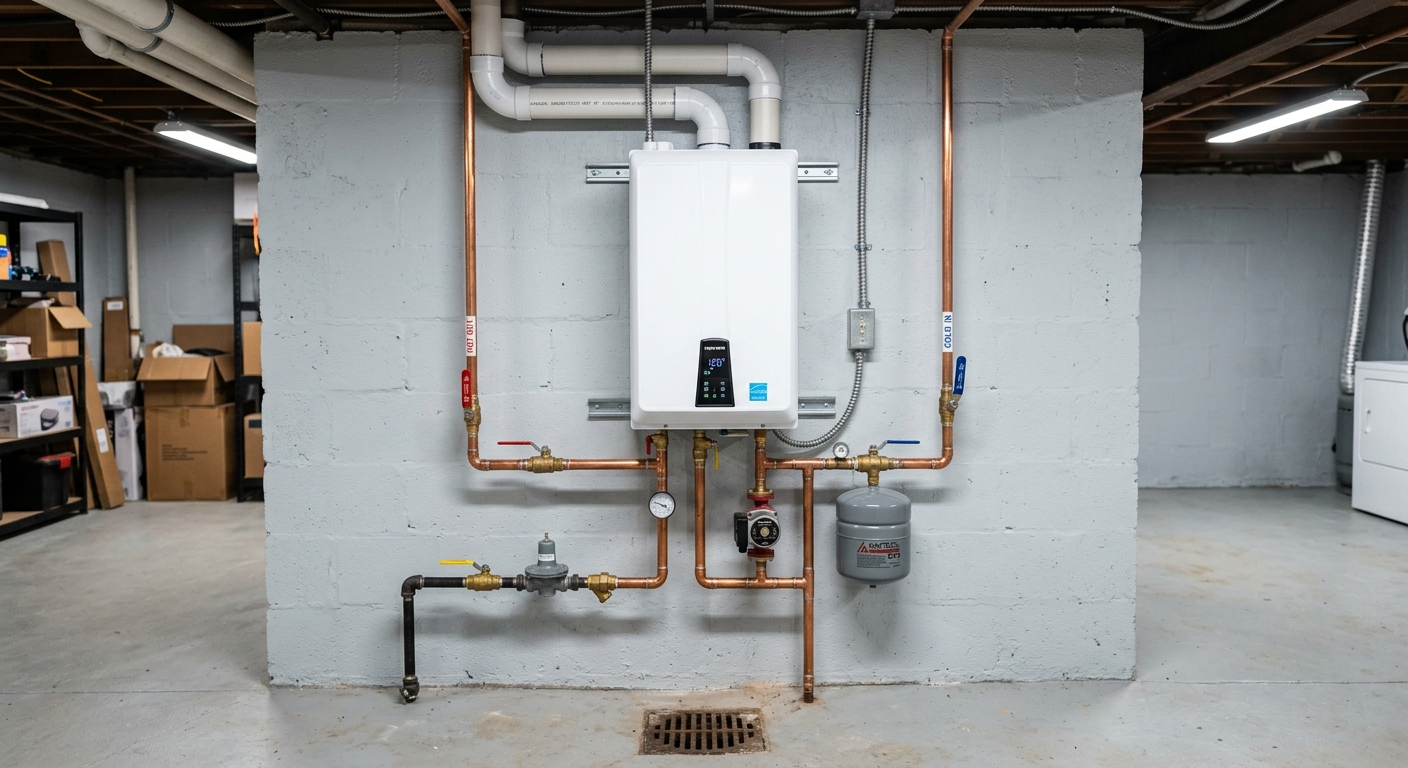
In Scranton, where nearly 88% of homes are older than 1980 and small basements are the rule, choosing a water heater takes more than just picking a brand. The gas tank heater is usually the cheapest installed option and fits most basements, but standby losses cost you efficiency and it’ll need replacement sooner. Tankless gas heaters attract people with endless hot water and wall-mount footprints—but they drive up cost fast if your gas line or venting needs upgrades (very common in pre-1940 houses), and those extras aren’t always quoted up front. Heat pump water heaters run on electricity and are by far the cheapest day-to-day, but they’re physically bigger, cool the surrounding square footage (bad for finished basements), and are noisy enough to be awkward if living space is nearby.
First-hour rating matters more than gallon size: Scranton’s big older homes often have multiple tubs, and if your family does back-to-back showers, you’ll want 50+ gallons or a high-output tankless. All modern installs require a thermal expansion tank, plus a pan and floor drain where possible. When failures happen, nine times out of ten the issue is with the tank itself, not the controls or thermostat.
| Type |
Installed cost |
Service life |
Operating cost |
Best when |
| Gas tank, 40–50 gal |
$1,050–$2,500 |
8–12 yrs |
moderate |
existing gas line, no vent upgrades |
| Electric tank, 40–50 gal |
$1,050–$1,700 |
10–15 yrs |
high |
no gas available, small family |
| Gas tankless |
$1,700–$2,500 |
18–25 yrs |
low-moderate |
high demand, access for venting |
| Heat pump water heater |
$1,700–$2,500 |
13–15 yrs |
lowest |
spacious, unfinished basement, electric only |
Finding a hidden leak in Scranton
Start simple: for Scranton homeowners, your first leak detection tool is the water meter. With every faucet, shower, washer, and outdoor spigot closed, check the meter—if the dial is twitching or spinning, you have a supply-side leak somewhere.
Professional leak detection starts around $300–$1,050 for an emergency call, and brings in methods like acoustic listening (for pipes in walls or under floors), thermal imaging (to spot temperature differences from leaking hot water pipes), tracer gas for stubborn cases, and pressure testing. For slab leaks—in Scranton, there are more crawlspaces than slabs, but older basements sometimes have water lines running in or under the concrete—these tools let a plumber pinpoint exactly, so you don’t pay for tearing up good floors chasing a bad guess.
Hidden leaks in wall cavities or embedded pipes get found with these non-invasive tools, not with sledgehammers. If your plumber’s first instinct is to break open walls before doing a full leak location, get a second opinion. You never want to pay for re-patching just for the sake of guesswork.
Galvanized, copper, PEX, cast iron
If your Scranton or Old Forge house was built before 1940, chances are high you’ve got (or once had) galvanized steel supply lines and cast iron or even clay tile drains. Galvanized pipe looks dull gray, is magnetic, and shows threaded joints; as it ages, it’s notorious for pressure loss and sudden blockages long before it leaks outright. Copper, used from the 1950s on in Scranton’s housing stock, is a reddish metallic tube, not magnetic, and typically sweated at the joints. If you scratch it, you’ll see the telltale copper color.
Some homes remodeled in the late 1970s through 1995 might have polybutylene—dull gray-blue, not magnetic, joined by plastic or copper crimps—which is uninsurable in many places due to splitting risk. PEX is flexible tubing, often red or blue, common in new repipes since the 2000s and run in long, joint-free lengths through walls. Cast iron is thick, heavy, black or rusted, and drains (not supply); clay tiles are beige with visible joints and occur outside to the main sewer.
Materials mark eras, and each comes with a lifespan clock. Galvanized rarely survives more than 60 years; postwar copper and PEX will last five decades plus if untouched. If you’re staring at a tangle of old galvanized and cast iron in your basement, your timeline on repipe is measured in years, not decades.
| Material |
Typical era |
Failure mode |
Service life |
| Galvanized steel supply |
pre-1960 |
internal corrosion, pressure loss |
40–60 yrs |
| Copper supply |
1950s–present |
pinhole leaks, joint failure |
50–70 yrs |
| Polybutylene supply |
late 1970s–1995 |
fitting failure, sudden bursts |
unreliable |
| PEX supply |
2000s–present |
fitting or UV degradation |
40–50 yrs |
| Cast iron drain |
pre-1975 |
corrosion, cracking, scale |
50–75 yrs |
| Clay tile sewer lateral |
pre-1980 |
root intrusion at joints, offset |
50–60 yrs |
| PVC / ABS drain |
1970s–present |
joint separation, crushing |
50+ yrs |
Frequently asked questions — plumbing in Scranton
What does discoloured water on first draw mean?
For Scranton homeowners, discoloured water coming out when you first turn on the tap—especially if it’s yellow, brown, or has visible sediment—often means there’s corrosion inside the plumbing. In much of our local housing stock, the common culprit is aging galvanized steel pipes: as the inside rusts and narrows, iron oxidizes and coats the pipe walls. After sitting overnight, the accumulated mineral and rust flushes out in those first seconds. City work on water mains or recent plumbing repairs can temporarily disturb sediment, too. This is rarely dangerous if it clears within a minute, but if it persists, you may be looking at internal corrosion and should budget for a repipe (which typically costs $3,100–$7,600 in Scranton). If your neighbors have clear water and yours doesn’t after running, call a licensed plumber to spot-check a sample from the main valve and inspect your supply piping.
What do I do about a burst pipe right now?
If a pipe bursts in Scranton—especially in winter, when freezing is common—your first move should be to shut off the main water valve, usually where the water service line enters your basement or crawlspace. Make sure everyone in your household knows where it is. Open the lowest faucet in your home (often the basement laundry sink) to drain down water trapped in the lines and relieve pressure. Next, call a plumber who is registered and permitted to work in Scranton. Emergency repairs here run $550–$1,050, and the right contractor will walk you through the process of getting a permit and inspection if the repair means new pipe or major work. Move belongings away from any affected area to minimize water damage, and snap photos for your records before clean-up.
Are tree roots a common sewer problem in Scranton?
Yes, in Scranton and across older parts of Lackawanna County, tree root intrusion is a leading cause of clogged or failing sewer laterals. With many homes built pre-1940, clay tile or cast iron sewer pipes run from your basement to the city main, and every joint is a target for root entry. Even newer lines with PVC sections can butt up against old clay outside. If you’re getting repeated drain backups or slow mainline clearing, a professional video inspection (usually part of a $200–$500 drain cleaning call) will confirm if roots are present, and a real bid for a spot repair should always supply video evidence before recommending excavation or relining.
Who owns the sewer lateral, me or the city?
In Scranton, the homeowner owns and is responsible for the entire sewer lateral—from the foundation wall all the way out to its point of connection at the city main, even if it runs under the public sidewalk or street. The Scranton Sewer Authority–related entities only handle the main lines. Any break, collapse, or clog on your stretch is on you to repair, including excavation and surface patching. Spot repairs on sewer lines here typically run $1,800–$10,500, depending on depth and what’s overhead, so it’s always a good idea to have a camera inspection before buying a home, and to avoid tree planting over a known line.
Why do plumbers charge a diagnostic fee?
In Scranton, as in most of Pennsylvania, nearly every reputable plumber charges a diagnostic fee for emergency or after-hours calls, and often for stubborn leak tracking or sewer main clogs. This covers the time and materials involved in investigating below floors, behind walls, or inside buried pipes—work that could otherwise eat half a morning with zero pay if everyone just "looked for free." Typical diagnostic rates for a mainline camera or wet wall investigation will be part of the $300–$1,050 emergency repair minimum. Always ask up front what the fee covers, and whether it’s applied to the final repair bill if you proceed.
Is a tankless water heater worth it in Scranton?
Tankless water heaters can make sense in Scranton, particularly if you have heavy hot water use or want to reclaim basement space. But in 87% of our mostly pre-1980 home stock, unexpected costs come up: old gas lines often aren’t big enough for the high BTU demand, and most basement venting isn’t prepped for a tankless install. This means your actual installed price usually runs at the high end—$1,700–$2,500. Unless you have lots of simultaneous shower use, need on-demand hot water, or are already planning vent and gas upgrades, a tankless system rarely pays back the difference in a smaller Scranton household.
Can I do my own plumbing work in Scranton?
In Scranton, you’re free to tackle small plumbing jobs yourself—like changing a faucet or replacing a toilet. But for anything involving a new water heater, full bathroom remodel, repipe, or alteration to supply/vent lines, city code requires a permit and inspection. Pennsylvania has no state-level plumbing license, but Scranton enforces its own permit and inspection system. If you skip this and something goes wrong (or you want to sell), your insurance may not cover water damage, and you could face fines or serious repair costs—the typical repipe job here runs up to $7,600. Always call your city’s permit office if you’re not sure, and don’t believe anyone who says permits are just for new construction.
How much does a water heater replacement cost in Scranton?
In Scranton, a standard gas water heater replacement (40–50 gallons) installed—including haul-away and all code-required work—will generally cost between $1,050–$2,500. This price includes new expansion tank, pan and drain, updated shutoff, and city permit and inspection. Older houses may need vent and gas line upgrades, which can push the number higher. Electric tanks are comparable or slightly less. Always ask for a quote that includes disposal of the old unit so you’re not left with an abandoned heater in your cellar.
Do I need to drain outdoor spigots in Scranton?
Absolutely. With Scranton’s frost depth at 36 inches and winter design temperatures well below freezing, every outdoor spigot should be turned off at the interior shutoff valve and drained before winter sets in. If water sits in a standard exterior hose bib and freezes, it’ll burst the pipe inside your wall, triggering leaks that can cost $300–$1,050 or more for emergency repair. Frost-free sillcocks still need hoses removed to function right. Think of it as part of your fall checklist—after all, a little effort now saves a headache (and a bill) once January rolls in.