Plumbing costs in Moosic — 2026
In Moosic, plumbing costs swing widely based on whether you’re calling for emergency service or planned work. Families here are mostly homeowners—about 65% by the most recent data (U.S. Census Bureau, ACS 2024)—living in homes where more than 6 out of 10 were built before 1980. Those older homes, especially around Scranton and Old Forge, often have original galvanized steel pipes, which tend to fail and get swapped out for copper or PEX. This local reality means what you pay for plumbing is often tied directly to your home’s era. Pipe material—galvanized, copper, or newer PEX—explains both the kind of trouble you’re likely to see and the size of the bill to fix it.
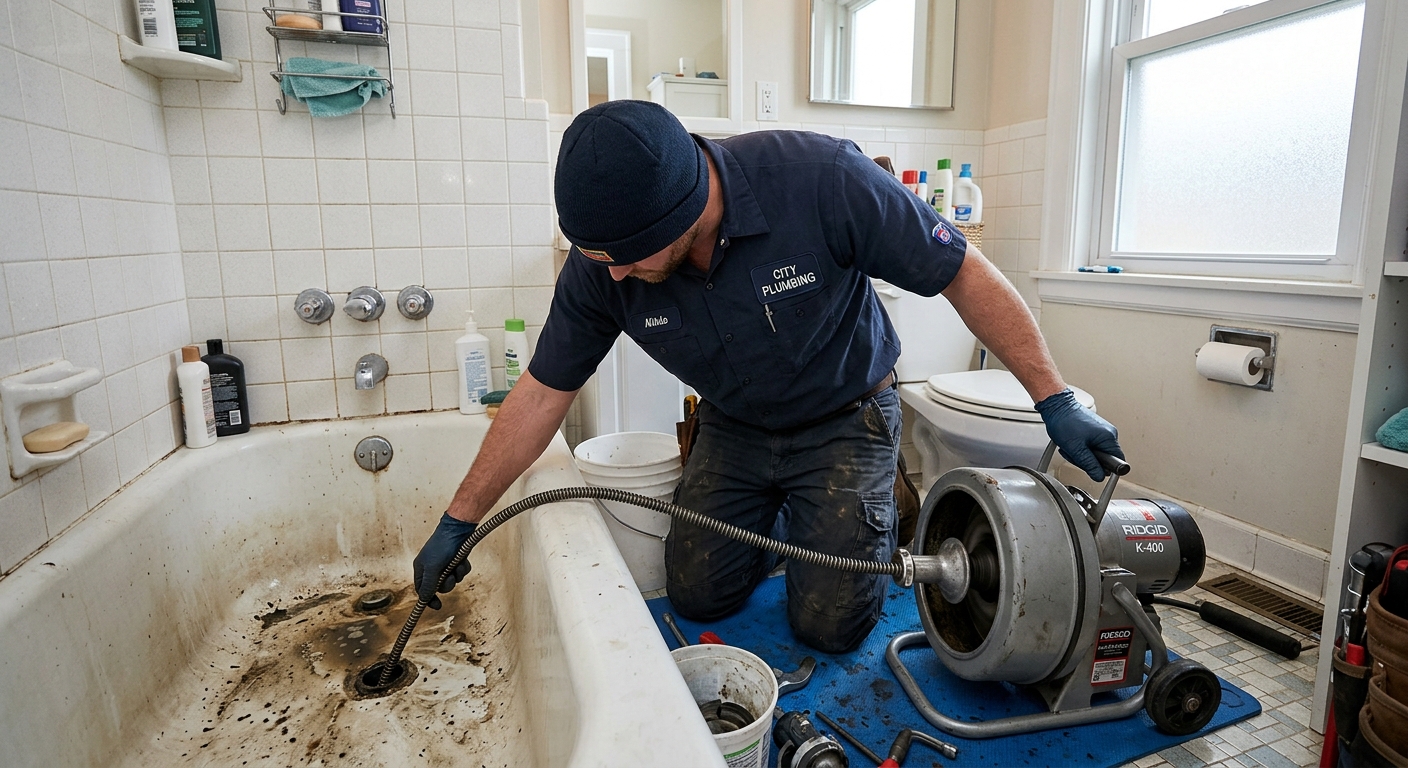
Timing matters. With a burst pipe or major leak after hours, you’ll pay an emergency rate that’s sometimes double for the same fix. For a planned water heater replacement or a slow-draining sink, standard rates apply. Since much of Moosic’s stock is older, jobs often involve finding pipes hidden behind original plaster or “making good” after opening a ceiling, adding complexity and cost. Below are local estimates for common plumbing services.
| Service |
Scope |
Emergency rate |
Standard rate |
| Emergency repair — burst pipe |
locate, open, repair section, restore service |
$550–$1,150 |
$325–$1,150 |
| Water heater replacement (gas, 40–50 gal) |
remove old, install, test, haul away |
$1,800–$2,700 |
$1,150–$2,700 |
| Drain cleaning — main line |
augering or hydro-jet, camera if needed |
$350–$800 |
$200–$500 |
| Sewer line spot repair |
excavate or reline a failed section |
$1,900–$11,500 |
$1,900–$11,500 |
| Whole-house repipe |
replace supply lines throughout, patch and finish |
– |
$3,300–$8,100 |
| Water service line replacement |
street to house, excavation and restoration |
– |
$5,300–$11,500 |
Estimates for a typical Moosic home. Access difficulty and pipe material move these figures more than anything else.
Plumbing systems in Moosic homes
In Moosic, your plumbing system is largely dictated by when your house was built. With 62.5% of homes built before 1980, many properties in the area still have at least some original galvanized steel supply lines and cast iron or even clay drains, particularly in the older sections. These materials are prone to corrosion, interior scale buildup, and root intrusion at joints—common issues that prompt today's frequent repipe jobs or drain replacement projects.
Homeowners in houses dating from before World War II are likely seeing their third water heater by now, and in some places, original galvanized pipes have gradually been patched with copper or, more recently, PEX. For these houses, the sewer lateral is often clay tile, prone to tree root invasion at each joint and in need of eventual replacement. Houses built from the 1950s to the 1970s may have a full copper water system and cast iron drains, but even these are at or near the end of their intended service lives.
If you’re in a newer subdivision or your home was built post-1980, you’re more likely to see PEX supply lines and PVC drains throughout, with the original builder-grade fixtures. Water heaters here are often on their first or second cycle, but don’t assume worry-free plumbing—materials like polybutylene (from a window in the late 1970s through the mid-1990s) can fail suddenly and leave you facing an urgent whole-house repipe. The age of your Moosic home—and what was in fashion then—predicts your likely plumbing headaches.
Finding a hidden leak in Moosic
If you suspect a hidden leak in your Moosic home, start with a simple step before calling anyone: the water meter test. Shut off all faucets and appliances, then check your water meter. If the meter dial is still spinning, there’s a leak on your supply line—somewhere between the meter and your indoor plumbing.
When a leak is buried in a wall, ceiling, or even under a concrete slab, plumbers use several professional tools. Acoustic listening devices pick up sound from pressurized leaks and are standard for pinpointing issues behind walls (typical cost: $200–$500 for detection only). Thermal cameras can find temperature changes from active leaks in floors or ceilings. For slab leaks, some pros use tracer gas—injecting a harmless gas and sniffing at the slab’s surface for where it escapes.
Leaks in wall cavities usually show with damp drywall, bubbling paint, or mold smell. For concealed irrigation lines, pressure loss or soggy soil may reveal trouble, but it takes a combination of meter testing and targeted detection. Cutting open walls before localizing the source is backwards and leads to unnecessary mess—good plumbers only cut when they know where. Expect to pay a distinct fee to trace a leak, not just repair it, especially if your home’s original pipes are hidden behind plaster or tight joists, common in Moosic’s older houses.
Licensing and permits for plumbing work in Moosic
Plumbing licensing in Pennsylvania isn’t statewide. Instead, it’s handled at the municipal level—meaning there’s no universal Pennsylvania plumber’s license, and every city or township runs its own system. In Lackawanna County, Scranton maintains its own permit registration, while other municipalities may operate their own offices or contract the work out. So, it’s not enough for a plumber to be “licensed”; they have to be licensed specifically in your municipality or qualify through its local process. If you’re not sure, ask “Are you registered or licensed to work here in Moosic?”—not just whether they are licensed in general.
For permits, Scranton (and several nearby municipalities) require you to pull a plumbing permit for any alteration, repipe, or water heater replacement—not just for new construction. Purely cosmetic jobs that don’t touch plumbing, electrical, or structure often don’t need a permit, but anything that involves supply or drain lines likely does. The local code enforced is the Pennsylvania Uniform Construction Code (UCC), based on the IRC. Inspections are handled by municipal staff or contracted agencies.
Contractor registration called Home Improvement Contractor (HIC) is required for all home improvement contracts over $500 and can be verified at hic.attorneygeneral.gov. All employers must carry workers’ compensation; you can check their status via WCAIS (wcais.pa.gov). Don’t accept a bid from anyone who can’t show both. If your house was built before 1978, federal EPA Lead RRP rules apply; always check your contractor’s certification. Written contracts are also mandatory over $500, giving you three business days to cancel under the Home Improvement Consumer Protection Act (HICPA).
Comparing plumbing estimates in Moosic
Moosic plumbers write estimates using two main approaches. A flat rate gives you price certainty: one number that covers everything expected, with the contractor assuming the risk if things go long, but padding built into the price. Time-and-materials billing starts lower and can be cheaper if the job is simple, but you pay for every additional hour or part—good if you trust the scope is predictable, but riskier if surprises pop up once the walls are open. What matters most is knowing which model you’re agreeing to; confusion here is where most homeowner disputes start.
Look for a diagnostic fee—does it apply to the job if you proceed, or is it a sunk cost? The estimate should spell out what will be opened, fixed, and put back together, not just a dollar amount. Restoration of cut drywall or floors needs to be included or clearly excluded. Any required permits should be explicitly listed and priced. The quote should also specify product brand and warranty for both parts and labor—labor warranties are typically separate from the manufacturer’s coverage. Lastly, ask if the rate changes after hours or for emergency work—Moosic jobs can double in price after dark or on weekends.
| Line item |
What to look for |
Red flag if… |
| Billing model |
flat rate or hourly, stated up front |
unstated |
| Diagnostic fee |
amount, and whether it credits |
vague |
| Scope |
what is opened, repaired and restored |
price with no scope |
| Restoration |
drywall and finish explicitly in or out |
silent |
| Permit |
included and priced |
'not needed' |
| Parts |
brand and model for fixtures |
'standard fixture' |
| Warranty |
labour period stated separately |
parts only |
Is your water line lead? How to find out
In Moosic and the surrounding areas served by Pennsylvania American Water and Scranton Sewer Authority–related utilities, the water service line—the pipe from the street to your house—may be made of lead, especially for older homes. Replacement programs in this region are ongoing, but as of now, there is no published figure confirming all lines are done. Utilities typically own the section up to the curb, while the homeowner is responsible from the curb or property line into the house. Most replacement programs, when available, only address the utility-owned portion unless you buy up to get your section replaced too.
To check your pipe: locate where it enters the house (usually in the basement near the meter). Scratch the pipe with a coin. If it’s dull gray and easily scratched, it’s likely lead; a magnet won’t stick. If it’s copper-colored, you’re in the clear; if magnetic and threaded, it may be galvanized steel. Be aware—replacing only the utility or only the homeowner side (called “partial replacement”) can disturb protective mineral coating and actually increase lead release for a short time.
Utilities in this area do maintain service line inventories, so check their websites for the address lookup or published maps. If you don’t find yours, contact the utility directly—there’s no one-size-fits-all replacement cost or program. Homeowner-side lead replacement here generally runs $5,300–$11,500. If your house is in the replacement pipeline, ask if you can coordinate full replacement and cost share with the utility rather than assuming coverage.
Pipe materials in Moosic homes and how they fail
Most Moosic plumbing issues track directly to the original install year and what materials were standard then. The older housing—especially in areas like Scranton and Old Forge—means you’re often looking at galvanized steel supply lines switched over to copper or PEX only when repairs have demanded it, and clay or cast iron drains still hanging on until they crack or clog too badly to clear. Each material tells its own story about failure and what’s left before replacement is necessary.
Galvanized steel, the staple up through the 1950s, is dull gray, magnetic, and has threaded fittings. It narrows from the inside with corrosion, giving lousy pressure before leaking. Copper, used heavily from the mid-20th century onward, is reddish-brown and non-magnetic; it’s durable but gets pinholes if treated water is aggressive. From the late 1970s through 1995, you might encounter polybutylene—usually gray, flexible, and marked “PB”—which is notorious for fitting blow-offs and hard to insure. PEX, in use since the 2000s, is flexible, colored blue or red, and non-magnetic; it’s durable but can fail at cheap fittings or with sun exposure.
Drains, too, vary by era. Pre-1975, cast iron rules the day—black, heavy, and joined with leaded joints—but at 50 to 75 years, these corrode and crack. Clay tile laterals pre-1980 are tan and fragile, with each joint a target for roots. Post-1970s, PVC and ABS—white or black, glued joints—are standard and reliable as long as joints hold.
To check what you have, scratch an exposed supply or drain pipe with a coin, check the color, and see if it’s magnetic. Connect your home’s build year to these timelines to estimate what’s still left in the tank for each system below.
| Material |
Typical era |
Failure mode |
Service life |
| Galvanized steel supply |
pre-1960 |
internal corrosion, pressure loss |
40–60 yrs |
| Copper supply |
1950s–present |
pinhole leaks, joint failure |
50–70 yrs |
| Polybutylene supply |
late 1970s–1995 |
fitting failure, sudden bursts |
unreliable |
| PEX supply |
2000s–present |
fitting or UV degradation |
40–50 yrs |
| Cast iron drain |
pre-1975 |
corrosion, cracking, scale |
50–75 yrs |
| Clay tile sewer lateral |
pre-1980 |
root intrusion at joints, offset |
50–60 yrs |
| PVC / ABS drain |
1970s–present |
joint separation, crushing |
50+ yrs |
Frequently asked questions — plumbing in Moosic
Does Pennsylvania license plumbers at the state level?
Pennsylvania does not license plumbers at the state level. Instead, each municipality—including those in Lackawanna County—handles its own plumbing licensing or registration. That means a plumber licensed in Scranton may not be automatically able to work in Moosic or Old Forge without meeting the local requirements. For any job, always ask whether your plumber is legally allowed to work in Moosic itself. No statewide exam or license exists, so don’t be fooled by claims otherwise. For home improvement contracts over $500, though, Home Improvement Contractor (HIC) registration is required and can be verified at hic.attorneygeneral.gov. This protects you by ensuring your contractor is insured and accountable, especially when a plumbing service like a water heater replacement—often between $1,150–$2,700—is involved.
How much does sewer line repair cost in Moosic?
Sewer line repair costs in Moosic depend on the repair method, how easy the line is to reach, and how much damage there is. For a spot repair—meaning one section either excavated or lined to fix a break—you can expect to pay anywhere from $1,900–$11,500, but most jobs in this area tend to fall around the middle of that range. Full replacements cost more, but even a short spot repair can be expensive if the pipe is buried under a driveway or large tree. If you’re in an older home with clay tile or cast iron lateral, root intrusion and joint failure are the most common causes. Always require a camera inspection before authorizing work—if the only tool is a shovel, you might not need the full dig.
Which utility supplies water to Moosic?
In Moosic, Pennsylvania American Water is the major water utility, and sewer services are linked to Scranton Sewer Authority–related entities depending on your neighborhood. These utilities serve most surrounding areas, including Scranton and many of the smaller boroughs nearby. If you have an issue with water quality, pressure, or need to know about possible lead service lines, Pennsylvania American Water is your first call. They also manage and update information on service line materials. Service line replacement, when needed, typically falls in the $5,300–$11,500 range for the homeowner portion in Moosic.
What counts as a plumbing emergency?
In Moosic, plumbing emergencies are any sudden events that threaten immediate water damage or completely stop your water service. Burst pipes, active leaks (especially in ceilings or walls), gas leaks near a water heater, sewer backups, or a failed sump pump during a storm all count. The most common example is a burst pipe in winter, which can flood a basement quickly. For these situations, expect to pay emergency rates—an emergency repair for a burst pipe will run $550–$1,150. It’s rarely worth paying emergency prices for a minor clog or drip, but anything flooding your house—especially in an older property with original pipes—needs a same-day response.
Repair or replace a leaking water heater?
In eastern Pennsylvania, and especially in houses built before 1980, a leaking tank water heater is usually a sign that the unit’s life is up. If the leak is coming from the tank itself (not a fitting or valve), replacement is almost always the right call—repairs won’t last and can risk a sudden tank burst. Replacement, including haul-away and installation, typically runs $1,150–$2,700 for a standard 40–50 gallon gas unit in Moosic. If the leak is only from a supply fitting or the T&P valve, a repair might make sense, but tank failure means it’s time to swap out before your basement floods.
How long should a water heater last in Moosic?
In Moosic homes, most standard tank water heaters last 8 to 12 years, though water chemistry and regular maintenance can stretch or shrink that number. With over 62% of local homes built before 1980, many have gone through three or more water heaters by now. If you’re getting minor leaks or performance drop-off from a unit over 10 years old, it pays to plan for replacement soon—waiting usually ends with a messy, full failure. Current replacement cost for a standard 40–50 gallon gas model falls in the $1,150–$2,700 range, and newer efficiency-rated models are on the higher end of that band.
What does repiping a house cost in Moosic?
Repiping a home in Moosic means replacing all the old supply lines—usually galvanized steel, copper, or, in some cases, polybutylene or early PEX—with modern copper or PEX throughout. The price depends on house size, access, and whether the work is done as a stand-alone project or during a remodel. Most Moosic repipes fall between $3,300–$8,100, with smaller homes at the low end and larger or multi-story homes at the high end. PEX is generally more affordable than copper, but the labor to open and restore walls or ceilings adds to the bill, especially in older homes where pipe runs aren’t easy to reach.
Do I need to drain outdoor spigots in Moosic?
Yes—winter in Moosic brings deep frost (design depth is 36 inches here), so you need to drain and shut off outdoor spigots every fall to avoid burst pipes. Even frost-free hose bibs can split if the hose is left connected or if the valve isn’t properly angled. With houses dating back to before 1980, you might still have old-style spigots fed by galvanized or copper lines, sitting close to cold exterior walls—these split even easier. A frozen, burst exterior line will land you in the emergency repair category, with work likely in the $550–$1,150 band if you call after-hours.
Who pays to replace a lead service line in Moosic?
Responsibility for replacing a lead service line in Moosic is split: typically, Pennsylvania American Water or the related local utility covers the street-side up to the property line or curb stop, and the homeowner is responsible from that point to their house. While there are ongoing inventory and replacement programs throughout Scranton and adjacent systems, most don't automatically cover the full run—especially not the private side. Homeowners needing a full lead line replacement should expect to pay $5,300–$11,500 for their portion. It pays to talk to the utility about cost-share arrangements or upcoming replacement cycles—don’t assume both sides are done unless you’ve seen confirmation for your address.