Plumbing costs in Cumru — 2026
In Cumru, with a homeownership rate of 72.1% and nearly two-thirds of homes built before 1980 (U.S. Census Bureau, ACS 2024), plumbing needs often reflect both the age and the original materials used in these systems. If your home is part of the large 1940–1970 housing stock common in Reading and surrounding townships, odds are you’re dealing with original galvanized supply lines, cast iron drains, and sometimes clay tile for the sewer lateral—each with its own replacement cycle and typical repair cost. Pipe material, paired with decades of freeze-thaw cycling in south-central Pennsylvania, drives both what fails and how much it costs to fix it.
Every plumbing job here comes with a price range, but there’s a major cost divide: emergency calls, like a burst pipe or active leak, always command a higher rate than jobs scheduled under less urgent circumstances. Given our climate’s 12 °F winter design temp and 30-inch frost depth, emergency winter repairs are common and, frankly, more complicated and expensive.
| Service |
Scope |
Emergency rate |
Standard rate |
| Emergency repair — burst pipe |
locate, open, repair section, restore service |
$600–$1,250 |
$350–$1,250 |
| Water heater replacement (gas, 40–50 gal) |
remove old, install, test, haul away |
$1,950–$2,900 |
$1,250–$2,900 |
| Drain cleaning — main line |
augering or hydro-jet, camera if needed |
$350–$800 |
$200–$500 |
| Sewer line spot repair |
excavate or reline a failed section |
$2,100–$12,500 |
$2,100–$12,500 |
| Whole-house repipe |
replace supply lines throughout, patch and finish |
|
$3,600–$8,800 |
| Water service line replacement |
street to house, excavation and restoration |
|
$5,700–$12,500 |
Estimates for a typical Cumru home. Access difficulty and pipe material move these figures more than anything else.
Dating your plumbing by what it's made of
In Cumru and the surrounding Reading townships, the material in your pipes is practically a time capsule. Older homes—especially those built from the 1940s through the 1970s—often have galvanized steel supply lines and cast iron drains. If your home fits that era (over 61.7% of local stock was built before 1980), odds are you’ll see signs of these materials on exposed pipes in the basement or utility areas.
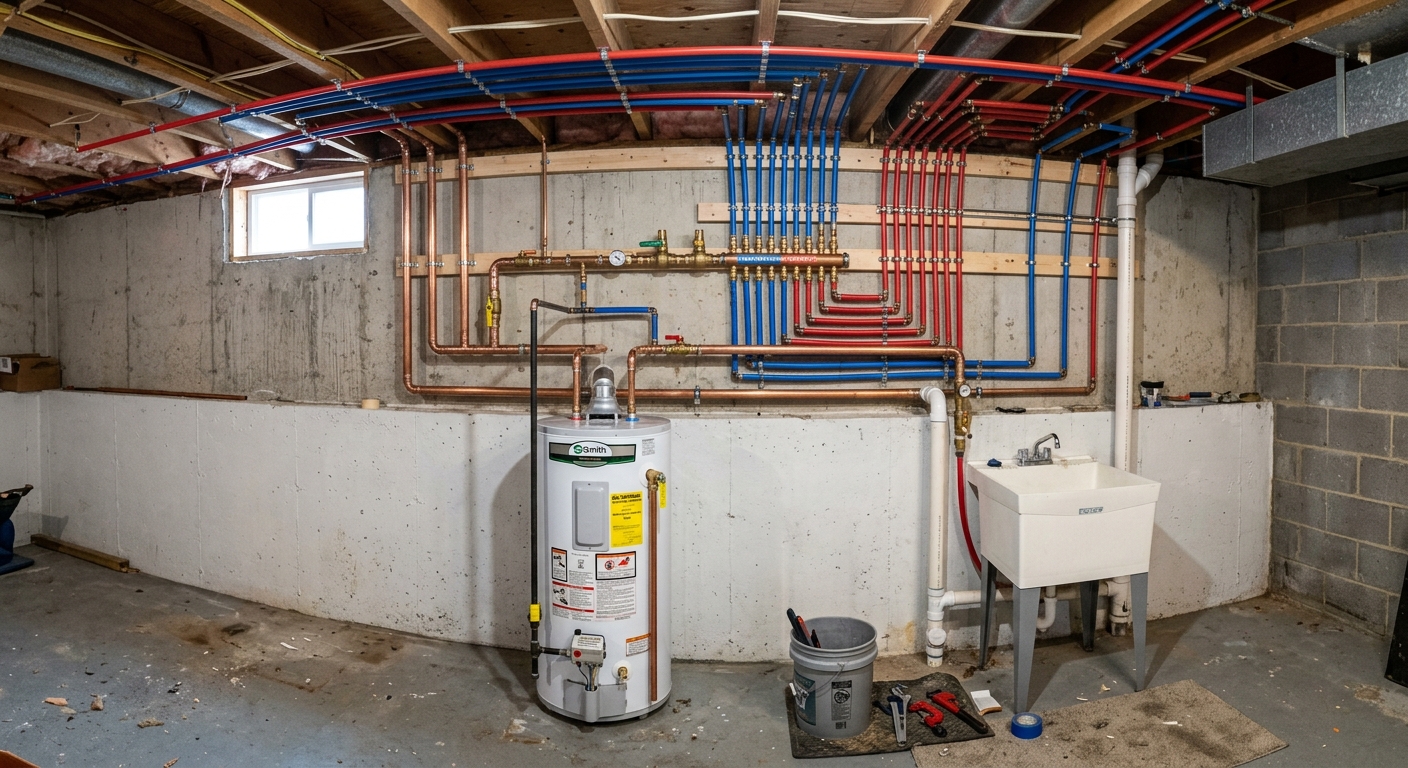
Galvanized steel is dull silver and can be checked with a magnet (it sticks) and a scratch test (shows bright steel beneath). Pressure drops and brownish water are signals it’s nearing the end. Copper has a warm reddish tone, takes soldered joints (rather than threaded ones), and will not stick to a magnet. Pinholes and green corrosion are typical warning signs. Polybutylene is gray-blue plastic, common from the late 1970s through mid-1990s, and is notoriously unreliable and often uninsurable. PEX is flexible plastic (usually red or blue) that’s been standard since the 2000s—much less prone to leak but can be damaged by sunlight or bad fittings. Drains from before 1975 are often cast iron (heavy, dark, rusty) or clay tile (thick, orange, in pieces), each with their own failure points: cast iron cracks and scales; clay tile lets roots in at the joints. Newer PVC or ABS is plastic and glued at fittings.
Your home’s era predicts which pipe is present, and that tells you how urgent replacement might be. If original, galvanized or cast iron is overdue by the numbers. Copper can last, but even a 1970s run will be showing its age. Polybutylene, regardless of condition, is a gamble. If you’re seeing plastic lines, count on 40–50 years of service, but only if installed to standard.
| Material |
Typical era |
Failure mode |
Service life |
| Galvanized steel supply |
pre-1960 |
internal corrosion, pressure loss |
40–60 yrs |
| Copper supply |
1950s–present |
pinhole leaks, joint failure |
50–70 yrs |
| Polybutylene supply |
late 1970s–1995 |
fitting failure, sudden bursts |
unreliable |
| PEX supply |
2000s–present |
fitting or UV degradation |
40–50 yrs |
| Cast iron drain |
pre-1975 |
corrosion, cracking, scale |
50–75 yrs |
| Clay tile sewer lateral |
pre-1980 |
root intrusion at joints, offset |
50–60 yrs |
| PVC / ABS drain |
1970s–present |
joint separation, crushing |
50+ yrs |
What construction era means for your pipes
Cumru homes, like much of the southern Berks area, are dominated by properties built before 1980. That age bracket directly affects what plumbing system you’ve inherited. A typical pre-1960s home here probably started with galvanized steel supply lines—now likely showing inside corrosion and pressure loss—and cast iron drains, which tend to scale and crack right around now. Sewer laterals in these homes are typically clay tile, a favorite target for tree roots where every pipe joint offers a weak point. Water service lines from the street might be original galvanized, copper, or, in infrequent cases, lead. And with all this age, the water heater is probably on its third life by now, unless upgrades have been staggered.
If your place is a newer suburban infill, odds shift to copper or possibly polybutylene supply lines (especially late ‘70s through mid-‘90s). Builder-grade fixtures in these houses can make minor leaks more common a generation in. The drains may be PVC or ABS plastic—less drama from corrosion, though joint issues still pop up. Modern homes are more likely to have their original water heater just reaching end of life now, but that doesn’t mean you can ignore replacements. Every era comes with a different culprit: old homes, it’s aging metal and roots in tile; newer homes, it’s faulty plastic, failing expansion tanks, or builder materials wearing out right on schedule.
Regardless of age, our climate’s freeze-thaw cycling and the regional history of plumbing standards mean both vintage and modern homes need eyes on their pipes—just for different reasons.
How to find a good plumber in Cumru
In Cumru and Berks County, picking a reputable plumber starts with checking credentials matched to the right municipality—since there is no statewide license for plumbing, but certain cities like Reading require their own trade licence for permit work. For most jobs over $500, a contractor must hold Pennsylvania Home Improvement Contractor (HIC) registration issued by the Office of Attorney General, and you can confirm that directly at hic.attorneygeneral.gov. Always request a certificate of insurance with your property named, and confirm workers’ compensation is active through the WCAIS portal (wcais.pa.gov) for any business with employees. Ask whether the company uses their own crews or relies on subcontractors—know who will actually be inside your walls. On emergency repairs, an up-front disclosure of after-hours or dispatch fees is a sign of a transparent operator in a market where emergency jobs are frequent and high-pressure.
- Verify HIC registration at hic.attorneygeneral.gov
- Ask the contractor to confirm they’re licensed in your municipality, not just “licensed” generally
- Get a certificate of insurance with your address listed, not just a generic proof
- Check workers’ compensation at wcais.pa.gov
- Request city trade license number if your project is in Reading
- Clarify if the company uses employees or subs for your job
- Get after-hours/emergency rates in writing before dispatch
- Ensure the contract names the property and details the work scope
- Ask for recent references for similar work (like repipes or water service replacement)
- Watch for a warranty separate on labor and on parts
- Confirm permit fees and inspections are included or disclosed
- Always get camera footage for sewer or main line work
In a dense contractor market like Reading and inner Berks, be wary of anyone pushing a sewer excavation or a whole-house repipe without showing you the camera video or a pressure test result.
Licensing and permits for plumbing work in Cumru
Pennsylvania does not issue a statewide plumbing license—licensing is strictly municipal for this trade. In Reading, for example, plumbers must hold a local trade license and be registered with the city to pull plumbing permits. In Cumru Township and other Berks County townships, requirements will depend on the specific municipal office or the third-party code enforcement agency they use. The key question to ask is never “are you licensed?” but “are you licensed to do this work here?”—because a plumber with the right paperwork for one township may be unqualified for the next.
For any plumbing work above a simple like-for-like fixture swap (such as replacement of faucets or showerheads within existing bathrooms), you may need a permit—especially for system alterations, replacements, or a new installation. In Reading, this specifically means any work beyond swapping a fixture typically needs a permit as required by the Pennsylvania Uniform Construction Code (UCC), with inspections enforced by municipal code officials. Home improvement contracts above $500 must be written up in compliance with the Home Improvement Consumer Protection Act (HICPA), and that contract must state your three-day right of cancellation, as well as name the property. Always verify workers’ compensation detail for every company with employees, and confirm insurance yourself; don’t trust a certificate unless it lists your address and system type.
Bottom line: no one-size-fits-all license or permit process for plumbing here. Each municipality sets its own rules, and knowing how they’re enforced is the only way to avoid costly rework or violations down the line.
What a plumbing quote should contain
A solid plumbing quote in Cumru will spell out the billing model up front—either flat rate or time-and-materials. Flat rate gives you a set price regardless of how things go, with the contractor taking on the risk if the job is more complicated than expected. Time-and-materials can be a better deal for very straightforward jobs, but if access is tricky or surprises pop up (not uncommon in older Berks County homes), you hold more risk. Neither model is “wrong”—not knowing which one you’ve agreed to is where problems start.
Pay close attention to diagnostic fees: some companies charge to show up and find the problem, but will credit that towards the work if you proceed. Any quote should state exactly what’s being opened, fixed, and restored—including whether wall/floor patch work is in or out, what permits cost, and brand/model of new fixtures. The labor warranty should be separate from the manufacturer’s part warranty, and after-hours or emergency premiums should be disclosed before any work starts. For anything more than a drain clean, a vague one-line quote is a red flag.
| Line item |
What to look for |
Red flag if… |
| Billing model |
flat rate or hourly, stated up front |
unstated |
| Diagnostic fee |
amount, and whether it credits |
vague |
| Scope |
what is opened, repaired and restored |
price with no scope |
| Restoration |
drywall and finish explicitly in or out |
silent |
| Permit |
included and priced |
'not needed' |
| Parts |
brand and model for fixtures |
'standard fixture' |
| Warranty |
labour period stated separately |
parts only |
Sewer line problems in Cumru
Homeowners in Cumru and southern Berks County own their sewer lateral all the way from the building to the main—sometimes into the public right-of-way. That means if you have a problem with the buried line, the responsibility (and the repair bill) is yours. Problems usually show up first as one slow drain, then as multiple slow fixtures, gurgling, or worst case—backups at the lowest drain in the house. If you’re seeing wastewater in the basement or the lowest tub, that’s a full main stoppage and needs immediate attention.
In most of the Reading area, homes built pre-1980 likely have a clay tile lateral which fails at the joints (tree roots love them) or suffers from shifting soils causing “bellies” or offsets in the run. Cast iron from the house out is also common. Before anyone quotes you for excavation or relining—where costs can stretch from $2,100–$12,500—they should show you camera footage of the actual problem spot. Never take a dig quote without visual proof in this market; too many old lines have minor blockages that can be hydro-jetted for a few hundred dollars instead.
On the outskirts of Cumru and rural Berks, on-lot septic systems are still widespread. Main issues there are less about the sewer lateral and more about tank pumping intervals and drainfield failure—different work altogether, and best handled by a septic specialist. For city sewer, insist on a camera inspection for any major decision: open-cut replacements are disruptive, and trenchless pipe relining can be a better fit if the damage is localized and the original pipe is stable enough to support it.
Frequently asked questions — plumbing in Cumru
Why do plumbers charge a diagnostic fee?
Diagnostic fees are common in Cumru and across Berks County because diagnosing a plumbing issue in older homes—where more than 61.7% were built before 1980—is time-consuming and sometimes involves specialized tools like cameras or pipe locators. The fee covers the time and skill invested even when you don’t proceed with suggested repairs. Most plumbers will credit this fee if you approve the work, but always clarify. For instance, on a burst pipe call, you might pay a diagnostic or “dispatch” charge upfront, then pay $600–$1,250 if you move forward with the repair. It ensures contractors aren’t out of pocket for “free” house calls, especially as emergency work is common in our climate.
Does Pennsylvania license plumbers at the state level?
No, Pennsylvania does not license plumbers at the state level. Instead, municipalities handle the licensing of plumbing work. That means a plumber licensed in Reading isn’t automatically allowed to do the same work in Cumru Township or elsewhere in Berks County without approval from that local code office. For jobs over $500, the state Home Improvement Contractor (HIC) registration is required and can be verified online, but this is about consumer protection and contract law—not trade proficiency. That’s why verifying both HIC registration (for consumer law coverage) and appropriate local credentials for your project is so important before signing off on a $3,600–$8,800 whole-house repipe or even a smaller job.
How do I prevent frozen pipes in Cumru?
To prevent frozen pipes in Cumru, focus on exposed supply lines in unheated crawlspaces, basements, or garages—especially original galvanized lines from the 1940s–1970s. With our 12 °F winter design temperature and pronounced freeze-thaw cycles, even modern homes are at risk. Insulate vulnerable pipes, keep cabinet doors open to warm under-sink plumbing during cold snaps, and allow a trickle of water to run overnight in extreme conditions. If you’re away, never set the thermostat below 55 °F. Pipe rupture repair costs can quickly hit $600–$1,250 on an emergency call, so preventive work is always cheaper. If your home has a history of freeze issues or questionable insulation, schedule an inspection before winter.
What do I do about a burst pipe right now?
If you have a burst pipe in Cumru, turn off the main water valve immediately—usually found where the service line enters your basement or crawlspace. Open faucets to drain the system, minimize damage, and call a local plumber who works in your township (emergency repair in this area runs $600–$1,250). Document any water damage for your insurer, and keep receipts for all work—your homeowners policy may cover emergency plumbing repairs if prompt steps are taken. Given how many local homes are pre-1980 and have vulnerable supply lines, fast action is the best way to limit expenses and further property damage.
Do older Cumru homes have galvanized pipes?
Yes, many older homes in Cumru—especially those built before 1960—still have original galvanized steel supply lines unless they’ve been systematically replaced. Galvanized pipes look silvery-gray, are magnetic, and have threaded joints. Over time, they corrode from the inside, causing rust-colored water, pressure loss, and eventual leaks. With typical service life at 40–60 years, any untouched run from the early housing wave is well past its prime and may be due for replacement. Expect a whole-house repipe to cost between $3,600–$8,800 depending on layout and material choices throughout your home.
Who owns the sewer lateral, me or the city?
In Cumru and the Reading area, the homeowner owns and is responsible for the sewer lateral from the house all the way to the main, often including the portion under the public right-of-way. That means if you have a blockage or break between your house and the sewer main, the repair—whether spot-fixing a clay tile joint or replacing the whole run—is on you. Costs for a sewer spot repair in Cumru range from $2,100–$12,500 depending on length, depth, and material. Always demand camera footage before approving any dig, and check if your homeowner’s policy has any lateral coverage (many do not).
How much does a plumber cost in Cumru?
The cost for a plumber in Cumru depends on the service and whether it’s an emergency. A typical emergency repair for a burst pipe or active leak starts around $600–$1,250; a gas water heater replacement runs $1,250–$2,900 depending on the model and difficulty of access. Even a straightforward drain cleaning (not a main line blockage) can range from $200 to $500 as a standard call. The material in your home (galvanized, copper, PEX) and how hard it is to reach drive job costs more than zip code does.
What causes low water pressure in Cumru homes?
In Cumru, the most common causes of low water pressure are aging galvanized steel supply pipes that have corroded and narrowed inside, restricting flow. This is a legacy issue in the large stock of homes built before 1970. Other culprits include failed pressure-reducing valves, partially closed main shutoffs (sometimes left that way after repairs), or hidden leaks—especially during freeze events. If pressure drops suddenly, it may be a break, which can cost $350–$1,250 to locate and fix, depending on access. If you’re seeing a slow decline, a camera or pressure test is usually needed to pinpoint the failing line.
Is a water softener worth it in Cumru?
Water softeners are a case-by-case call in Cumru. Most water supplied by the Reading Area Water Authority is moderately hard—not aggressively so, but enough that calcium scale builds up over decades in old galvanized or copper pipes, reducing pressure and lifespan. A softener can extend the life of new fixtures and appliances and lower maintenance costs, but it’s not always needed. If you’re considering a full repipe (which costs $3,600–$8,800), a test of your home’s supply hardness and talking over options for targeted softening may be smart before investing. For many, annual or biannual descaling and basic system inspections are plenty.